Reports: Hochul Halts NYMTA Congestion Pricing; Suppliers Will Suffer; Agency Outlines Next Steps (UPDATED 6/27/24)
Written by William C. Vantuono, Editor-in-Chief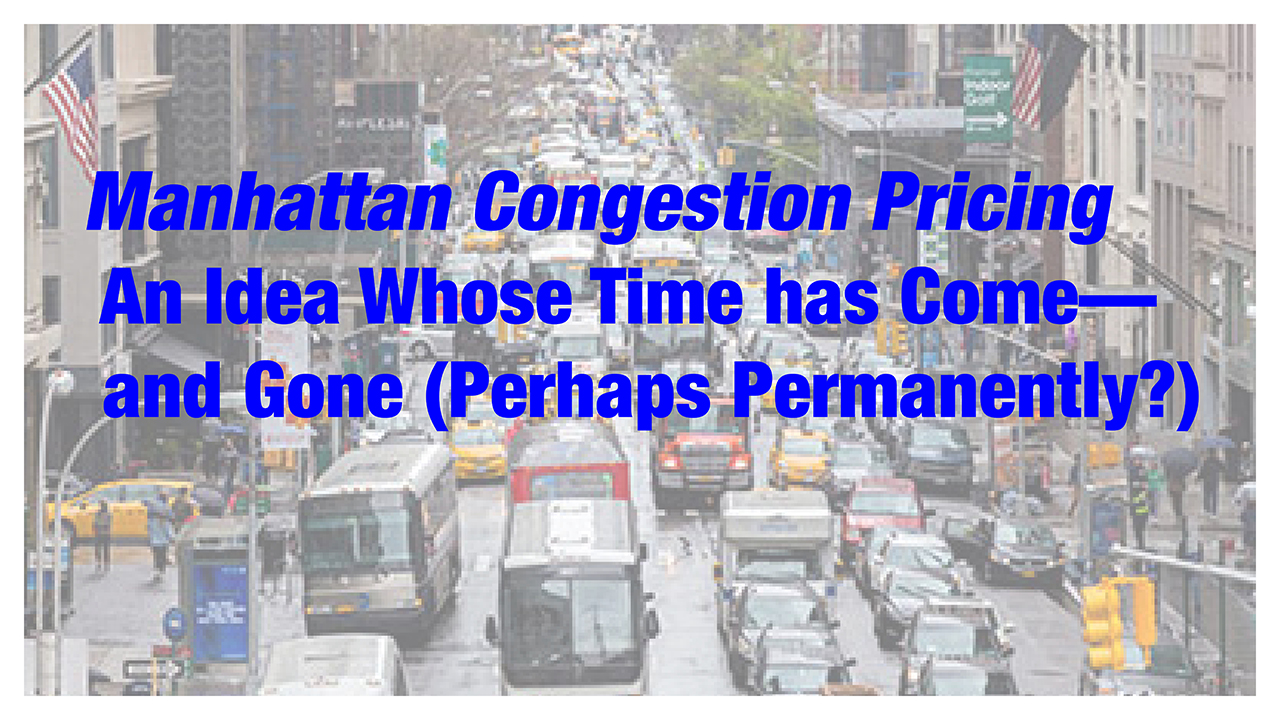
New York Democratic Gov. Kathy Hochul has unexpectedly—but perhaps not surprisingly—halted the New York Metropolitan Transportation Authority’s controversial congestion pricing (Central Business District Tolling Program) plan, which was expected to raise up to $1 billion annually for the agency to help offset looming deficits and support major capital programs that now run the risk of scale-backs or even cancellation. At least one major MTA supplier, Alstom, is speaking out that the governor’s move—widely believed to be politically motivated—will hurt the company and force layoffs. On June 10, the MTA finally addressed what its next move could entail, and Chair Janno Lieber emerged from silence. On June 27, Hochul released a statement saying “there is no reason for New Yorkers to be concerned that any planned projects [such as Phase 2 of the Second Avenue Subway] will not be delivered.”
“Supporters of congestion pricing are furious at Hochul’s ‘betrayal,’” The New York Times transit reporter Ana Ley wrote June 5. “Advocates who have been fighting for decades for the program were shocked by the governor’s sudden move and its impact on funding for the city’s [transit system],” North America‘s largest. “With weeks to go before the launch of a plan to toll drivers in Manhattan’s core commercial district, advocates and organizers of congestion pricing had been celebrating a victory years in the making. They were shell-shocked on [June 5] and furious with Hochul after she indefinitely suspended the plan, saying she didn’t think the time was right for a tolling scheme that could deter visitors to Manhattan and slow the city’s economic recovery from the pandemic. [T]hey woke up to devastating news when it was revealed that Ms. Hochul had been quietly working to postpone the program.”
“We’ve been blindsided,” New York Regional Plan Association Executive Vice President Kate Slevin told The Times. “It’s a betrayal of millions of transit riders and the future of New York’s climate and economy.”
The Riders Alliance, a grass-roots organization of transit riders, protested in front of Hochul’s New York City offices. “‘Congestion pricing must move forward,’” Danny Pearlstein, a spokesman for the Riders Alliance, shouted … as he led a crowd of demonstrators, according to a video posted on social media,” The Times noted. “‘Congestion pricing is the linchpin of New York’s recovery. This city runs on our subway. It runs on the millions of buses we have on the street.‘”
(The MTA New York City Transit bus fleet actually numbers 5,700. Go figure.)
The MTA did not immediately respond to a request from The Times for comment, which called Hochul’s move “a crushing setback to the authority, which had been defending itself from at least eight lawsuits fighting the program.” However, on June 6, MTA Construction & Development President Jamie Torres-Springer and Alstom Vice President of Communications Dani Simons spoke with CBS2 News New York reporter Elijah Westbrook
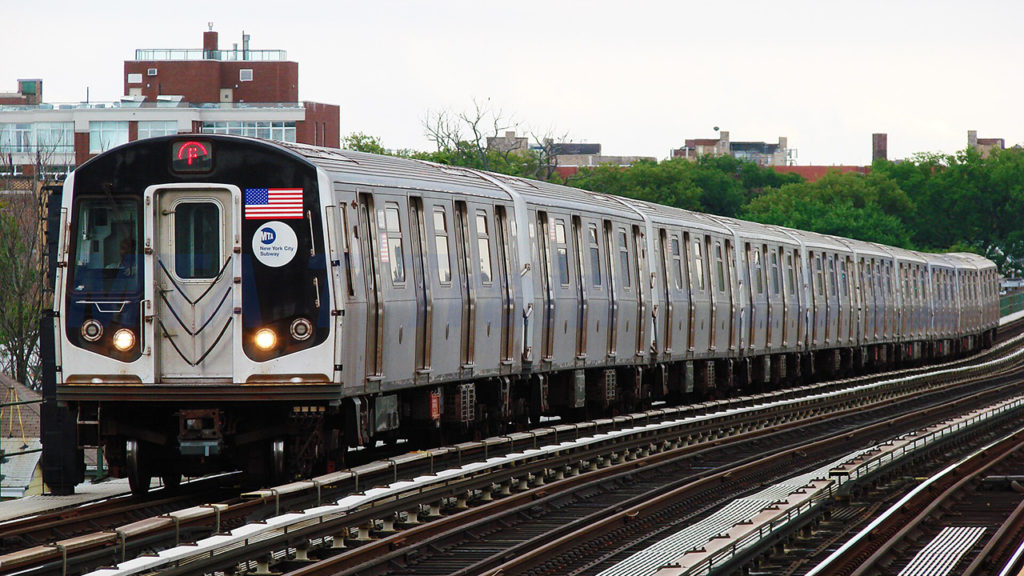
“Manufacturer faces potential budget cuts, layoffs due to congestion pricing delay,” Westbrook reported. “Alstom is responsible for building about half of New York City‘s subway cars. Its subway fleet dominates the more-than-century-old system. So what does the delay in congestion pricing, and the funding that was expected to come from the tolling program, mean for the future of Alstom?
“‘I think that this throws things into a lot of uncertainty … and for manufacturers like us that were looking to a reliable steady stream of funding,’ said Simons. She says without a dedicated funding stream, ‘the MTA can’t refresh their fleet and that means we can’t [provide] good manufacturing jobs.’ Now, the manufacturer faces the risk of budget cuts, which could lead to layoffs. ‘We need to be able to know that we have those projects in our pipeline so that we can be able to keep people employed,‘ Simons said.
”That expected funding, with a price tag in the billions, was supposed to go toward improving the MTA’s aging subway fleet, some of which has been around since the 1970s. Without the funding, those older subway cars will likely remain in service a lot longer than the MTA expected. The MTA has been vocal about updating its subway cars to the newer R211s, but they‘re not rolling out as quickly as the MTA had anticipated.”
The New York MTA accounts for roughly 25% of all public transportation capital spending in the U.S. The agency’s 2020-2024 Capital Program includes $54.8 billion of investments in the region’s subways, buses, commuter railroads, bridges and tunnels.
Watch the video:
https://www.cbsnews.com/newyork/news/alstom-subway-car-manufacturer-congestion-pricing-delay
MTA Finally Responds
On June 10, MTA Chief Financial Officer Kevin Willens and MTA General Counsel Paige Graves released a joint statement confirming the potential impact on the rail supply/consulting community:
“This week’s announcement regarding the future of congestion pricing has serious implications for the MTA’s 2020-2024 Capital Program and likely other aspects of the agency’s financial condition. The MTA cannot award contracts that do not have a committed, identified funding source. Until there is a commitment for funding the balance of the 2020-2024 Capital Program, the MTA will need to reorganize the Program to prioritize the most basic and urgent needs.
“As such, the MTA Board will be evaluating what changes need to be made to the Capital Program in the lead-up to this month’s Board meeting. Modernization and improvement projects like electric buses, accessible (ADA) stations and new signals (CBTC) will likely need to be deprioritized to protect and preserve the basic operation and functionality of this 100-plus-year-old system.
“New York State law places an obligation on MTA to implement a congestion pricing program, and the agency stands ready to do so. But under applicable federal law and regulation, the MTA cannot act until the Central Business District Tolling Program is approved by New York State, New York City and the federal government—and with the announcement of the pause, we no longer have the State’s consent.”
At a June 10 press conference, MTA Chair Janno Lieber emerged from silence, outlining the agency’s next steps and also squashing rumors that he would resign in protest. He said that agency will ensure that riders “don’t suffer impacts from disinvestment in public transit … For New Yorkers, mass transit is like air and water. We need it to survive.”
Lieber said MTA will focus will be on “three key areas”: the capital program, operations, and the agency’s obligations under a 2019 state law that created the congestion pricing program. The MTA will conduct an “intensive review” on how to reprioritize and reduce the 2020 2024 Capital Program. “This is not something we do lightly. But we simply cannot award contracts without dedicated funding in place,” he said. MTA Deputy Chief Development Officer Tim Mulligan will lead this effort. Lieber said the agency must prioritize the state of good repair work that assures system safety. The MTA will also examine federal funding to preserve capital project grants that have already been awarded, including Second Avenue Subway Phase II. “We’re going to do our best to prevent it from being put at risk, though that is a challenge,” he said. Special Advisor for Federal Policy Naomi Renek will focus on federal grant preservation. Lieber added that he has spoken with elected officials, among them Senate Majority Leader Chuck Schumer (D-N.Y.), and Reps. Jerrold Nadler, Dan Goldman and Ritchie Torres (all D-N.Y.) who he said “are committed to minimizing the impact on federal funding for the MTA … We don’t want to lose that funding, although there are some real complexities right now.”
MTA Chief Accessibility Officer Quemuel Arroyo will work with the ADA community to ensure the agency “squeezes out” as much station accessibility work as possible “notwithstanding the shrinkage of our existing program,” Lieber said.
MTA Deputy CFO Jaibala Patel will review the agency’s operating budget “to identify how the loss of congestion pricing revenue will impact the capital program,” Lieber said, adding that many of MTA employees are paid “in large part or in part” out of the capital budget. “We have to figure out how the operating budget will be impacted as we adjust the capital program,” he said. As well, the MTA will “fight like hell” to not reduce service. “That has been an area of incredible progress in the past couple of years,” Lieber said. “We have actually grown service on subway lines, on bus lines, especially on commuter rail, and we don’t want to lose that.”
When she announced killing congestion pricing, Hochul said she had spoken with numerous officials about her decision. However, Lieber said he was informed “the night before,” June 3. He added the MTA will continue developing the details of the congestion pricing program to ensure it’s ready “if and when we get the green light.” The agency will also continue to defend the lawsuits against the plan.
Watch highlights of Lieber’s press conference from New York 1:
Politics Prevail
According to a June 4 report in The Times, Hochul’s decision is most likely politically motivated. She had been “quietly maneuvering to delay [the] plan … just weeks before it is slated to go into effect, according to two people familiar with the discussions. The first-in-the-nation congestion pricing plan, which has been decades in the making, is slated to start June 30 … But even as Hochul believes that congestion pricing is good environmental policy, she has concerns that the timing was less than ideal, according to a person familiar with her thinking. The governor feared that it might deter commuters from returning to the central business district, which has yet to fully recover from the pandemic.”
However, “Her gambit, if successful, could also help her fellow Democrats in the House who might otherwise face angry voters in an election year,” The Times reporters Dana Rubenstein and Grace Ashford wrote. “The plan to charge drivers to enter Manhattan’s central business district has sparked fierce opposition from unions, drivers, Gov. Phil Murphy of New Jersey … and New York City suburbanites during an election year when several suburban congressional seats are at stake … If congestion pricing were to go into effect, it would be borne heavily by drivers from New York City, Connecticut, New Jersey and surrounding counties.”
Hochul has been considering proposing a tax on New York City businesses to raise the MTA’s $1 billion as an alternative. “[Shifting] the tax burden from drivers to business could also carry some populist appeal ahead of the general election,” Rubenstein and Ashford noted. This so-called “payroll mobility tax” would require the support of the New York State legislature, which approved the congestion pricing plan several years ago.
On June 6, the legislature rejected Hochul’s alternative.
Railway Age Contributing Editor David Peter Alan has reported extensively on the congestion pricing plan in a series that so far has 12 installments (the twelfth his commentary, below):
First of a Series: A New Congestion Remedy, with Help for Transit
Second of a Series: Congestion Pricing Around the World
Third of a Series: New York’s Plan and Why Officials Want It
Fourth of a Series: A New Kind of Border Dispute
Fifth of a Series: Twists and Turns in NJ Federal Court
Sixth of a Series: A Ruling Later This Year
Seventh of a Series: The Empire State Strikes Back
Eighth of a Series: MTA Says ‘No Tolls, No Capex’
Ninth of a Series: Here Comes the Judge! What’s Next?
Tenth of a Series: NY Dangles Dollar Carrots
Eleventh of a Series: MTA Sets Start Date, Against Pushback
COMMENTARY, Twelfth of a Series: Hochul Flips the Switch to OFF!
By David Peter Alan, Contributing Editor
After a campaign that started before the COVID-19 virus struck, a half-dozen or more court cases on both sides of the Hudson, installation of all the equipment needed to make the system work, and roughly 30,000 words of coverage here in Railway Age, it appears that the long-awaited congestion pricing plan for Manhattan is dead. In a stunning announcement, Gov. Kathy Hochul announced that implementation of the plan, which had been scheduled for June 30, will be postponed “indefinitely.”
The MTA, advocates for transit riders and other urban-minded folks liked the idea of charging a fee for motor vehicles to enter the crowded city, and using the proceeds to help keep transit in a state of good repair. Former Gov. Andrew Cuomo proposed the idea, but he was forced out of office, and times changed in other ways, not the least of which were the pandemic and the inflation that followed it.
The opposition to the plan was strong, and it seemed that the proposal’s detractors almost suddenly, but vastly, outnumbered its supporters. Republicans like Staten Island House member Nicole Malliotakis hated it, along with many other members of her party. On the New Jersey side, Democratic Gov. Phil Murphy and House member Josh Gottheimer, also a Democrat, opposed it in court. So did other Democrats, especially those from the City’s outer boroughs and the Garden State. It was a rare show of agreement between the two parties, who seem to fight over everything else.
Business interests fought the plan, too, claiming that requiring motorists to pay $15 per day to come to Manhattan would hurt business in the City. Of course they did not mention the alternative of taking transit, which would have avoided the toll. Even labor was not solidly behind the plan. John Samuelson, the head of the Transport Workers’ Union (TWU), left the plan’s advisory committee, saying that he did not like its recommendations. In short, the plan’s supporters were left with few allies and surrounded by its opponents, who had the wherewithal and the desire to fight against the plan in court. Even Andrew Cuomo expressed second thoughts recently.
Then there’s politics, which rules essentially every decision about transit. Many Democrats joined Republicans in opposing the toll, so Hochul had no safe harbor. She and everybody else who watches politics in New York State remember how Republicans flipped four House seats in the State, which was apparently the decisive factor in the GOP gaining control. Two of those seats were in districts on Long Island (the Democrats won one back), another was in the Hudson Valley, Metro-North territory. If Democrats hope to take the House back in November, they must score some gains in the Empire State.
It’s easy to think of “New York” as a stronghold where Democrats rule. That’s true for the City, but not for other parts of the state. There seems to be little doubt that Biden will carry the state as a whole, but Republicans win local elections in non-urban Upstate areas, on Eastern Long Island and elsewhere. If Hochul were to campaign for her fellow Democrats on support for a proposal as unpopular as the congestion pricing plan had become, her party could lose more seats, rather than taking them back. As a matter of political survival, it seems that she had no choice.
New developments are happening quickly, and we are updating our reporting accordingly. There has been a reaction, as transit advocates have used words like “betrayal” to describe Hochul’s recent action. Some commentators have criticized her especially strongly for killing the tolling plan abruptly, and leaving the MTA to figure out how to get by with a reduced capital program while hoping that the newly announced lack of a source for capital improvements will not have a negative effect on day-to-day operations.
A commentary by Ross Barkan in The Nation bearing the headline “Has New York Governor Kathy Hochul Killed Congestion Pricing for Good?” concluded: “For now, she can back in the glow of praise form many Republicans and Democrats who wanted congestion pricing dead. But her existence only gets more precarious from here; Manhattan is congested, and public transportation needs revenue. None of these problems vanish just because the governor feels she’s won a PR war.” Still, it might be more than a PR war, especially if Hochul and party House leader Hakeem Jefferies are correct that the opposition to the plan among state residents far from the City runs as deep as recent reports seem to indicate. If it does, it does not seem feasible that any congestion tolling plan would be approved, or even positively received among many New York State voters any time soon.
As of Wednesday, June 12, local talk about Hochul’s decision still abounds. Elizabeth Kim of WNYC, the city’s NPR station, visited the diners where Hochul claimed to have gotten advice to kill the tolling plan. After reporting that visit, Kim reported interviewing a subway commuter, identifying riders as a group that Hochul had not consulted. Her interviewee described visiting a town in the south of France that restricts automobile use and enjoying the atmosphere there. The next local story came from transportation reporter Stephen Nessen, who said that subway delays on weekdays had increased 30% over last year. Andrew Albert, a rider-rep on the MTA board, told Railway Age that some of those delays, especially in the evening, are caused by ongoing work projects.
Does Hochul’s about-face mean that charging some sort of toll for motor vehicles to enter Manhattan (or parts of it) will never happen? Not necessarily, but it is highly unlikely to occur within the foreseeable future. What the governor’s announcement does mean is that she is a politician, after all, and she wants her party to do well in the election that will take place in five months.
Maybe circumstances will change again someday, but Hochul’s announcement signals that the primacy of the motor vehicle in American life and the privilege enjoyed by motorists are still firmly entrenched. How the transit system will get the money for repairs and capital projects that the congestion toll would have raised is now anybody’s guess, if it happens at all. In the meantime, there are cases still pending in Federal courts on both sides of the Hudson, and Judge Leo M. Gordon is expected to rule later this month on issues that concern whether or not Federal transportation officials acted properly when they approved the project. We reported extensively on these cases, but they might now be moot, in light of the Hochul’s move.
We’ll cover the court ruling, which will be the thirteenth story in this series. Some of us remember TV shows that were canceled after thirteen episodes. The congestion pricing plan, as well as our series covering it, now seems likely to meet the same fate.
Hochul: A Whole Lot of Nothing
Hochul on June 27 released the following statement amounting to little more than political puffery:
“Since the moment I was sworn in as Governor, I have demonstrated unwavering support for the MTA and worked in close partnership with Chair Lieber to deliver a world-class public transit system for New Yorkers. I have invested in robust public safety initiatives: installing cameras on trains, adding additional resources to stabilize the system after a spike in crime, and expanding efforts to help get unhoused individuals the care they need. I have advanced generational projects such as the Second Avenue Subway extension, the Interborough Express, and the renovation of Penn Station.
“Last year, as the MTA faced a fiscal cliff that represented one of the most existential threats in the system’s history, I proposed and then worked successfully with the State Legislature to secure significant, reliable, and recurring operating funding for the MTA in the State budget. As a result, the MTA is now in a strong financial position, which will allow it to continue to meet its responsibilities to its millions of riders to provide safe and timely transport. And at a time when transit systems across the country are cutting service to their riders, New York has instead provided increased service across the MTA system.
“It is also important to note that the MTA is in the process of finalizing its 2025-2029 capital plan, which will be voted on by the MTA Board this fall, and would require new funding sources. In the coming months, my team will work with the MTA to further develop a comprehensive approach to fund both the remaining projects in the 2020-2024 capital plan and the new capital plan. And I will continue to work in partnership with the State Legislature to implement comprehensive solutions and ensure appropriate funding sources in next year’s budget.
“This administration’s proven commitment to the MTA, as well as my record of delivering resources for critical priorities in the State budget, should provide the MTA with full confidence in future funding streams. While the timing of the next budget may necessitate temporary adjustments to the timeline of certain contracts, there is no reason for New Yorkers to be concerned that any planned projects will not be delivered.
“In the interim, the MTA has committed to direct all available resources to ensure the system remains in a state of good repair and continue to advance priority projects, and prepare to activate new contracts immediately following the designation of new revenue sources in next year’s budget.
“I also believe that there are additional opportunities for savings and improved revenues within existing MTA operations. Last year, at my direction, my administration and the MTA’s leadership team successfully identified operating efficiencies to the tune of more than $400 million, and I am confident in our ability to take those efforts even further.”