Commentary
Tenth of a Series: NY Dangles Dollar Carrots
Written by David Peter Alan, Contributing Editor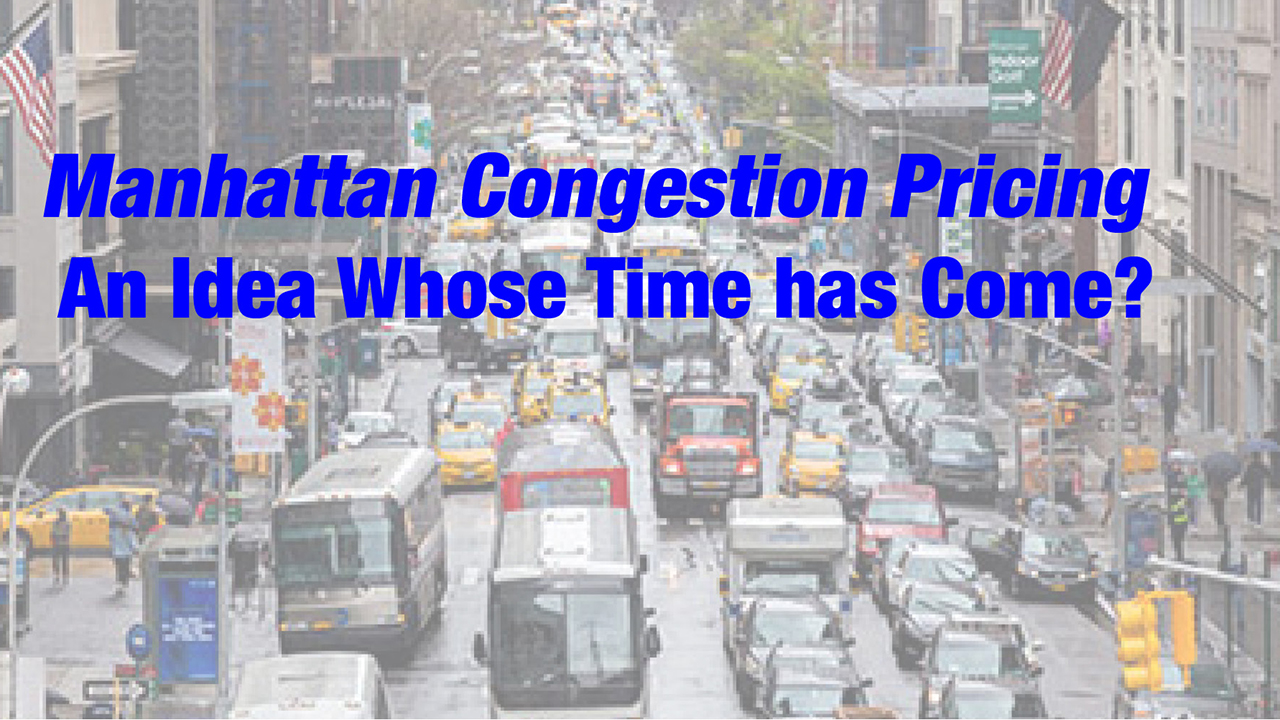
The MTA on April 26 announced that Central Business District Tolling, which the agency calls “the country’s first congestion pricing program,” will begin in Manhattan ‘s designated Congestion Relief Zone early on Sunday, June 30, at 12:00:01 a.m. (details below). Is the MTA jumping the gun, or is at the very least over-confident?
When we most recently reported to you about the proposal to initiate congestion pricing in Manhattan, we were waiting for Judge Leo M. Gordon to decide the case filed by the State of New Jersey and other opponents of the tolling plan against the U.S. Department of Transportation and federal highway officials who had approved the plan. The proposed policy would charge a toll for vehicles that enter Manhattan’s Central Business District, defined as the part of the island from 60th Street and going south.
The case brought by New Jersey and other plaintiffs is in federal court for the District of New Jersey. There is also another case in that district, and there are several more in the Southern District of New York, located in Manhattan. The plan has its proponents and its detractors on both sides of the Hudson. In the case concerning New Jersey, both sides consider the facts of the case undisputed, so they are waiting for a ruling on legal issues that concern whether highway officials used proper administrative and environmental practices and procedures when they approved the tolling plan for implementation. If Gordon gives the plan a green signal, the New York Metropolitan Transportation Authority (MTA), whose capital programs will benefit from the revenue the toll is expected to raise, will implement the plan shortly afterward. The plan’s opponents want a new environmental review. New Yorkers who oppose the plan also want more exemptions from the toll, especially for public sector employees.
New Jersey is also complaining that the Garden State should have a share of the money that the toll would raise, to remediate the environmental damage that more vehicle traffic around the Manhattan tolling zone is expected to cause. Beyond that, New Jersey officials expect that the toll will discourage some motorists from taking their vehicles into Manhattan, and that New Jersey Transit would have to take up the slack by accommodating extra riders on trains to Penn Station New York and buses to the Port Authority Bus Terminal.
A report by Brenda Flanagan from April 3 on NJ Spotlight News summarized the positions of the parties and their supporters at oral argument. Attorney Randy Mastro, representing New Jersey, said at a news conference: “New Jerseyans are going to be paying the price tag, and New Jerseyans are going to be experience of a lot of the adverse environmental effects of this plan.” He added: “There’s something fundamentally unfair about all of that.”
MTA attorney Robbie Kaplan disputed New Jersey’s claim that the state would not receive any money from the proposed tolls: “The papers make very clear that money is going to be sent to mitigation to the various New Jersey counties that need it.” Flanagan reported that Judge Gordon questioned how that would be accomplished. Her report quoted him as asking, “Why should the court step in with a full judicial review over an administrative process that doesn’t appear to be final? Nobody has got enough data, yet, to help me understand …”
MTA Confirms New Jersey Money—Without Elaborating
On April 17, MTA officials said that some of the potential toll revenue would be allocated to New Jersey. Janno Lieber, the agency’s Chair and CEO, said, “The way all of this is determined is allocations by the number of people who are in areas that are impacted by the truck traffic, and New Jersey will get its share exactly on the arithmetic.” Marcia Kramer, political reporter for WCBS-TV, reported the same day that the total of $155 million for environmental mitigation would be split between New York and New Jersey, and it will pay for such measures as roadside vegetation, renovating green spaces like parks, air filtration, and electric truck charging stations.
At this writing, Andrew Albert, Chair of the New York City Transit Riders’ Council and a rider-representative on the MTA Board, has not heard anything further about an actual amount that New Jersey would receive.
Will It Be Enough?
Congressman Josh Gottheimer is a Democrat who represents a district along the northern tier of New Jersey, with much of its population living in Bergen County. Along with Gov. Phil Murphy, a fellow Democrat, Gottheimer is one of the tolling plan’s most vocal opponents. He has repeatedly called for a new environmental review at the federal level, which would be time-consuming, and he is not the only local official who opposes the plan. Bergen County Executive Jim Tedesco told WBGO in Newark, “I am pleased that they have recognized that there’s going to be impacts here, but at the end of the day, this is still something that I don’t believe is in the best interest of the City of New York or New Jersey.”
While environmentalists and many Manhattanites generally favor the plan, officials from New Jersey and some New York officials, particularly from places like Brooklyn and Staten Island, oppose it strongly. While Lieber has said that some money will go to New Jersey, it appears that he plans to stand by the formula for environmental mitigation, which might or might not provide an opening for talks that could settle the matter before Judge Gordon issues his ruling, which is expected in June.
Less has been said about additional costs elsewhere in New Jersey, such as the money that NJTransit will need to spend for more buses and trains into Manhattan. In an April 18 report in Newark’s Star-Ledger, Larry Higgs quoted MTA officials as saying that a projected 80,000 to 110,000 commuters would switch from driving to using transit, but added that NJ Transit officials did not have a forecast concerning New Jersey riders.
Still, it costs money to provide additional transit service, and NJ Transit recently approved a 15% fare increase that will take effect on July 1, to fill a shortfall in the agency’s budget. The Lackawanna Coalition, which advocates for NJ Transit’s rail riders, called for the Garden State to get a share of the money from the tolling plan. Coalition Chairperson Sally Jane Gellert said in a blog post, “It certainly should happen, as NJT will have increased ridership, and fares only go so far in covering expenses of added service.” Albert agreed, saying, “I think it would be to New Jersey’s benefit to contribute a lot more money to NJ Transit, which is how 85% of New Jersey commuters come to New York.”
Will the Parties Negotiate?
Albert called on both sides to negotiate the implementation of the program. He told Railway Age, “Perhaps this would be a good time for the two states to talk about the logistics of implementing this very important program, which would bring in billions of capital dollars to help pay for the $55 billion MTA capital program, which benefits people from every state who come to New York to visit or work.”
There have been rumors of talks between the MTA and the tolling plan’s opponents, but we could not confirm those reports, and it’s too soon to tell if the New York agency’s mention of money for environmental mitigation in New Jersey will help to promote such talks and a possible settlement. If New Jersey persuades the MTA to give the Garden State a larger share of the revenue, tolls will have to be increased to give the MTA the full benefit of the toll revenue for its own capital program that supports the subways and other transit, including the Long Island Rail Road and Metro-North. Any other changes, like giving city workers an exemption from the tolls, or even giving them a discount, would also raise the amount that everybody else would be required to pay.
So, unless the MTA’s statement on money for environmental mitigation starts the process toward a settlement, which now appears unlikely, we will report to you again after Judge Gordon issues his ruling. Meanwhile, following is what the MTA detailed on April 26—giving the impression the plan is a done deal.
Plan Details
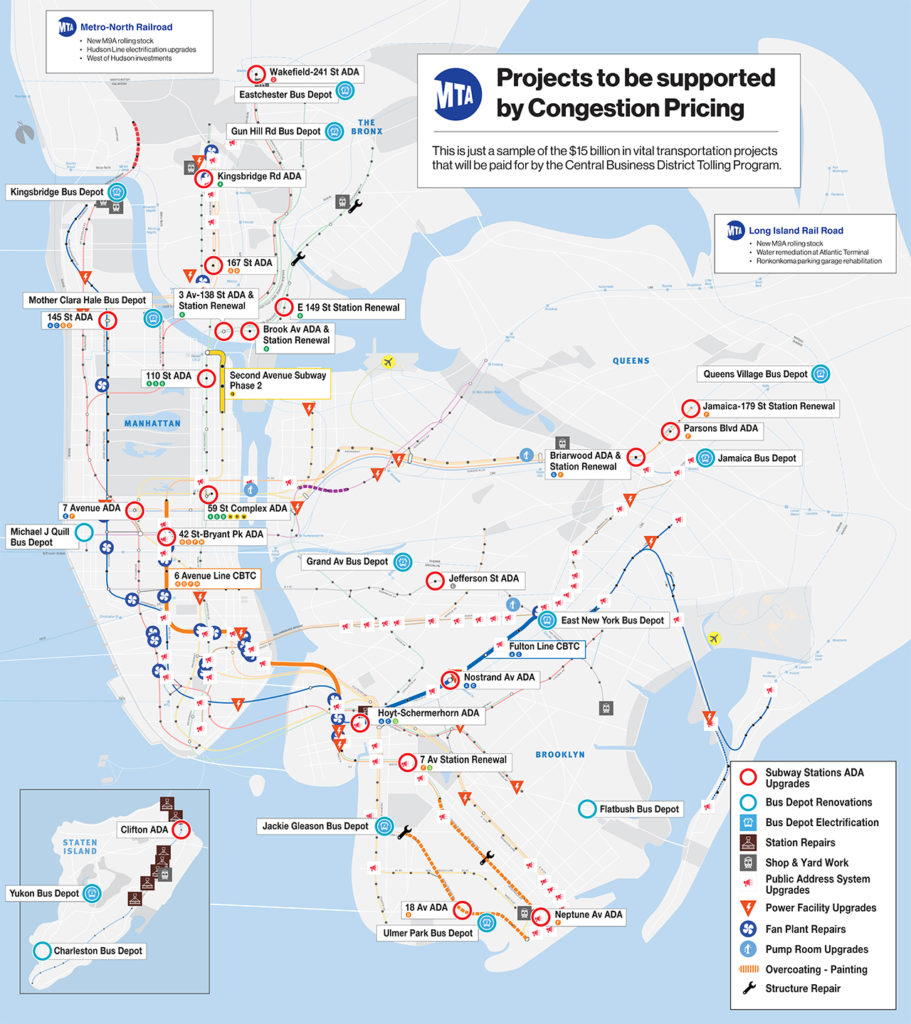
“Eighty percent of the revenue generated will go to capital improvements on NYC Transit subways and buses, 10% to Metro-North Railroad and 10% to LIRR,” MTA said on April 26. “Projects to be supported by congestion pricing include ADA upgrades, new electric buses, new subway and commuter railroad cars, systemwide state-of-good-repair work, and expansion projects like Second Avenue Subway Phase 2.”
The MTA also opened application portals for discount and exemption plans, with detailed information on who qualifies and how to apply. “Together with the website, they are part of a comprehensive public education campaign that includes a multi-platform advertising campaign, in-person community events, civic and business outreach, virtual webinars, email campaigns and much more,” the agency noted. “This builds on months of engagement and hundreds of public meetings over the past several years, including:
- “More than 25,000 comments and nearly 400 verbal testimonies at four public hearings received in just the most recent public comment period earlier this year.
- “Dozens of meetings with different stakeholder groups, with a special focus on environmental justice communities.
- “An extensive public comment period after the release of the draft Environmental Assessment in August 2022 that included six public hearings and resulted in more than 22,000 individual comments and more than 55,000 form submissions.”
Discount and exemption plans include:
- Low-Income Discount Plan: Households earning less than $50,000 a year who travel frequently into the zone may apply to enroll for a discount on the peak toll.
- Individual Disability Exemption Plan: Individuals who have disabilities that prevent them from using transit may apply to enroll a designated vehicle that would be exempt via E-ZPass.
- Organizational Disability Exemption Plan: Organizations that operate vehicles that transport people with disabilities, such as Access-A-Ride, ambulette services, or schools and special education facilities may apply to enroll a vehicle that would be exempt via E-ZPass.
- Emergency Vehicles: Organizations that operate qualifying authorized emergency vehicles may apply to enroll a vehicle that would be exempt via E-ZPass.
- Buses and Commuter Vans: Organizations that operate school buses contracted with the NYC Department of Education, commuter vans licensed with the NYC Taxi and Limousine Commission, and buses providing scheduled commuter services open to the public may apply to enroll a vehicle that would be exempt via E-ZPass.
- Specialized Government Vehicles: Organizations that operate publicly owned vehicles specifically designed to perform public works other than general transportation, and directly engaged in a core agency purpose, may apply to enroll a vehicle that would be exempt via E-ZPass.
“In addition, New York State will offer a tax credit for low-income drivers who live in the Congestion Relief Zone,” MTA said. “More information about the tax credit will be issued by the NYS Department of Finance in Fall 2024.”
All tolling infrastructure needed for the Central Business District Tolling Program to begin has been installed across 108 locations. The MTA said that, over the past year, it “has rolled out service enhancements that will complement the start of congestion pricing.“ Among these:
Subways: New York City Transit is operating 1,200 additional subway trains every week with increases that took effect over several months last year on the lines. Six more lines will receive increases in service in June.
Long Island Rail Road: With the opening of Grand Central Madison, systemwide service “increased an overall 41%: More than 77,000 more trains a year, about a 35 % increase at eastern Queens stations, 30% increase in Brooklyn trains (55% increase in weekend service), and 50% increase in reverse peak service. A $7 peak City Ticket was introduced for travel on the LIRR and Metro-North Railroad between commuter railroad stations within city limits, and an LIRR Far Rockaway ticket, offering more cost-conscious fare options.
Metro-North Railroad: To “increase transit options and encourage ridership,” Metro-North has increased service in the Bronx, which is complemented by discounts offered by the $7 peak CityTicket.
Buses: The MTA is redesigning all the boroughs’ bus networks, “which focuses on delivering more efficient service, better match today’s travel patterns, reduce travel times, increase off-peak service, and improve connections.”