Commentary
Sixth of a Series: A Ruling Later This Year
Written by David Peter Alan, Contributing Editor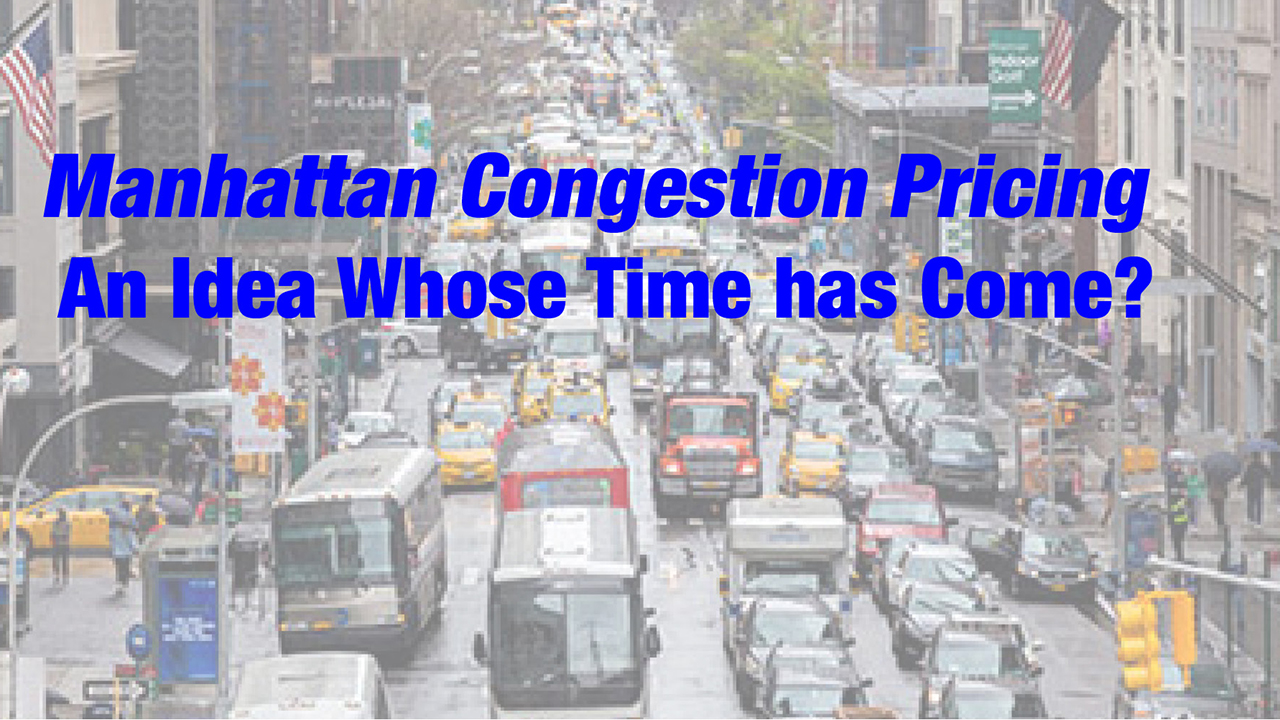
A lot happened last year in the court case concerning the proposal for congestion pricing, charging a toll for vehicles entering the Central Business District of Manhattan, defined as the area south of 60th Street, but excluding the highways along the perimeter of that part of the island.
The action to invalidate and set aside the Environmental Assessment (EA) and Finding of No Significant Impact (FONSI) from the Federal Highway Administration (FHWA) was filed by the State of New Jersey in federal court for the District of New Jersey. While one purpose of the congestion toll is to fund capital improvements for New York City’s transit, with some funding for the Long Island Rail Road and Metro-North, the issues in the case centered around administrative and environmental law.
The State of New Jersey had sued the U.S. Department of Transportation, the Federal Highway Administration, and officials in that agency. The Metropolitan Transportation Authority (MTA) and its affiliate, the Triborough Bridge and Tunnel Authority (TBTA), sought to intervene on the side of the defense. Forty-five non-parties joined in filing amicus curiae (“friend of the court”) briefs, supporting the congestion tolling program and expressing the nature of their interests in the outcome of the case.
There are not many complex litigations on court dockets, but the present case is one. A look at the litigation “by the numbers” will demonstrate that. There were 21 attorneys involved in the case in 2023. Three more joined the case and one asked to withdraw from it, so far this year. Of those, 13 asked to participate pro hac vice (which means they are not admitted to practice before the U.S. District Court in New Jersey, and had to get permission from the judge to participate). The three more who asked to join and the one who asked for permission to withdraw this year were also allowed to participate pro hac vice. There were 13 motions (meaning that one of the sides placed a request before the judge, and the other side is allowed oppose it, with both sides making their arguments), and judges issued six other orders. Such orders are usually about such matters as settlement conferences or scheduling. This year so far, judges have issued orders on 20 motions and five others, mostly scheduling orders.
Bergen County, a New Judge, a Name Reappears
The State of New Jersey filed the original action to stop the congestion tolling program, and Bergen County weighed in on the State’s side on Jan. 8, 2024. The county is in the northeastern corner of the state, across the Hudson River from most of Manhattan (longtime New Jersey advocate Albert L. Papp has referred to that body of water as the “Hudson Ocean” for reasons that became more obvious as the present case developed). The George Washington Bridge connects the two. The county requested permission to file an amicus brief, arguing that it had its own perspective on the case that was not the same as the State’s and, therefore, should also have its say. Assistant Bergen County Counsel David Mateen argued: “The congestion pricing plan has a different impact on commuters from Bergen County (as well as New York) and a different impact on the traffic and the financial burden on commuters, as well as a different impact on the pollution that will ultimately be experienced by both New York and Bergen County residents” (at 3). In essence, Bergen County argued that it would experience higher traffic volume and more air pollution without receiving any benefit from the program. That request was granted on Feb. 9.
Fort Lee Mayor Mark Sokolich and fellow plaintiff Mark Galler, who had a different case against the congestion tolling plan, requested that their matter be consolidated with the State’s case. Sokolich, a Democrat, was one of the main characters in the “Bridgegate” controversy in 2013. He was mayor then, too. Two of the three toll lanes for the George Washington Bridge, which has its New Jersey end in Fort Lee, were suddenly closed on Sept. 9, and a massive traffic jam ensued. It was alleged that Gov. Chris Christie, a Republican, was exacting revenge on Sokolich for not endorsing him for re-election. Christie was never brought to trial, but some of his aides were convicted, and those convictions were reversed by the U.S. Supreme Court in 2020. Christie was re-elected by a landslide. Whatever role he might or might not have had in the affair that became known as “Bridgegate,” Christie’s political fortunes began to decline as his second term started, amid later speculation that the incident with the bridge and its aftermath helped sink his presidential aspirations in 2016.
Sokolich and Fort Lee residents had filed a class action, No. 2:23-cv-32739. In his motion to consolidate the cases, Sokolich’s attorney argued that his case and the State case came from the same facts, and that they were sufficiently similar to warrant consolidation. On February 8, Judge Leo M. Gordon of the Court of International Trade (a specialized court sitting in New York City), to whom the case had been assigned, denied the motion. He noted that the briefing on the summary judgment motions had been completed, and: “Though the actions involve similar claims, they seek different remedies and reflect different procedural postures.” On February 13, Gordon allowed the Sokolich plaintiffs to file an amicus brief, and their attorney did so on February 20, supporting the State’s case. Gordon also allowed Bergen County to file abrief supporting the State’s case against the toll and allowed EmpowerNJ and the Environmental Defense Fund to file briefs supporting the Defendants.
The State returned to its case in chief on January 12, in a 50-page brief supporting its motion for summary judgment. The arguments primarily appeared similar to those made by Sokolich and the Fort Lee residents, although the motion was not about their case. The State’s arguments reiterated its support for its previous motion for summary judgment, expanding on arguments made the previous month, and arguing that there were no issues that needed to be tried, a situation that a party seeking summary judgment must prove, because granting it would deprive a party of its “day in court.”
New Jersey Asserts New Constitutional Claims
On Jan. 16, Randy Mastro of the firm of King & Spalding, who represents New Jersey, asked for permission to amend the State’s Complaint to add new allegations, considering the proposed toll rates set by the Traffic Mobility Review Board (TMRB) on Nov. 30. As widely known now, the base toll would be $15 per day for passenger cars entering Manhattan south of 60th Street between 5:00 AM and 9:00 PM on weekdays (9:00 to 9:00 on weekends) and $3.75 overnight, with higher rates for trucks and most buses, and a discount for vehicles entering through tolled bridges and tunnels. Mastro proposed to add Timothy Horner and Eric Grossman as Plaintiffs, along with the State of New Jersey. Horner is a jazz drummer who performs in Manhattan, while Grossman is a curator of musical instruments at Julliard, a music conservatory in Manhattan. According to the new allegations, both must use their automobiles to travel for their work, and cannot use transit, so they would have to pay the extra tolls.
Mastro alleged that, with the proposed toll charges, New Jerseyans would not receive the tax breaks that New Yorkers who live in the CBD portion of Manhattan would receive, and they would pay more to enter the tolling zone, which would “deter, impede, and penalize New Jerseyans’ right to travel from New Jersey to the CBD” (at ¶4). He also alleged (at ¶21) that the plan violates the “dormant Commerce Clause” that prevents states from impeding interstate commerce (at ¶¶187-197). The actual Commerce Clause (at Article I, §8, cl. 3) gives Congress the authority to regulate interstate and foreign commerce. The “dormant Commerce Clause” is not in the Constitution but is a legal doctrine that is invoked to support it. Mastro alleged: “The congestion pricing scheme intentionally places an undue, excessive burden on interstate commerce and discriminates against New Jersey drivers…” and claimed: “These discriminatory features of the tolling scheme do not serve a legitimate purpose that could not be served as well by nondiscriminatory alternatives.” He suggested some alternatives, including “allowing New Jersey to share in the revenues from the tolling scheme” (at ¶22).
The brief he filed also contended that “the tolling scheme unconstitutionally infringes on the right to travel under the Privileges and Immunities Clause … because (1) it will deter travel from New Jersey to New York, (2) its primary objective is to deter travel from New Jersey to New York, and (3) the tolling scheme penalizes the exercise of the right to travel especially by low-income New Jersey residents.” The original Clause at (Article IV, §2, cl. 1. “prohibits a State from discriminating against other States in favor of its own” (at ¶198) The clause by the same name, but in the Fourteenth Amendment “protects, among other things, the right to pass freely from state to state” (at ¶200).
Gordon denied the motion to consolidate the cases on Feb. 8, writing: “In its request, Plaintiff recognizes that briefing on cross-motions for summary judgment in connection with its existing claims concluded on Jan. 26, 2024, and that resolution of those claims in Plaintiff’s favor will obviate any need to resolve the proposed claims. Plaintiff therefore urges adjudication of the existing claims prior to adjudication of the proposed claims. Given these considerations, the court finds that granting Plaintiff’s request at this stage of the litigation does not serve judicial economy. Instead, the prudent course is to deny Plaintiff’s request without prejudice so that Plaintiff may renew the request after the court adjudicates the existing claims” (at 3, citations omitted). He also scheduled oral argument for April 3 and 4, and the Daily News reported that he said that he expected to issue a ruling by early June.
So, now it’s time to wait, at least until later this spring. In the likely event that the losing side appeals to the Third Circuit (the federal appellate court whose region includes New Jersey), the wait will be longer, and longer still if the loser at the appellate level petitions the U.S. Supreme Court for review.
There could also be another path to delay. Gordon denied the State’s request to expand the Complaint to add the allegations based on Constitutional law, but without prejudice. If the State wins its motion for summary judgment, the tolling plan approved by Federal highway officials and currently presented will not be implemented. At the very least, it would have to be reconsidered and amended to cure all defects that he might find and taken through every administrative and public process that was required the first time. At worst, the proponents of the plan might have to start over again, if there is reason to believe that a different congestion pricing plan could pass court muster. All of this takes time, possibly years.
If Gordon upholds the plan based on the record and the arguments already presented, the State could raise its Constitutional arguments after the decision is rendered. The judge would then decide on the new arguments, after the Defendants have the opportunity to oppose them, but on the same factual record. That would probably not take as much time as formulating a new tolling program, but any final order from the judge could be subject to the long, time-consuming appeal process that could take years.
Meanwhile, the New Jersey cases are not the only ones where plaintiffs are suing to stop the congestion pricing plan. An assortment of New Yorkers, including the United Federation of Teachers, elected officials from Staten Island and residents of the Lower East Side, have sued in federal court in New York to prevent implementation of the toll. We will look at that case in the next article in this series.