Fifteenth of a Series: Opponents Raise New Issues in N.J. Court Case
Written by David Peter Alan, Contributing Editor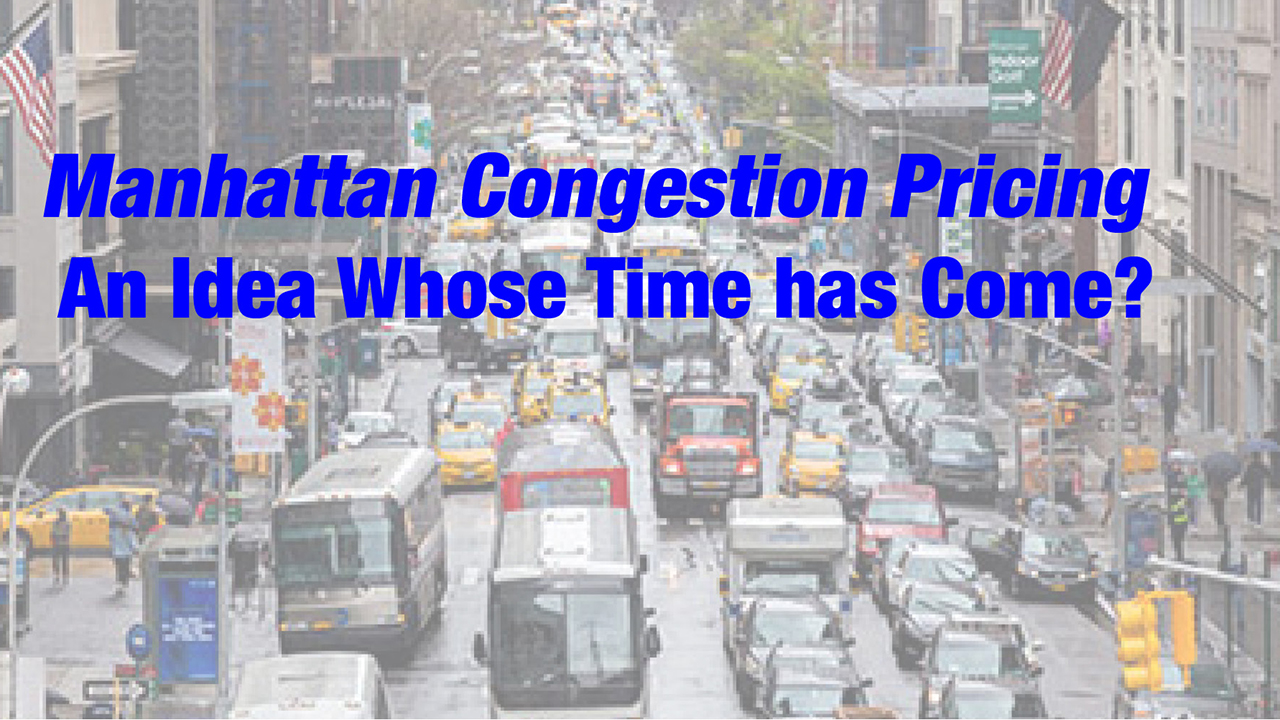
Throughout the spring, we reported on the slow but steady progress of the proposal to charge tolls for most vehicles entering the Central Business District of Manhattan, defined as the part of the island south of 60th Street. The idea of paying some “rent” to use a bit of the limited and congested street space in that densely packed region made sense to many Manhattanites and other New Yorkers who ride the subways and buses that keep City moving, since the proceeds were slated to contribute to the capital programs on the region’s Metropolitan Transportation Authority (MTA).
Most of those proceeds would go toward New York City Transit (80%), while the rest would go to the Long Island Rail Road and Metro-North for uses like equipment purchases, adding accessibility features to subway and elevated stations for riders with disabilities, and keep the system generally in a state of good repair. At least it looked like Congestion Pricing’s time had finally come, at least through our first eleven reports.
There were developments during the summer, as we turned our attention to the fiscal cliff that could wreak a catastrophe throughout the transit scene in this country. Judge Leo M. Gordon was widely expected to issue a ruling on the case brought by New Jersey opponents of the toll, including Gov. Phil Murphy on behalf of the State of New Jersey itself. and Rep. Josh Gottheimer, in the federal court for the District of New Jersey. That ruling was expected in mid-June, before the intended and postponed (at least) date for implementing the toll: June 30. Now, almost three months later, it has still not come.
In the meantime, as we reported in the thirteenth and fourteenth parts of this series, Judge Lewis J. Liman issued a ruling in the consolidated cases brought in the Southern District of New York that gave the toll a green signal, for the most part, anyway. Then supporters of the toll in New York City filed two separate actions in New York State court in Manhattan, asking Judge Arthur F. Engoron (famous for hearing the civil fraud case against Donald Trump) to direct the governor and state transportation officials to start collecting the tolls, based on a theory that the Traffic Mobility Act of 2019 does not give them the authority to refuse to collect them.
Now, the “New Jersey case” is coming alive again. As we reported in the fourteenth episode of this series, Hochul told Politico in an interview that she might propose a modified version of the congestion toll after the election. On the New York side, there had been mounting speculation that she “paused” the tolling program because it was widely unpopular in suburban areas north of the City and on Long Island, and pursuing such an unpopular program would hinder Democrats in their efforts to capture House seats in those areas, seats that the party needs to recapture the House in the upcoming election.
With Hochul’s announcement that she might propose another version of the congestion toll again anyway, it is now unclear how much her original “pause” on the program early in June will actually help the Democrats win the House seats they need. In New Jersey, the move has reactivated opposition to the plan, among elected officials and others who had hoped that the case had become moot.
“New” Argument from New Jersey
The New Jersey plaintiffs, including the State itself, raised a new argument as Larry Higgs reported in Newark’s Star-Ledger in an August 31 article headlined N.J. Makes more arguments against $15 fee to enter N.Y.C. after Gov. Hochul hints at its return. Higgs began his report by saying: “The legal team leading New Jersey’s opposition to New York City’s congestion pricing plan have made more arguments hoping to convince a judge to overturn federal approvals of the $15 fee to enter Manhattan … New Jersey’s attorneys are taking no chances. Papers and a copy of a District of Columbia court ruling overturning federal approval of a natural gas pipeline and terminal in Port Isabel, Texas, were filed on Aug. 20 by Attorney Randy M. Mastro, who is representing the state in the suit filed against the Federal Highway Administration in July, 2023 in U.S. District Court.”
Understandably, since the ruling in the New York Congestion Pricing cases came down, Mastro sought to distinguish it from the case at bar in New Jersey. He wrote to Judge Gordon on June 21, https://storage.courtlistener.com/recap/gov.uscourts.njd.515237/gov.uscourts.njd.515237.160.0.pdf saying: “Your Honor is not bound by the decision in Chan v. U.S. Dep’t of Transp., No. 23-10365 and the consolidated cases, and the FHWA’s notice misstates the holding in those cases. While the court denied the specific NEPA challenges raised by Chan and the other plaintiffs, the Court did not find that the Defendants complied with NEPA in issuing the Final EA and FONSI for all challenges, including those raised by New Jersey. While some of the legal doctrines may overlap, New Jersey has distinct arguments about the effects of the congestion pricing scheme on New Jersey, its environment, and its environmental justice communities, and the lack of mitigation to mitigate those adverse effects.” He also requested the opportunity to brief “how the decision in that case is distinct from the issues raised in this case, or wrongly decided to the extent there is any overlap.”
There was a status conference in the case on June 27, but no more activity until August 20, when Mastro filed a Notice of Supplemental Authority (NSA) , citing City of Port Isabel, et al. v. Federal Energy Regulatory Commission, No. 23-1174 (D.C. Cir. Aug. 6, 2024). He attached the ruling from the D.C. Circuit Court of Appeals, which he said was a “decision vacating the Federal Energy Regulatory Commission (‘FERC’)’s approval of natural gas export terminal and pipeline reauthorizations on the grounds that FERC’s decision not to issue a supplemental Environmental Impact Statement (‘EIS’) for its environmental justice analysis was arbitrary, capricious, and in violation of the National Environmental Policy Act (‘NEPA’). The opinion confirmed that ‘NEPA requires an EIS if any significant impacts ‘might result’ from the proposed action, not only when it definitively concludes that a significant impact will result (citations omitted). Moreover, although the agency ‘did solicit public comment as to some of the data underlying its environmental justice analysis,’ ‘it did not solicit any public comment on the final cumulative air emissions model’ – exactly what Defendants and Intervenor-Defendants did here with their final tolling scheme” Id. at 18 (emphasis added)” Mastro quoted the cited decision (at 15), and had added the emphasis for his filing in the present case.
Appeals from decisions by administrative agencies are heard by the D.C. Circuit, wherever the case before the agency might have arisen (the D.C. Circuit’s decision in City of Port Isabel can be found at https://storage.courtlistener.com/recap/gov.uscourts.njd.515237/gov.uscourts.njd.515237.163.1.pdf).
According to the opinion (at 4), the Petitioners in that case “argue that the Commission failed to comply with certain National Environmental Policy Act and Natural Gas Act requirements. Once again, we agree in part. The Commission erroneously declined to issue supplemental environmental impact statements addressing its updated environmental justice analysis for each project and its consideration of a carbon capture and sequestration system for one of the terminals. It also failed to explain why it declined to consider air quality data from a nearby air monitor.” The court denied the petitions in all other respects and sent that issue back to FERC for further consideration.
City of Port Isabel was brought under the Natural Gas Act, which favored construction of natural gas pipelines and facilities, but also required environmental review under NEPA. The issue was presented this way: “Petitioners – environmental groups, residents, and the nearby city of Port Isabel – intervened in the Commission’s proceedings and sought rehearing of the authorization orders. They argued that the Commission’s analyses of the projects’ ozone emissions and impacts on climate change and environmental justice communities were deficient under NEPA and the Administrative Procedure Act (‘APA’). They also claimed that the Commission failed to justify its determinations of public interest and convenience under the NGA. Regarding the Rio Grande project, petitioners further argued that the Commission violated NEPA by failing to adequately analyze alternative project designs” (at 7).
The court originally remanded the case to FERC for more information, and noted that: “On remand, the Commission generated a new and significantly expanded environmental justice analysis for each project” and briefly described that analysis. The decision also said that the Commission did not prepare a Supplemental EIS, which would have required more effort, but said that the response was insufficient without it (at 11-12). The court noted a provision in the Code of Federal Regulations (C.F.R.) that says: “NEPA regulations require a supplemental EIS when “[t]here are significant new circumstances or information relevant to environmental concerns and bearing on the proposed action or its impacts” (at 12, citation omitted), but also noted: “Here, the pertinent ‘new information’ includes the updated demographic and environmental data submitted by the developers, as well as the Commission’s entirely new analysis and interpretation of that data, which are substantially different from the previously conducted environmental justice analysis in the final EIS” (Id.). The original study was conducted on an area within a two-mile radius of the site at issue, but the study conducted on remand concerned a radius of 50 kilometers, or about 31 miles. The significantly larger area made a difference to the results, which prompted the court to say: “At least where, as here, the Commission issued an entirely new and significantly expanded environmental justice analysis that reached new conclusions, we hold that the Commission needed to issue a supplemental EIS. Its failure to do so was arbitrary and capricious” (at 17). The court addressed several other issues in its opinion, which pertained specifically to natural gas situations, so they would not pertain to other environmental situations.
New York’s MTA and TBTA responded to this proposed Supplemental Authority on Aug. 23. They argued that City of Port Isabel “is readily distinguishable and has no bearing on the instant litigation” (at 1). The MTA and TBTA distinguished City of Port Isabel this way: “Initially, the case arose in a materially different procedural posture and is inapplicable for this reason alone. The D.C. Circuit in City of Port Isabel found procedural and substantive inadequacies in the defendant’s attempt to correct deficiencies in an Environmental Impact Statement (EIS) prepared for a natural gas terminal and pipeline project, which deficiencies the Court had previously identified in a prior challenge that resulted in a remand to the Federal Energy Regulatory Commission (FERC). Reviewing the revised analysis following the remand, the D.C. Circuit held that the new analysis should have been published in a Supplemental EIS to enable public comment because of material differences in the analysis and results. City of Port Isabel, at *12–20. Here, by contrast, the instant litigation challenges a Final Environmental Assessment that resulted from a formal comment period and was itself the subject of a public availability period during which public comments (including from Plaintiff) were accepted and considered by the Federal Highway Administration (FHWA). Unlike City of Port Isabel, here there has been no remand, and the parties’ cross motions for summary judgment on the Final Environmental Assessment are still pending” (at 2). The New York agencies also argued that a party is not allowed to use an NSA “to advance new arguments that were absent from a movant’s complaint” (at 2), that the plaintiffs did not challenge the adequacy of the Reevaluation of the tolling plan from June 14 (at 3), and that the FHWA’s FONSI found that the tolling project “would not have significant effects” (at 3, emphasis in original). The MTA and TBTA concluded by saying that City of Port Isabel has no bearing on the present case and requested that New Jersey’s request to consider it be disregarded.
Anything New Here?
Cases in administrative law, including environmental law, often turn on their facts, rather than solely on the application of a legal principle. The FHWA’s scope of official concern included environmental degradation to the places in an around Manhattan where the proposed tolls would have an effect. That also included New Jersey and other parts of New York City and places in the State outside the city. The New York case before Judge Limon and the New Jersey case before Judge Gordon are essentially based on the same set of facts, although judges can apply the relevant law to a given set of facts in different ways, and sometimes they come to different conclusions.
We know that Judge Limon has already issued his opinion on the New York side, in the Southern District. Judge Gordon, on the New Jersey side, in the District of New Jersey, has not. It appears to this writer that City of Port Isabel, which the D.C. Circuit decided on August 6, is not sufficiently similar to the present case that it would trigger a remand of the present case to the FHWA. If Judge Gordon says it is and remands the matter to the FHWA for further consideration, the result could cause more than just delay, which would bring bad news to the MTA’s capital program on its own. It could also include a set of appeals and a motion to Judge Limon to reconsider his decision that was rendered in June.
Things like that can happen with complex litigation, especially when similar cases are heard in more than one district. That could be especially tricky here, since federal cases in New Jersey are appealed to the Third Circuit, federal cases in New York are appealed to the Second Circuit, and the only court with the authority to settle conflicts between circuits is the Supreme Court. It seems unlikely that a case of such local, and not necessarily national, significance could go that far, but nobody can ever know for sure. We will know much more after Judge Gordon issues a ruling.
Different MTA “Fiscal Cliff”?
We previously quoted a report by Larry Higgs in the Star-Ledger. It concluded this way: “While congestion pricing is on pause, federal officials told the court in June that a decision is still needed in the case because the “lawfulness of the agency’s action remains very much a live legal issue.” Murphy also said on June 6 the state wasn’t dropping the suit after Hochul’s pause “because we’re not sure what’s going to happen.” That’s where things stand now, and we’ll report developments as they occur.
In the meantime, we spent the summer reporting on the fiscal cliff that transit is facing when the one-shot grants of COVID-19 relief money that Congress authorized in 2020 and 2021 for the operating side of transit run out. As we reported in that series, New York’s MTA is in better shape on the operating side than the other agencies we examined. Despite the operating side of New York’s transit and local railroads being in relatively good shape for the time being, it now appears that the agency could fall off a different fiscal cliff even if the toll is eventually collected: this cliff on the capital side.
While the congestion toll is supposed to generate funds for the capital side, recent reports now say that the situation requires far more money than the hoped-for infusion of funds from the tolls can deliver. We will look at the prospects for the MTA’s capital side in the next report in this series.