Commentary
Brightline: Will Ridership Meet Expectations?
Written by David Peter Alan, Contributing Editor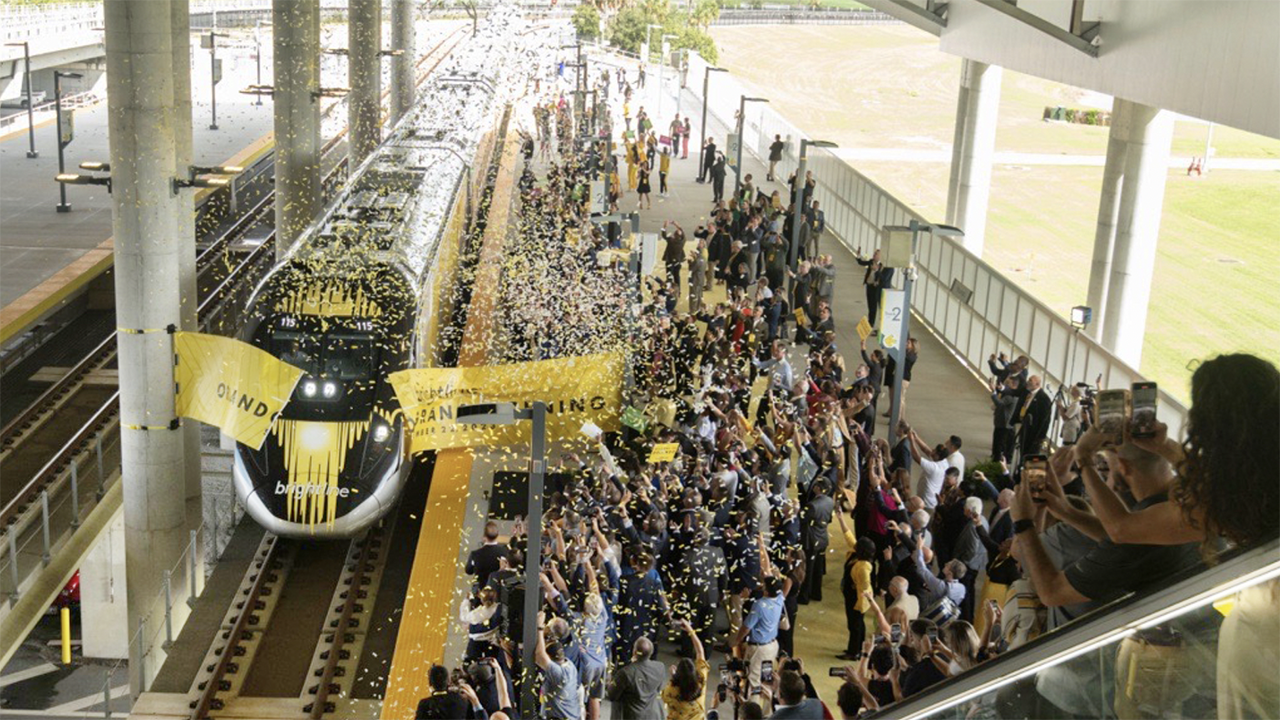
Brightline Florida grand opening at Orlando International Airort
Railway Age recently reported on the proposed Sunshine Corridor in Central Florida, which is slated to connect Brightline’s newly opened northern terminal at Orlando Airport with points west and southwest in the Orlando area, interchange with local service on SunRail, and serve as part of an extension of Brightline to Tampa someday. The extension from West Palm Beach to Orlando Airport opened for service on Sept. 22, 2023 to great fanfare as the first private-sector passenger railroad to operate corridor-length trains since the Rock Island discontinued its Illinois trains that ran beyond Chicagoland in 1978.
Railway Age covered the opening, including the crowds waiting to ride, and it appeared that the newly extended route was off to a good start. There has been little reporting about ridership on the line since then, although early reports indicated that the service was doing well. More recently, though, a subsequent report has raised questions about the line’s ridership in the longer term.
One year ago, the picture looked great for Brightline. Wilkine Brutus reported on WLRN, Miami’s NPR station, that “the latest data from the company has confirmed that ridership demand is on a fast track—with a 143% increase in passengers from this time last year. Brutus also reported that Orlando Airport service was expected to start in March, but it began six months later. The 143% increase counted only riders between Miami, West Palm Beach and intermediate stops, but it indicated that Brightline was recovering from the impact of the COVID-19 virus, which resulted in a suspension of service from March 26, 2020 until Nov. 8, 2021.
Good start for Orlando Airport Extension
On Dec. 1, 2023, Ananya Tiwari reported in the Treasure Coast Newspapers that Brightline reported 79,686 Orlando riders during October. “Long-distance passengers constituted 38.73% of all 205,745 passengers over the month, and ticket revenues from these trips constituted more than 70% of ticket revenues for the month, Tiwari wrote. “Brightline has seen a 390% increase in ticket revenue as compared to October 2022.” That number represented a month when the schedule was ramping up from six daily round trips through Oct. 9, 15 through Oct. 24, and the current schedule of 16 after that.
On Jan. 23, 2024, Ryan Lynch reported in the Orlando Business Journal that ridership rose through the end of the year: “Brightline passenger train service wrapped up 2023 with the continued growth of ridership on its new route to Orlando. The Miami-based intercity rail charted more than 115,683 December riders between South Florida and Orlando International Airport. That is up from 93,184 in November. In total, 306,131 riders took the trip between the two regions from its local start on Sept. 22 to the end of December.” Lynch also reported that Brightline took in $26.1 million in ticket revenue on the Orlando Airport runs and was hoping to provide as many as 4 million rides per year as early as 2025.
Will Growth Continue?
Despite these early predictions of strong ridership, a recent article in Bloomberg’s CityLab, a platform normally devoted to urban planning and policy, calls those forecasts into question. In an article that delves into the financial side of the service, Martin Z. Braun reported on Jan. 26, 2024 that Brightline had slashed its 2024 ridership forecast. He began his report by saying, “Brightline, the first U.S. private passenger railroad built in more than a century, is on a slow track toward building ridership.” He reported that the railroad reduced its ridership forecast for this year to 5.5 million riders (including local riders between South Florida stations) from an anticipated number of “about 7 million” last September, a 21% decrease, according to bond documents that Brightline had released.
“Brightline is betting on replicating the model of Amtrak‘s high-speed Acela service between cities in the Northeast, but without government subsidies,” Braun reported. “The railroad says travelers between Miami and Orlando—both big tourism citie —can avoid the stress of a traffic-clogged four- to five-hour drive or the hassles of air travel.” Still, a subhead in the article noted “Brightline Needs Big Ridership Jump to Meet Projections.”
Just how big a jump is needed? Braun reported 2023 figures and 2024-26 projections, all attributed to Brightline. While somewhat imprecise (only to two significant digits), they still convey an idea of Brightline’s expectations. For “Short-Distance” (local South Florida) riders, there were 1.8 million in 2023. Projections for 2024 are 2.7 million (a 50% increase), and 3.7 million for 2025 and 2026, a 37% increase over 2024. For “Long-Distance” (Orlando Airport) riders, there were 0.3 million while service ran in 2023, with projections of 2.8 million for 2024, 4.3 million for 2025 and 4.5 million for 2026. The nominal ridership for 2024 was projected to be 9.33 times the actual 2023 number, but service ran for only 101 days of the year, and on a reduced schedule at the start.
For an approximation, I took 83 days of full service (15 or 16 round trips) and 18 days of 40% capacity (six round trips), to yield 7.2 days of full service (rounded to 7), for an equivalent to 90 days’ worth of service capacity. This approximates to 1.2 million Orlando Airport riders if full service had been offered for all of 2023. So, the “big jump” that Braun mentioned would require that Brightline increase its Orlando Airport ridership to 2.33 times what the level experienced during the first few months of service had been. Can Brightline accomplish that feat, while also increasing local South Florida ridership by 50%? That appears difficult, but not impossible.
The next question: Can Brightline accomplish those projections with its existing fleet and schedule? Brightline’s current fleet consists of ten four-car sets of Siemens Venture cars, with Siemens Charger SCB-40 locomotives at both ends. Each set includes three coaches with 66 seats each in 2-2 configuration (called “Smart” class on Brightline), and a “Premium” car with 50 seats in 2-1 configuration, for a capacity of 248 passengers per train. At 16 round trips on the entire line, that allows room for 7,936 passengers per day, or 2,904,576 for all of 2024 (a leap year). Brightline would need to fill more than 96% of its current capacity with Orlando Airport riders to reach its projection, a difficult feat, but theoretically possible.
While Brightline could attain its goal of 2.8 million Orlando Airport riders this year, the railroad also projects an additional 2.7 million riders will take the trains locally, between Miami and West Palm Beach. If all Orlando Airport riders were to go all the way to Miami Central Station, there would only be about 100,000 seats available for local South Florida riders. There are two additional round trips that run only as far north as West Palm Beach, which add 992 seats per day, or 363,072 seats for the year. That still leaves a shortfall of about 2,237,000 seats.
For Brightline to accommodate all its projected load of local riders, almost 80% of Orlando Airport riders would have to get on or off at a station in South Florida, and that would require a perfect match with a local rider going to or from that station. Under the current schedule, that appears impossible. Fourteen South Florida round trips might be enough, but it would take fifteen to accommodate 2,723,040 riders, enough to fulfill the forecast.
At this writing, 20 more cars are on order, and Brightline expects to take delivery sometime in 2025. Assuming that the new cars are 66-seat coaches, that would add 132 seats to each train, which means 4,224 more seats per day, or 1,541,760 for all of 2026 on the current Orlando Airport schedule. Those cars would fall short of accommodating Brightline’s projected 4.5 million for 2026, unless more trains are added, but lengthening the span of service might result in inconvenient departure or arrival times. Low fares, like Amtrak Night Owl fares on the Northeast Corridor, might attract enough riders. Even with the longer trains available by 2026, a more-robust South Florida local schedule would be needed to add capacity for the projected 3.7 million riders in the region. At 380 riders per train, capacity for each round trip on the schedule would total 277,400 for the year. It would still require 14 round trips between Miami and West Palm Beach to accommodate Brightline’s local ridership projection for 2026. I will not conjecture about 2025, because we don’t know when new cars will enter service.
Expansion Probably Ahead; Ridership Uncertain
Brightline released a 13-page “Monthly Revenue and Ridership Report” in December 2023 (download below). It reported large increases over the same period in 2022, but average fares, money spent on food and beverages and distances traveled increased significantly because service on the longer portion of the route to Orlando Airport began last September. The report said: “We believe the swift adoption of our service by customers demonstrates the latent demand in the market for an improved mode of travel between South and Central Florida” (at 3). The report went on to describe new contracts between Brightline and sponsorship partners, including Uber and Mears Transportation, a bus company in the Orlando area, to provide connecting transportation for Brightline riders (at 4-5).
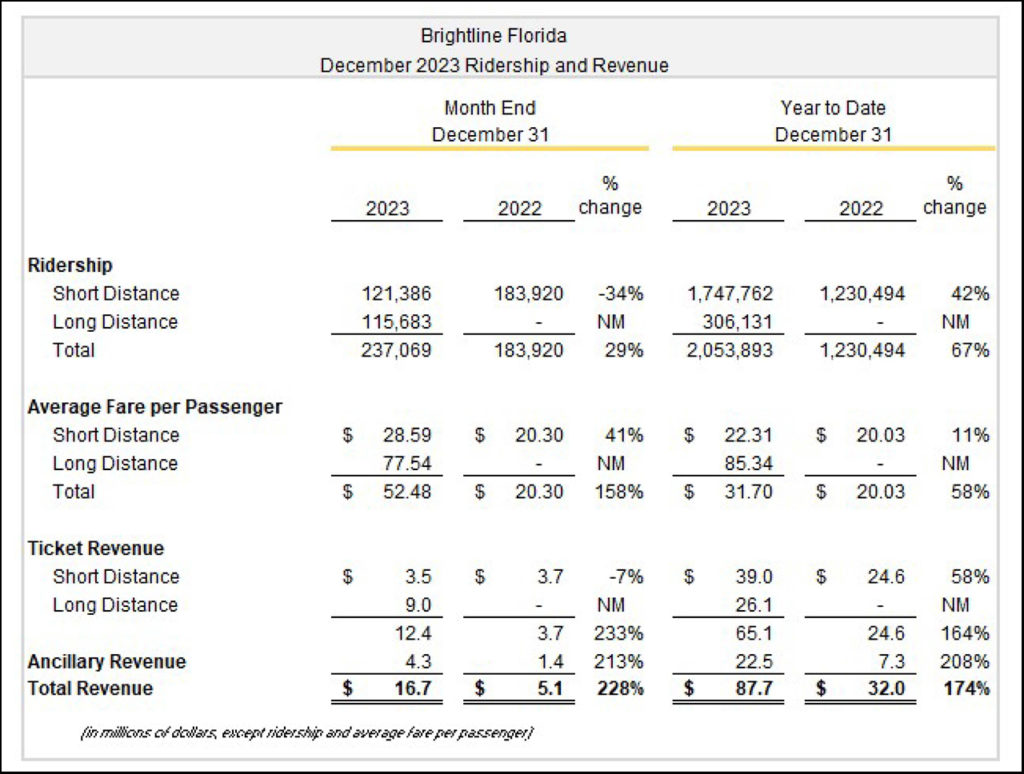
In addition, the report described in detail Brightline’s plans to establish commuter service in Miami-Dade, Broward and Palm Beach Counties, which would be located parallel to the existing Tri-Rail line and east of it (at 7-9). The report also mentioned the extension to Tampa (at 9-10), which will use the proposed Sunshine Corridor, about which Railway Age reported Feb. 2.
If Brightline can meet its current projections, then what? Railway Age has reported extensively about Brightline and its plans through the years. The new services under consideration could improve the mobility map for non-motorists and motorists alike in Brightline’s service area, especially for visitors to the tourist-packed region. That goes for Brightline’s plans to provide local service in South Florida, as well as running trains on the proposed Sunshine Corridor and westward to Tampa. If Brightline ever uses the rest of the historic Florida East Coast main to run passenger trains to Jacksonville through Daytona Beach and St. Augustine (which is currently not served by any intercity buses at all), such a service could reopen Florida’s original rail tourist corridor, first developed by FEC and which flourished until 1963, when through trains from points north stopped running on the line.
Brightline is a bold experiment in bringing passenger trains in the U.S. back into the private sector. The railroad has its crowd of well-wishers who hope that the private-sector model will catch on elsewhere in the country. Time will tell if that happens. For the moment, Brightline’s diminished ridership projections could slow the high-performance line down, if not physically, at least as far as the investors, managers and advocates who observe the rail scene are concerned. However sobering the new projections might be, it appears that it will take more trains on the schedule to fulfill even Brightline’s new and more-modest ridership forecasts. If Brightline can manage to succeed in attracting and carrying so many riders, that feat could still serve as a proof of concept for a private-sector passenger rail corridor in the U.S. The next step for all of us is to follow the actual ridership numbers.
Brightline did not respond to my request for comment.

David Peter Alan is one of North America’s most experienced transit users and advocates, having ridden every rail transit line in the U.S., and most Canadian systems. He has also ridden the entire Amtrak and VIA Rail network. His advocacy on the national scene focuses on the Rail Users’ Network (RUN), where he has been a Board member since 2005. Locally in New Jersey, he served as Chair of the Lackawanna Coalition for 21 years, and remains a member. He is also Chair of NJ Transit’s Senior Citizens and Disabled Residents Transportation Advisory Committee (SCDRTAC). When not writing or traveling, he practices law in the fields of Intellectual Property (Patents, Trademarks and Copyright) and business law. Opinions expressed here are his own.