Commentary
Eighth of a Series: MTA Says ‘No Tolls, No Capex’
Written by David Peter Alan, Contributing Editor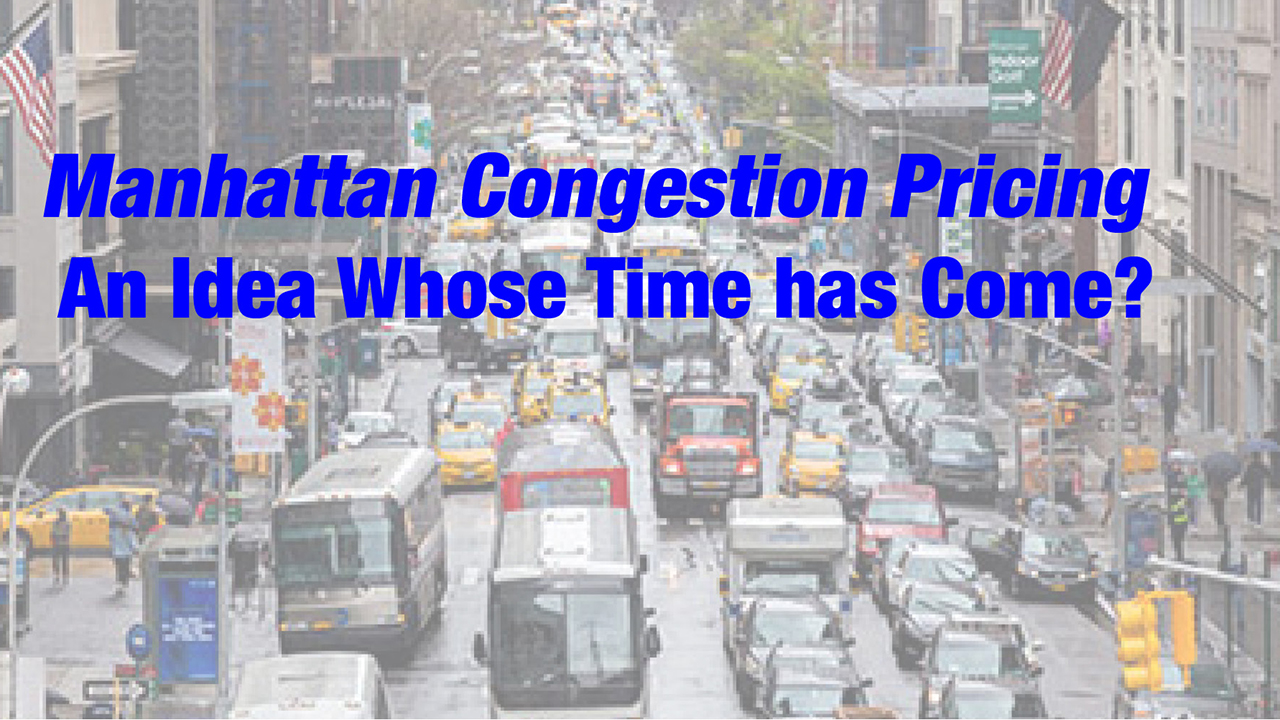
As we wait for Judge Leo Gordon to decide the case filed by the State of New Jersey in federal court in that state, and as we also wait for a group of cases filed in the Southern District of New York to proceed, New York’s Metropolitan Transportation Authority (MTA) has been moving forward in its own way: preparing for the revenue that will come from the congestion tolling program in Manhattan, which is slated to pay for capital projects that will keep the city’s transit and two regional/commuter railroads going.
On Leap Year Day, New York’s NPR station, WNYC, reported that nearly all cameras for collecting tolls have been installed at entry points into the tolling zone, which will encompass all of Manhattan south of 60th Street, except for two highways on the east and west edges of Manhattan Island and the underpass that connects them. The system will use E-Z Pass to collect the tolls, which have been set at $15.00 for passenger cars from 5:00 AM until 9:00 PM on weekdays and from 9:00 to 9:00 on weekends. Tolls for trucks and buses will be higher, and there are other features, too. We reported on the rates in greater detail earlier in this series.
The tolling plan has always been controversial. Nothing like it has been attempted in North America before, but such tolls have been successful in London, Stockholm, and Singapore. The State of New Jersey is fighting it in court, as are various other organizations. In addition to the New Jersey case, there are other cases filed in Manhattan that have the same objective: to invalidate the Environmental Assessment (EA) and the Finding of No Significant Impact (FONSI) that are necessary parts of the process leading toward implementation. Meanwhile, different organizations are defending the program in the actions against the transportation officials whose job is to implement it. The MTA had hoped to start collecting tolls in April, but it will not happen that soon. The earliest that the New Jersey case can be decided will be in June, we don’t know about the New York cases, which are running behind it.
Work Postponed
The cases are already having an effect. As Railway Age Senior Editor Carolina Worrell reported on Feb. 16, MTA capital projects that would depend on revenue from the congestion tolls have been postponed. The MTA plans to use the money to fund $15 billion worth of projects. On Feb. 26, the MTA sounded the alarm about those projects in a press release headlined MTA Details Accessibility, Expansion, and Reliability Projects at Risk Due to Congestion Pricing Lawsuits. Its subheads said, “Lack of Work to Bring the System into a State of Good Repair Would Lead to Unreliable Service and Disruptive Emergency Work” and “23,000 Jobs at Stake: Hundreds of Businesses Owned by Minorities, Women and Veterans Likely to Be Impacted.”
The Release began: “The Metropolitan Transportation Authority (MTA) today detailed projects across the subway system, buses, Metro-North Railroad and the Long Island Rail Road (LIRR) that are at risk due to the lawsuits against congestion pricing. Anticipated congestion pricing bond proceeds of $15 billion make up more than 50% of the remaining funds in the MTA’s 2020-2024 Capital Program. As a result, the MTA Capital Program must be largely placed on hold, halting advertisement of nearly all new construction contracts and moving forward only with limited, urgent exceptions. Without the funding Congestion Pricing will provide, these projects to make the transit system safer, more reliable, accessible and equitable for the millions of commuters who rely on public transportation every day are at risk.” The document also contained a map of proposed stations and other places where the work would be done if and when the tolling program is implemented.
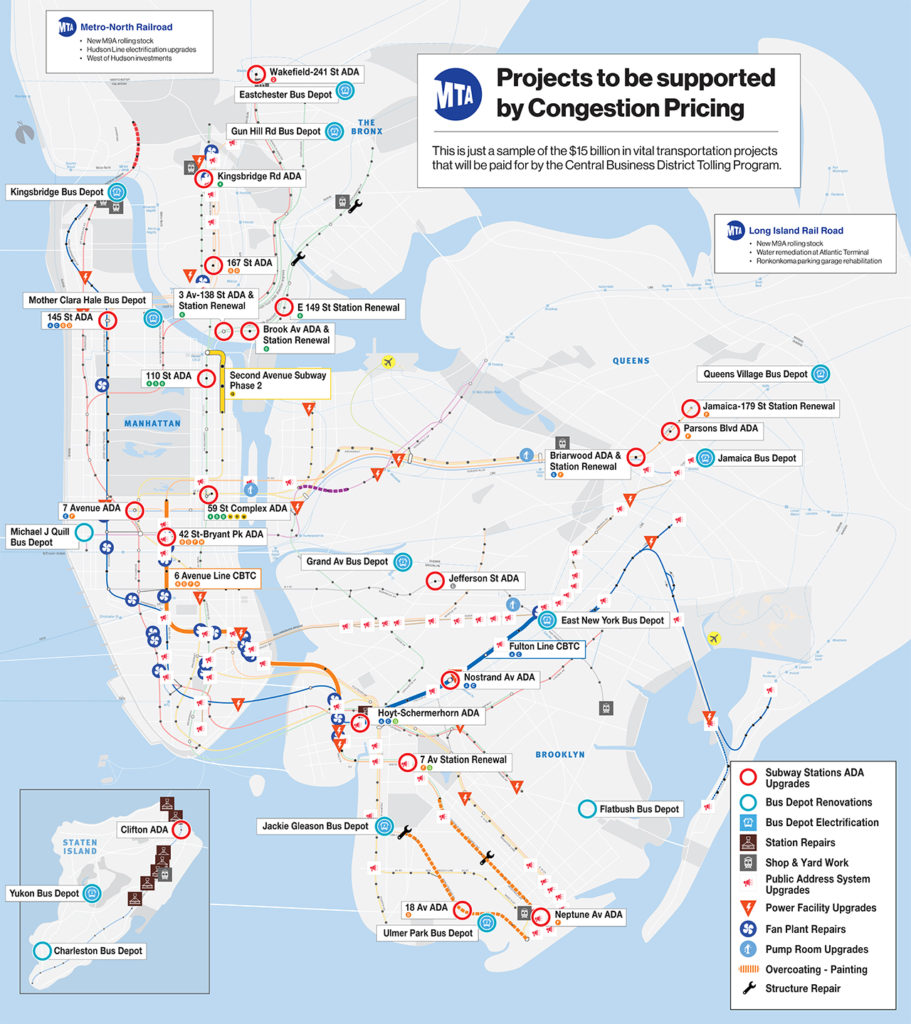
Reliability projects that have been postponed include $1 billion for purchases of new subway cars, new M9A cars for Metro-North and the Long Island Rail Road, new locomotives for the LIRR, and signal modernization on the NYCT Fulton Line in Brooklyn and the Sixth Avenue Line in Manhattan on the subways.
Twenty-four stations are slated for “Accessibility and Station Modernization” projects or “Station Renewals” in all five boroughs, including Clifton on the Staten Island Railway (SIR), a line between the St. George ferry terminal and Tottenville near the southern tip of the island, running along its east shore. (The SIR was originally owned and operated by the Baltimore & Ohio Railroad, and a ferry once ran between there and Perth Amboy, N.J., which is served by NJ Transit’s North Jersey Coast Line.) There are also several projects for bus depots, including preparations for electric buses.
The MTA also mentioned several State of Good Repair projects, and one subway expansion that has been in the plans for decades: “Future contracts to advance Second Avenue Subway Phase 2 rely on funding from congestion pricing. This project, long overdue for the residents and businesses of transit-dependent East Harlem, will create three brand-new accessible stations at 106th, 116th and 125th Streets and increase transit connectivity at the 125th Street station, with connections to Metro-North trains and M60 Select Bus Service to LaGuardia Airport.”
Capital Projects in Trouble
The release concluded with a warning of doom if the congestion pricing program is not implemented: “All the projects outlined are not only critical to New Yorkers, but for the thousands of workers and businesses that depend on these projects for their livelihoods. The capital program is estimated to support 57,400 jobs—23,000 of which are at risk. This has an impact on the economy at every level, especially for minority-owned, women-owned and federally designated disadvantaged businesses as well as businesses owned by veterans disabled in the line of service. Last year, the MTA paid $833 million across more than 500 different firms in these categories.”
Andrew Albert, head of the NYC Transit Riders Council and a rider-representative on the MTA Board, told Railway Age, “There are several things in the capital program that are now on hold that are very, very important: for instance, new Communications-Based Train Control (CBTC) signaling on the Fulton Street Line in Brooklyn and the Sixth Avenue Line in Manhattan. Without CBTC installed on the Sixth Avenue Line, all the work they did on Queens Boulevard and the Culver Line in Brooklyn [where the F train runs] will not be effective. Without the middle of the line signaled, you can’t utilize CBTC, because trains would catch up to other trains on the non-CBTC portion of the line.” Albert added that acquisitions of new subway and commuter railcars and electric buses are suspended. Phase II construction for the Second Avenue Subway, from 96th Street to 125th Street, is also now on hold.
Singular Exemption
One of the biggest challenges to the program comes from the United Federation of Teachers, who complained that public employees, including teachers in the city schools, will be required to pay the toll. The union’s request for an exemption was denied, as were many others from public employees. One of the few exemptions applies to vehicles carrying persons with disabilities. The Bridges and Tunnels division of the MTA issued a news release on the subject on Feb. 26 that noted only one vehicle would be exempted per person with a disability, as well as for organizational vehicles like paratransit vans that carry persons with disabilities.
MTA said, “The first plan, to be known as the Individual Disability Exemption Plan (IDEP), would enable people with disabilities to apply for the exemption for a vehicle they are registered to own or a vehicle they designate, such as that registered to a family member or caregiver” and “The second plan, known as the Organizational Disability Exemption Plan (ODEP), would enable public and private organizations that transport people with disabilities (such as Access-A-Ride or ambulette services) to apply to register so that their qualifying vehicles are exempt from the central business district toll.”
Access-A-Ride is the MTA’s version of paratransit, a mode designed specifically to carry riders whose disabilities render it difficult or impossible for them to use the city’s subways and fixed-route buses. Paratransit is required under the Americans with Disabilities Act (ADA), which also mandates access to transit, among many other provisions designed to assist persons with disabilities. Paratransit operations like Access-A-Ride use specially equipped vehicles that have spaces to secure wheelchairs and other accessibility features, and they run along or near existing transit lines at the times those lines run in revenue service. New Jersey Transit’s version of paratransit is called Access Link, and all major transit operations have a “complimentary paratransit” operation. There are limitations, though. For example, Access-A-Ride does not go to New Jersey, and Access Link does not go into New York.
The MTA quoted Chief Accessibility Officer Quemuel Arroyo as saying, “Based on feedback from the disability community and examples from other cities, we believe that the disability exemption program is a fair and equitable approach that meets the requirements of the law and serves the needs of people with disabilities.” MTA sources have given Arroyo high marks for pushing to make the city’s subway system more accessible, especially by modifying subway and elevated stations with elevators and other features that meet ADA standards. In an ironic twist, some of the contracts that have been placed on hold because the congestion pricing has not yet been implemented call for installing accessibility features at some of those stations.
Albert also mentioned efforts to make more stations accessible. He said that the MTA recently settled a lawsuit brought by advocates for persons with disabilities that calls for making 95% of the system’s subway and elevated stations accessible. “That’s on hold and would cost billions, too” he said.
“Now or Never”?
While the proponents of the congestion pricing plan expect the courts to allow it to be implemented, there is always some likelihood that a judge or a panel of judges will rule the other way. Albert reportedthat he asked MTA Board Chair and CEO Janno Lieber at the end of the last Board meeting if he has a “Plan B” if the court does not approve the plan. He said that Lieber replied: “There is no ‘Plan B.’”
Hearings were held on the plan at the end of February and the beginning of March. According to Albert: “Public comments were 60% in favor and 40% against. Most of the comments in opposition wanted more exemptions or had something to say about the pricing.” He also made it clear that “the vast majority of people who come to the Central Business District come into the area on transit.”
Meanwhile, the tide might be turning against the plan, as opposition appears to be growing. This trend was reported in the March 21 edition of the New York Times by Winnie Wu and Anna Ley, in a story headlined As Congestion Pricing Nears Reality, it Faces Growing Opposition. Wu and Ley highlighted the legal and political battles associated with the initiative. They reported that a settlement conference on March 13 failed to produce an agreement that would settle the litigation, “while lawmakers on both sides of the aisle in Albany have put forth proposals to repeal congestion pricing or carve out exemptions.” They reported that TV talk show host Whoopi Goldberg complained to Gov. Kathy Hochul about it, too, saying that she had friends who couldn’t afford the toll.
In an opinion piece that appeared in the New York Post on March 11 titled Yes, I approved congestion pricing but it’s time to hit the brakes, former New York Gov. Andrew Cuomo acknowledged that charging the toll is “designed to incentivize people to use mass transit” but also said, “However, many things have changed since 2019 and while it is the right public policy, we must seriously consider if now is the right time to enact it … New York City still hasn’t recovered from COVID; office occupancy is still at only 48.9%. For many, traveling to the city is no longer a necessity—and for some it is an unwelcome hardship. What impact will an additional $15 entry surcharge have on New York City’s recovery in this moment—when the migrant crisis, crime, homelessness, quality of life and taxes are all pressing problems?” He also expressed concern that people might not be confident to ride the system because many consider it unsafe. He noted that ridership is now 29% below pre-pandemic levels.
We don’t know how much the increasing opposition to the plan will matter in the long run, but it seems highly unlikely that the tolls will be implemented any time soon, with so many complex court cases pending. We will consider the question “Where do we go from here?” in the next article in this series.