Anecdotes Are Not Data
Let’s resume where I left off, moving right along, next up: The NPRM intends to amend section 236.1029, PTC System Use and Failures. The provisions authorizing “temporary exceptions” to the prohibition on
“We”—old timers, old heads, just plain old—sometimes refer to ourselves as “fossils,” but we’re not really. Fossils, as far as “we” know, can’t think, change positions, make jokes, whine, or delude themselves
The Federal Railroad Administration (FRA) on Oct. 25 published a notice of proposed rulemaking (NPRM) to amend certain regulations on Positive Train Control (PTC) systems.
Safety is the principal driver of FRA RD&T. With that in mind, Dr. Maryam Allahyar Wyrick—Director of the Office of Research, Development and Technology (RD&T) at the Federal Railroad Administration—joins Railway Age
Railway Age’s Next-Gen Train Control (NGTC) Conference—presented jointly with Parsons—will bring together communications and signaling professionals from across North America to explore the most recent industry projects and the future of the
The National Transportation Safety Board (NTSB) is calling on the Federal Railroad Administration (FRA) to formulate a plan to “incorporate promising new [Positive Train Control (PTC)] technology into the existing system that
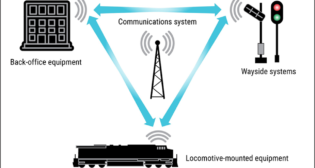
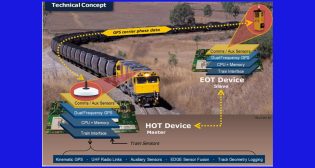
The ability to precisely locate and track train movement on the rail network is the cornerstone of modern train control systems. The Interoperable Electronic Train Management System (I-ETMS) and Positive Train Control (PTC) systems currently used by Class I railroads, operational on approximately 54,000 route-miles, rely on the Global Positioning System (GPS) to identify the location of the train lead locomotive, crew-entered track information, and switch position. The location of the rear of the train is then derived from the location of the lead locomotive using the train length, typically provided by the railroad’s management information systems (MIS) and confirmed or updated by the locomotive engineer.
We, the railroads, have established certain principles of safe train operations that we wish were absolute, positive, inviolable. We apply one such principle in the enforcement of train separation: the principle that
Effective Aug. 26, 2021, the Federal Railroad Administration is revising regulations governing changes to Positive Train Control (PTC) systems and reporting on PTC system performance.
New Jersey Transit met the December 31, 2020 federally mandated deadline for implementing Positive Train Control. NJT President and CEO Kevin Corbett discusses the project’s complexity, and the “come from behind” coordination