Lac-Mégantic

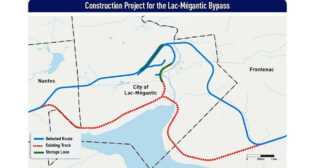
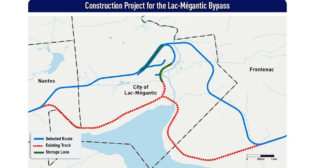
The graphic shows the map of the route for the future bypass at Lac-Mégantic, which will go through the municipalities of Nantes, Lac-Mégantic, and Frontenac. The blue line shows the chosen route; the red line shows the route of the existing track which will be dismantled following the commissioning of the bypass; and the green line shows the sector of the Lac-Mégantic industrial park where car triage and storage activities will take place. (Map and caption courtesy of the government of Canada)

Lac-Mégantic Rail Bypass Project Advances

More than 12 years after the crude oil train wreck at Lac-Mégantic, Quebec, that claimed 47 lives and led to new tank car regulations in Canada and the U.S., the Canadian Transportation Agency (CTA) has now received the official application to build a 7.75-mile (12.5-km) rail bypass around the village. According to the government of Canada, this allows the project to move into the assessment phase.
  • News

Lac-Mégantic Bypass Work Continues

Nine years after the July 13, 2013 crude oil train runaway wreck at Lac-Mégantic, Quebec that claimed 47 lives and destroyed much of the village’s downtown, the Government of Canada and Transport Canada continue preliminary work on building a bypass rail line.

Bypass Build Slated for Lac-Mégantic

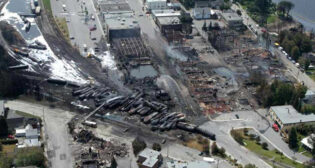
Few will forget that horrific day, July 6, 2013, when a crewless, runaway Montreal, Maine & Atlantic crude oil train with five locomotives and 75 loaded DOT-111 tank cars carrying volatile Bakken crude rolled into Lac-Mégantic, Quebec and derailed. The resulting fireballs and explosions (contrary to popular belief, the derailed cars did not explode; their contents ignited after the tanks had been breached) killed 47 people, and a large section of the downtown area was destroyed. The tragedy’s aftermath, as well as accidents involving other CBR trains in the U.S. and Canada, led to a long regulatory process resulting in the stronger DOT 117 tank car as well as several changes to CBR operating regulations.