

Grade Crossing Improvements Discussed at Rail Subcommittee Hearing
Four witnesses on Jan. 18 discussed improving safety at highway-rail grade crossings at a hearing of the Subcommittee on Railroads, Pipelines, and Hazardous Materials.
Four witnesses on Jan. 18 discussed improving safety at highway-rail grade crossings at a hearing of the Subcommittee on Railroads, Pipelines, and Hazardous Materials.

Duos Technologies Group, Inc. (Duos) announced Jan. 17 that it has secured a three-year agreement with a leading Class I railroad for advanced AI-Based Defect Detection models into its day-to-day operations, as
The American Public Transportation Association (APTA) is urging the House and Senate Transportation, Housing and Urban Development (THUD) Appropriations Committee leaders “to resolve their differences and provide the critical investments needed to improve our nation’s public transit, passenger rail, and multimodal infrastructure.”
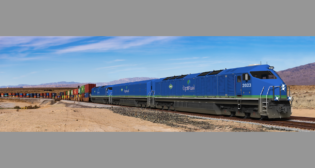
OptiFuel Systems (OptiFuel) announced Jan. 11 that it will begin testing a 5600 hp Total-Zero™ Renewable Natural Gas (RNG) Line Haul Locomotive and 2500 hp Total-Zero™ Powered Tender with 7,500 DGE (diesel gallon equivalent) capacity, in January 2025.
The California High-Speed Rail Authority (CHSRA) on Dec. 27 celebrated “a year of progress” with a video retrospective of its top 10 milestones.
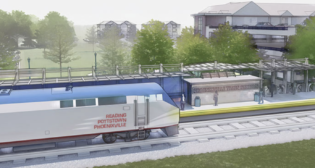
Schuylkill River Passenger Rail Authority (SRPRA) in Pennsylvania selects a consultant to prepare a Reading-Philadelphia service development plan. Also, Santa Clara Valley Transportation Authority (SCVTA) closes on a $23.8-million land purchase near Diridon Station in San Jose, Calif.; and Washington Metropolitan Area Transit Authority (WMATA) eliminates the $2 SmarTrip fare payment card fee for seniors.
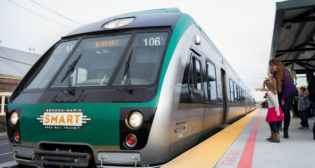
The Sonoma-Marin Area Rail Transit District (SMART) announced Dec. 18 that its east-west rail corridor, connecting the City of Novato to Suisun City, has been designated for inclusion under the Federal Railroad Administration (FRA) Corridor Identification and Development (Corridor ID) program.
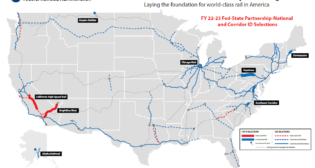
The Federal Railroad Administration (FRA) on Dec. 8 announced that it has awarded $8.2 billion for 10 passenger rail projects across the country while announcing corridor planning activities that will “impact every region nationwide.”

ASLRRA PERSPECTIVE, RAILWAY AGE DECEMBER 2023 ISSUE: The story of “The Little Engine That Could” began as an American folktale popularized by various authors in the 1900s. An early published version of the tale appeared in 1906 under the title “Thinking One Can” in Wellspring for Young People, a national Sunday School Publication. A subsequent version was published in 1910 in the Kindergarten Review under the title “The Pony Engine.” In 1930, the story became widely known under the title “The Little Engine That Could” after a Chicago publishing house released it as an illustrated children’s book that was used in schools to teach children the value of optimism and hard work.
The Volkswagen (VW) Environmental Mitigation Trust for California has approximately $55 million in funding available to support “statewide combustion freight and marine projects that replace or repower equipment to the cleanest commercially available internal combustion, hybrid or zero emission technologies,” the American Short Line and Regional Railroad Association (ASLRRA) reported in its Nov. 30 Views & News newsletter.