


Shippers, Small Roads Weigh In on CN-IANR Merger Proposal
Written by Marybeth Luczak, Executive Editor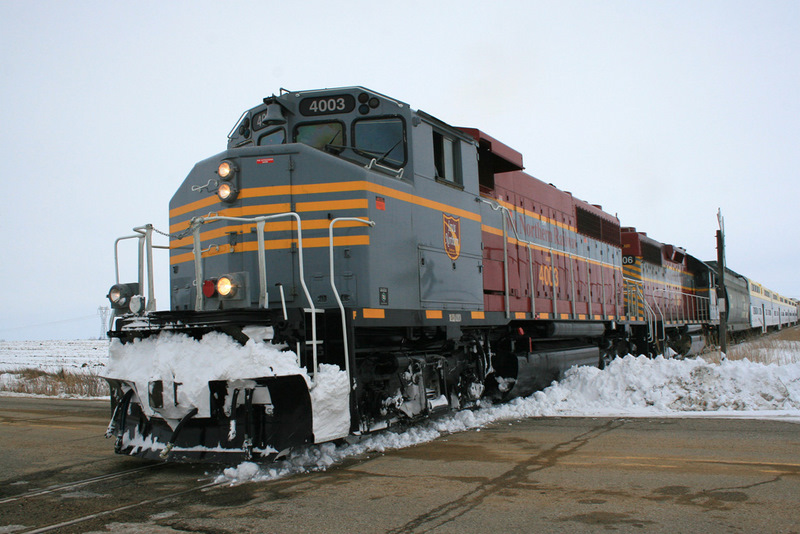
(IANR Photograph)
Class III D&I Railroad (D&I) in northwest Iowa and southeast South Dakota, plus two long-time CN customers have submitted letters of support for the Canadian Class I’s application to the Surface Transportation Board (STB) to acquire control of U.S. regional Iowa Northern Railway (IANR). Additionally, Iowa Interstate Railroad (IAIS) is calling on the Board to evaluate the proposed merger as a “significant” transaction.
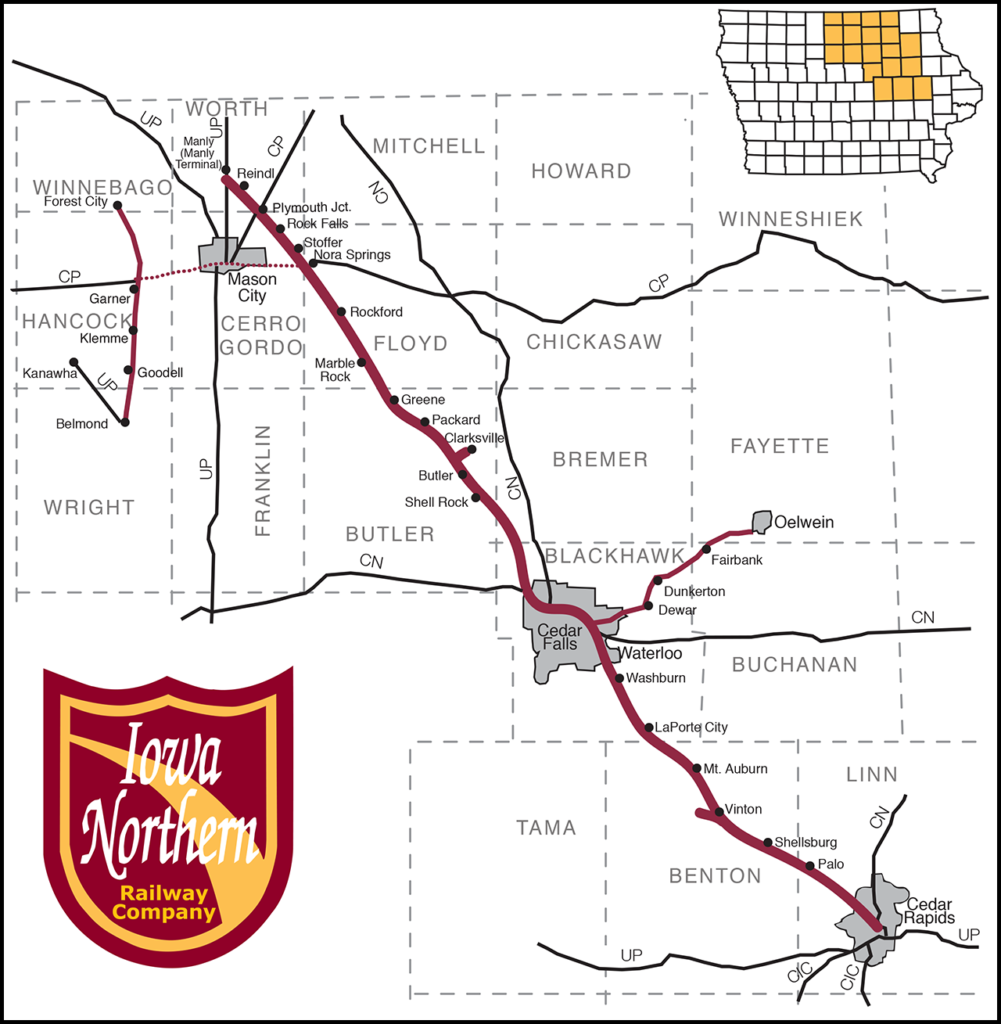
CN on Dec. 6 signed and closed an agreement to acquire IANR, an approximately 275-mile Class II (see map above) that it interchanges with in Waterloo and Cedar Rapids. Terms were not disclosed.
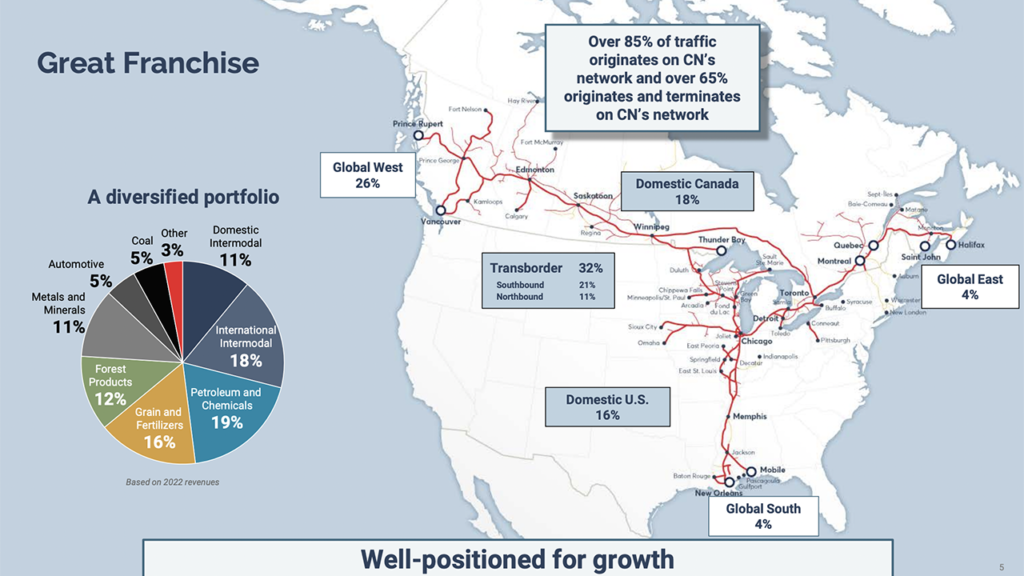
According to CN, which filed its application with the STB on Jan. 30, the transaction “represents a meaningful opportunity to support the growth of local business by creating single-line service to North American destinations, while preserving access to existing carrier options.” The transaction closed into an independent voting trust pending regulatory review by the STB, which announced upon accepting the application that it will issue a final decision no later than July 26, 2024.
D&I Railroad
D&I General Manager Scott Van Den Top, in a letter dated Feb. 7 (scroll down to download), told the STB that he supported the CN-IANR combination and encouraged the federal agency “to do the same by approving it.” The approximately 138-mile D&I interchanges with CN in Sioux City, Iowa, “and works well with CN today,” he said. According to Van Den Top, the merger “will have a positive impact on Iowa’s railway network and freight customers for years to come” and “has the potential to produce new opportunities and important synergies within Iowa’s transportation industry that come when a national rail carrier emphasizes local operations and service to customers.”
D&I transports a variety of products, including ethanol, dried distiller grains (DDGs), rock, and other industrial- and agriculture-related products. “The transactions emphasis on promoting resilience in critical supply chains, such as food products and biofuels, means more opportunities for D&I customers to reach new markets across the rail network and better access to existing markets here in Iowa,” Van Den Top explained. “I am confident that this combination will be a growth engine for Iowa’s communities, economy, and transportation industry.”
NEW Cooperative, Inc.
Dan Dix, CEO of Fort Dodge, Iowa-based NEW Cooperative, Inc., also wrote a letter of support (scroll down to download). In the Feb. 27 letter, he Dix said his company appreciates “CN’s focus on reliable service, which is consistent with Iowa Northern’s approach,” and reported that his “business will benefit from the more efficient single-line service available and connecting points on Iowa Northern to greater access to CN’s broad network and service offerings, without losing Iowa Northern’s access [to] other rail carriers.” Dix concluded by calling on the STB to approve the merger “for the benefit of companies like mine and those we serve.”
Viterra Canada
Another long-time CN customer, Viterra Canada, is also backing the merger proposal. Kyle Jeworski, CEO of the Canadian grain handler and marketer that ships several types of grains, oilseeds, and pulses through CN annually, wrote a letter of support dated Feb. 27. “CN’s acquisition of Iowa Northern would create additional opportunities for our company in milling grains, ethanol by-products, oats, and corn,” he reported. “[W]e anticipate more efficient transits through direct service as opposed to hand offs to servicing carrier[s]. Expanded single-line rail service has a significant impact on the success of our supply chains and ultimately the success of our industry. At Viterra, we rely substantially on our supply chain partners, including rail carriers, and I look forward to partnering with and utilizing CN’s expanded rail service moving forward. I appreciate the certainty that CN’s investment will bring to ensure that Iowa Northern can continue offering safe and reliable local service to customers.”
IAIS
In a March 1 filing (scroll down to download), the approximately 560-mile regional IAIS wrote that it “respectfully submits that the Board committed material error in … making a determination that Canadian National Railway Company’s and Grand Trunk Corporation’s (together ‘CN’) proposed acquisition of Iowa Northern Railway Company (‘IANR’) is a ‘minor’ transaction under 49 U.S.C. § 11325 and the Board’s rail merger and acquisition rules at 49 C.F.R. § 1180.2(b), without giving any regard to CPKC’s February 26, 2024, Comment on Proposed Classification of Transaction (‘Comment’) demonstrating that the proposed acquisition should be evaluated as a ‘significant’ transaction.”
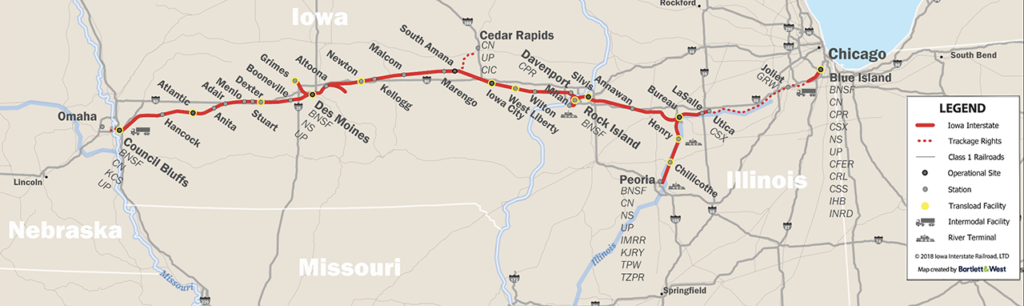
The regional’s attorneys reported that in addition to Council Bluffs and Chicago, IAIS maintains interchange connections with Class I railroads at Des Moines, Iowa City, and Davenport, Iowa, and at Rock Island, Peoria, and Utica, Ill. (see map above). Through a number of interchange points, IAIS has connections with and handles freight traffic in conjunction with all Class I railroads, as well as several short lines and regionals. Of particular significance, they said, IAIS has an interchange arrangement with the Cedar Rapids and Iowa City Railroad (CIC) at Cedar Rapids, Iowa, through which IAIS moves shipments of ethanol, denatured alcohol and agricultural commodities originating on the IANR to Chicago and (via subsequent interchange) to points beyond. IAIS competes with CN for this traffic, they reported, and the “IANR-CIC-IAIS routing provides a number of Iowa shippers with a competitive alternative to an IANR-CN haul. The importance of maintaining this alternative on an effective competitive basis establishes IAIS’s interest in this proceeding.”
According to the IAIS attorneys, the STB’s “merger rules provide that a proposed transaction can be evaluated as ‘minor’ only if (1) the transaction clearly will not have any anticompetitive effects, or (2) the anticompetitive effects clearly will be outweighed by the transaction’s contribution to the public interest in meeting significant transportation needs. 49 C.F.R. § 1180.2(b) (emphasis added).” They pointed out that a “transaction not involving the control or merger of two or more Class I railroads is to be classified as ‘significant’ if neither of these determinations can be made … While CN made a series of broad statements in its application to the effect that the transaction ‘will preserve transportation for Iowa Northern customers … and ‘clearly will not have any anticompetitive effects’ … CN provided no detailed evidence-based explanation of why this would be so, or the steps that CN would take post-transaction to ensure such an outcome. In its Comment, CPKC explained in considerable detail how the transaction would threaten the horizontal competition that currently is represented by parallel CN and IANR lines through Iowa, and catalogued the numerous shipper facilities presently accessible to both carriers that would lose these alternatives if the transaction is approved as proposed.” Such “horizontal impacts” are not addressed in the CN application, the attorneys said.
Additionally, CN’s application “failed to address the vertical impacts of its acquisition of IANR in a manner sufficient to ‘clearly’ establish no adverse effects on competition,” the attorneys wrote. “As the Board most recently held in its decision approving the creation of CPKC [Canadian Pacific Kansas City], ‘[t]these adverse impacts may arise where, as here, a carrier that once provided neutral access to multiple competing railroads is then acquired by one of those competitors and has an incentive post-merger to favor its own new single-line routing over interline alternatives. . . . Accordingly, the Board has expressly rejected the presumption—applied in some prior Board proceedings—that a vertical combination will not result in competitive harm.”
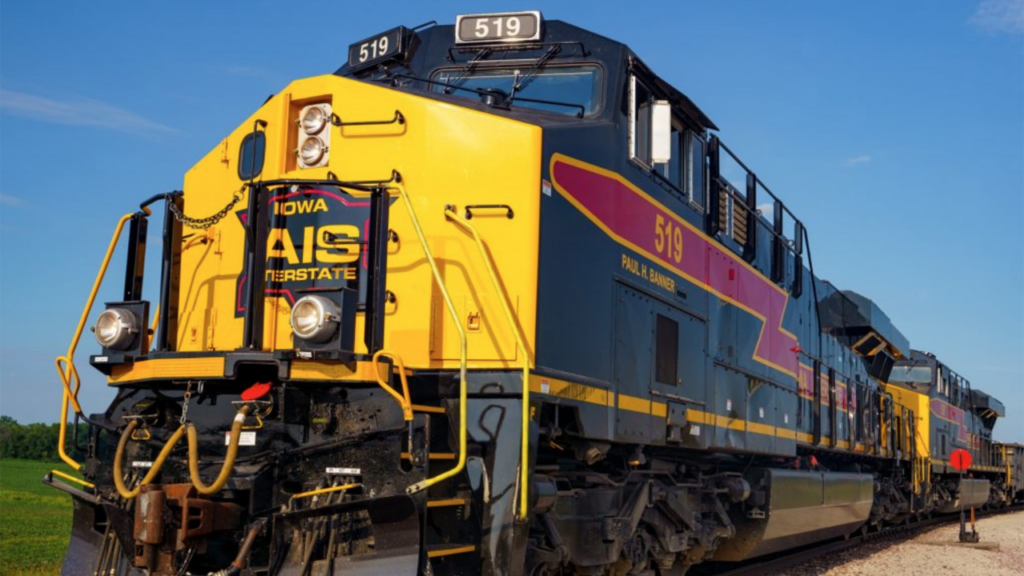
The attorneys reported that IAIS competes with CN for shippers’ traffic originating on IANR that moves to Chicago and other points East, via its interchange arrangement with CIC. “As part of its application, CN presented a traffic diversion study sponsored by its witness David Hunt, which projected the post-transaction shifting of 10,503 carloads of different commodities—including ethanol and denatured alcohol—from other rail carriers to a new single-line IANR-CN route … When his analytical model showed a diversion opportunity for IANR-CN, he assumed that 100% of the subject traffic would divert … According to Mr. Hunt’s workpapers, a substantial percentage of overall diversions would come at the expense of IAIS, and the involved shippers would stand to lose this competitive alternative. In its Comment, CPKC showed that nothing in the proffered post-transaction operating plan demonstrated any new operating efficiencies or other service improvements that would support these significant diversions … The logical inference to draw from this evidentiary deficiency is that the rail-to-rail diversions projected by Mr. Hunt would be the result of post-transaction CN pricing decisions on the former IANR lines, the very type of adverse vertical impacts that the Board in the CPKC Decision found to be evidence of ‘competitive harm’ … Certainly, such an obvious threatened impact contradicts the notion that the proposed transaction ‘clearly will not have any anticompetitive effects.’”
The attorney’s for IAIS concluded that the STB should “reclassify CN’s proposed acquisition of IANR as a ‘significant’ transaction under 49 C.F.R. § 1180.2(b), direct CN to supplement its application as required by the applicable regulations, and modify the procedural schedule for this docket accordingly.”
In the STB’s Feb. 29 decision to accept the CN-IANR merger application for consideration (scroll down to download), it explained why it found the transaction to be “minor” under 49 CFR 1180.2(c). According to the agency, “it appears from the face of the application that the efficiency and other public interest benefits would clearly outweigh whatever anticompetitive effects may exist.” The STB wrote that, “[a]s discussed in the application, Iowa Northern shippers could benefit from operational efficiencies and access to markets through single-line service on the combined CN-Iowa Northern system … The Proposed Transaction, if approved and implemented, could also provide a firm financial foundation for a combined CN-Iowa Northern to provide safe, reliable local service to customers in Iowa … In addition, Iowa Northern customers could benefit from access to a broader range of railroad equipment and improved equipment utilization.”
The STB also wrote that the proposed transaction “does not appear to pose any significant anticompetitive effects.” The application, it said, “indicates that the proposed transaction would not result in any two-to-one customer stations (although, as applicants acknowledge, there are three potential three-to-two customer stations).” Additionally, it said, “CN has made a gateway commitment to ensure that Iowa Northern customers would continue to have access to interline options on commercially reasonable terms … Specifically, CN represents that it ‘will commit to the Board and to Iowa Northern customers that, if the proposed transaction is approved, CN would provide Iowa Northern-served customers with commercially reasonable rates and service for interline traffic with rail carriers other than CN,’ and that such commitment would apply equally both to traffic that originates and terminates on Iowa Northern’s lines.” According to the STB, CN has also “committed to maintain existing carrier access to locations in current CN and Iowa Northern voluntary reciprocal switch tariffs.” For these reasons, it said, “based on the information provided in the application, the Board finds the Proposed Transaction to be a minor transaction under 49 CFR 1180.2(c).” The STB emphasized, however, “that this is not a final determination and may be rebutted by subsequent filings and evidence submitted into the record for this proceeding.” The agency also said that its determination “should not be read to mean that the proposed transaction is insignificant or of little importance,” as after the record is fully developed, “the Board will conduct a careful review before making a final determination as to whether the Proposed Transaction would substantially lessen competition, create a monopoly, or restrain trade, and whether any anticompetitive effects would be outweighed by the public interest … The Board may also consider imposing conditions on the Proposed Transaction.”
DOWNLOAD STB DECISION, ACCEPTING CN-IANR MERGER APPLICATION FOR CONSIDERATION:
DOWNLOAD D&I RAILROAD, NEW COOPERATIVE, VITERRA CANADA LETTERS:
DOWNLOAD IAIS FILING WITH THE STB:
For more on IANR, read “Maintaining Laser Focus” in Railway Track & Structures, a Railway Age sister publication.


