


Commentary
CARB’s Unattainable Rail Mandate
Written by Frank N. Wilner, Capitol Hill Contributing Editor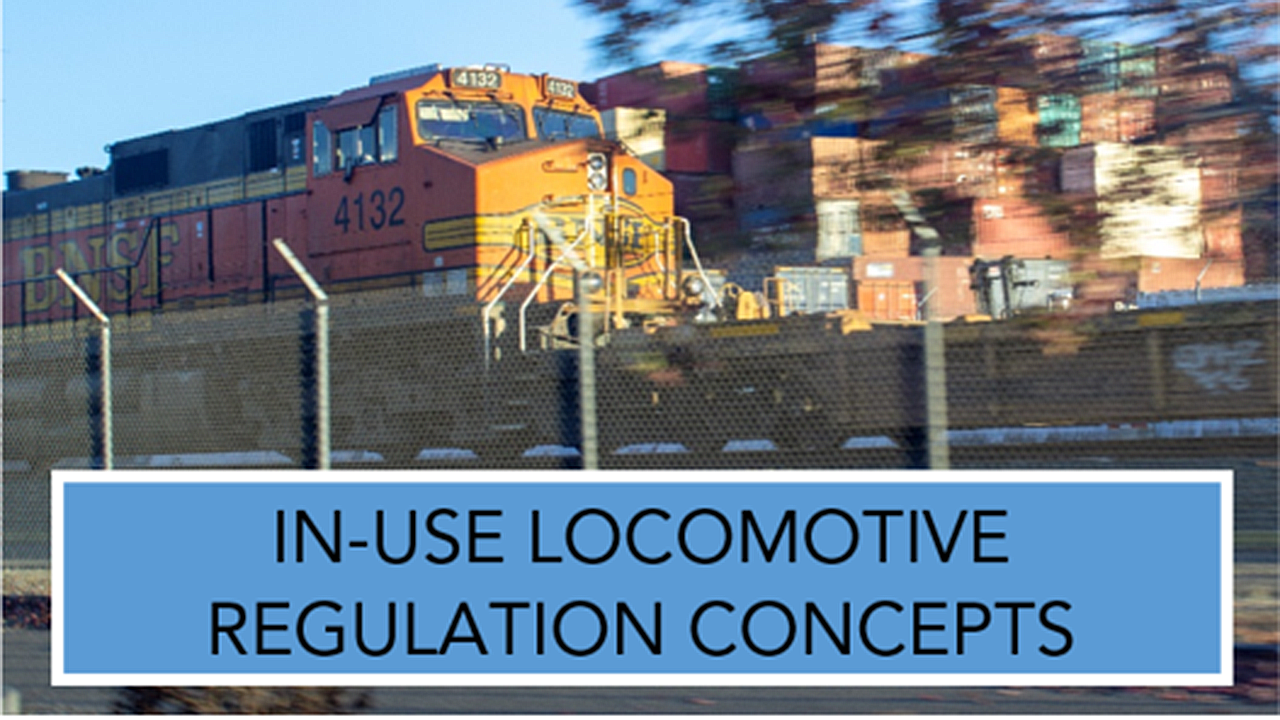
CARB Environmental Justice Blog photo.
WATCHING WASHINGTON, RAILWAY AGE JUNE 2024 ISSUE: One would think California’s housing cost crisis, soaring energy prices, hundreds of companies relocating and a population exodus would induce greater regard for benefits and costs when formulating public policy. Not so the California Air Resources Board (CARB) that seeks to impose on railroads a regulatory burden whose CARB-estimated costs could exceed $13 billion, adversely impact productivity and market growth, and fail to deliver advertised benefits.
CARB is asking the federal Environmental Protection Agency (EPA) for authority to function as a de facto nationwide railroad regulator. It seeks a mandatory scrapping—beginning in six years—of in-state operated locomotives more than 23 years old and their replacement with zero-emissions propulsion such as hydrogen fuel cells or batteries.
Yet neither is available commercially for broad deployment. Prematurely locking railroads into unproven technology will retard incremental innovation and discourage experimentation with alternative fuels, as locomotives are long-lived assets.
Worse, while the CARB rule pretends to govern only locomotives operating in California, it ignores that rail operations are interstate—that locomotives are interchanged among railroads and traverse wide geographic areas. This is why the U.S. Surface Transportation Board (STB) holds exclusive congressional authority to prevent a patchwork of inconsistent state regulations from impeding the flow of rolling stock, locomotives and goods across state lines
Where there is “apparent conflict” among laws—such as between the Environmental Protection Act and Interstate Commerce Act—the 9th Circuit Court of Appeals held that efforts must be made to harmonize them. But as CARB seeks to usurp STB authority in a way that would impede interstate commerce, harmonization is unlikely. Railroads are asking a federal court to shut the door on CARB.
While CARB’s desire to improve air quality is admirable, it is aspirational, but the cost to railroads of a mandate to embrace unproven technology is real, immediate, extraordinarily high and not in the public interest.
Beyond the premature sending to scrap yards of thousands of economically efficient in-service locomotives, the CARB rule would impose on railroads, in the interim, a costly duty to record idling time and fuel usage, plus calculate, as if railroads are scientific institutions, the harm to California residents from fossil fuel emissions of yet-unscraped locomotives.
The CARB rule also assesses a tax on all non-zero emissions locomotives operated in California during the transition period. Those state-collected dollars will later be directed by CARB toward purchase of CARB-preferred locomotives, giving the agency partial authority over railroad capital spending decisions. BNSF and Union Pacific estimate their combined tax at $1.4 billion annually.
Should the EPA grant CARB the authority sought, other states could write conflicting rules, creating the very inconsistent patchwork of commerce-impeding state regulation the Interstate Commerce Act is intended to prevent.
Significantly, the CARB rule could put short lines—most operating on thin margins and lacking market power to raise rates—out of business. California’s Sierra Northern Railway CEO Kennan H. Beard III says all 36 of his locomotives must be scrapped under the CARB rule, that battery power is currently impractical, and prototype hydrogen fuel cell power, while showing “a promising future,” is unaffordable at $7 million.
Larger railroads would lose incentive to grow market share as they cannot shift to their mostly price-sensitive freight the CARB-induced higher costs, lest freight migrate to less safe and environmentally more damaging trucks, whose carbon dioxide emissions, says EPA, are 10 times those of locomotives.
While CARB says it will mandate zero emissions for big trucks, that technology also is problematic, with the cost unaffordable for most fleets and owner-operators. Forecast operating costs also are high, given limited mileage per charge, charging-time delays, and battery weight that accelerates tire wear and reduces payload. Other concerns are electricity grid capacity and highway charging station availability.
“Zero-emissions locomotives will easily exceed $5 million per unit, making CARB’s authoritarian locomotive policies economically infeasible,” says railroad equipment finance expert, Railroad Financial Corp. President and Railway Age Financial Editor David Nahass.
For a rail industry whose carbon footprint already is lowest among modes, and which is voluntarily spending to reduce it further through creative and competitive innovation, CARB’s inflexible rule is arbitrary, capricious, counter-productive and an interstate commerce-impeding tax.
Wilner’s new book, Railroads & Economic Regulation, is available from Simmons-Boardman Books at www.railwayeducationalbureau.com, 800-228-9670.


