


Calif. State Budget Proposal Includes $19.6B in Transportation Funding
Written by Carolina Worrell, Senior Editor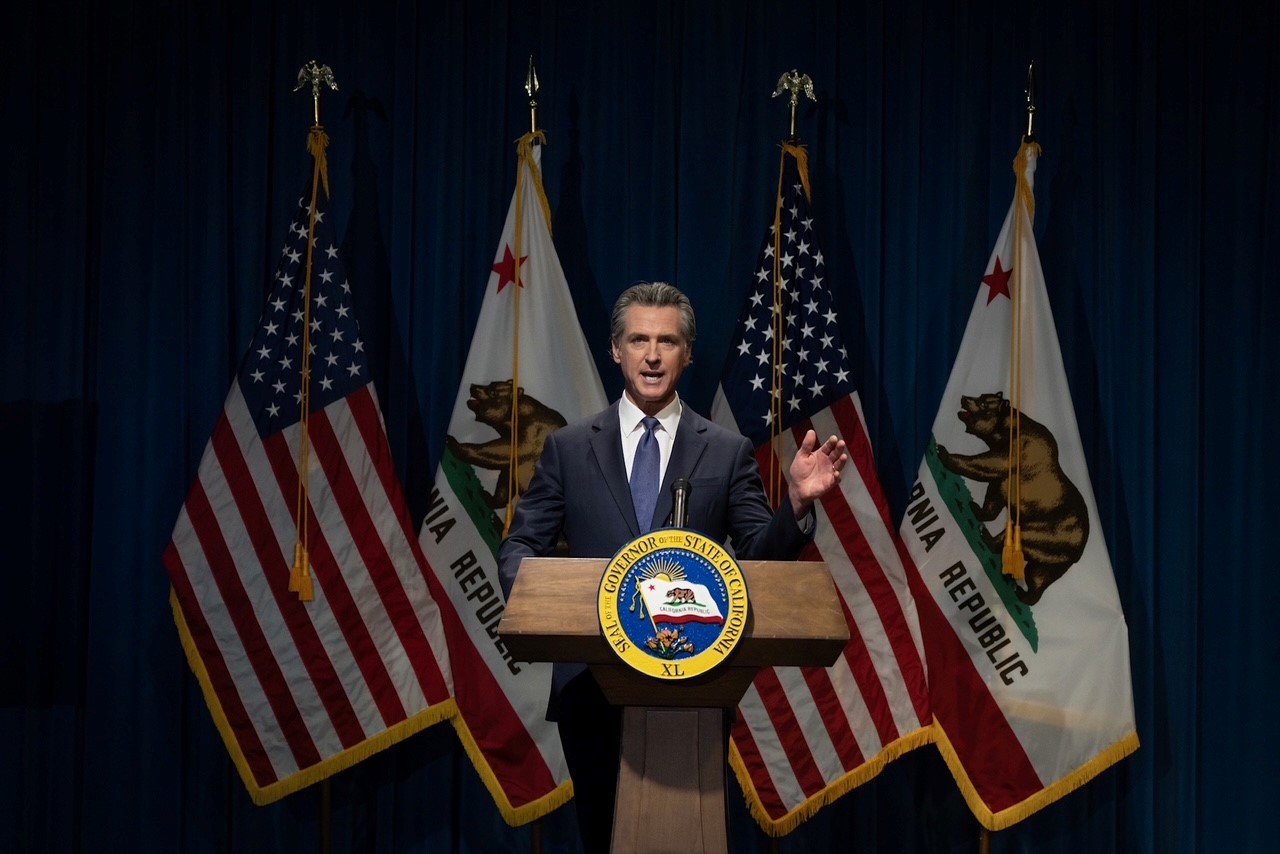
California Gov. Gavin Newsom on Jan. 10 introduced his $291 billion 2024-25 state budget proposal, which includes an investment of $19.6 billion in transportation funding and closes a projected $37.86 billion shortfall.
The budget (download below) proposes adjustments to transportation infrastructure to account for a reduction in forecasted general fund revenue and includes a reduction of $1.1 billion General Fund, partially offset by $791 million of Greenhouse Gas Reduction Fund, for a net reduction of $200 million. These adjustments will maintain a total of $15.9 billion of the $16.1 billion in recent one-time transportation investments, including:
- “$7.7 billion for high-priority transit and rail infrastructure projects that will improve rail and transit connectivity between state and local/regional services that are designed to reduce traffic congestion and greenhouse gas production.
- “$4.2 billion Proposition 1A for the High-Speed Rail Authority to continue building the 119-mile Central Valley Segment from Madera to just north of Bakersfield.
- “$1.2 billion for projects that improve goods movement on rail and roadways at port terminals, including railyard expansions, new bridges, and zero-emission modernization projects.
- “$350 million for grade separation projects that support critical safety improvements and expedite the movement of traffic and rail by separating the vehicle roadway from the rail tracks.”
To address the projected budget shortfall, the budget proposes general fund solutions to achieve a balanced budget. These include $296 million of general fund reductions, $791 million in fund shifts, and $3.2 billion in delays across various programs.
Active Transportation:
- “A $200 million reduction, leaving the Active Transportation Program (ATP) with $850 million of the $1 billion originally included as part of recent one-time transportation investments. To ensure no impact to previously awarded projects, $200 million of ATP funding that was expected to be available for allocation in future cycles will instead be used to backfill the projects awarded in Cycle 6 of ATP.
- “A $400 million delay from 2021-22 to align the budget with expenditure schedules. This will not have a programmatic impact.”
Competitive Transit and Intercity Rail Capital Program:
- “A delay of $2.1 billion from 2021-22 to as late as 2027-28 to align the budget with expenditure schedules. This will not have a programmatic impact.
- “A shift of $530 million from the General Fund to the Greenhouse Gas Reduction Fund. This will not have a programmatic impact.”
Formula Transit and Intercity Rail Capital Program:
- “A delay of $1 billion from 2024-25 to 2025-26.
- “A shift of $261 million from the General Fund to the Greenhouse Gas Reduction Fund. This will not have a programmatic impact.”
Port and Freight Infrastructure Program:
- “A delay of $100 million General Fund from 2021-22 to align the budget with expenditure schedules. This will not have a programmatic impact.”
Port of Oakland
- “A reduction of $96 million from 2021-22 leaves $184 million General Fund for Port of Oakland improvements.”
Despite the downward revision, the Office of the Governor says 2022-23 revenues are estimated to still be 23% higher than pre-pandemic levels. California’s GDP remained strong in 2023, and the state’s big three revenues are projected to return to levels consistent with a normal revenue growth trajectory.
Even after the proposed withdrawals, the budget plan reflects $18.4 billion in total budgetary reserves, including $11.1 billion in the Rainy Day Fund.
“Thanks to the record reserves we have built up and a commitment to fiscal discipline over the years, our state is in a strong position to close this shortfall while protecting key priorities and programs that millions of Californians rely on,” said Gov. Newsom. “This balanced budget plan keeps California on firm economic footing while continuing our work to tackle homelessness, keep communities safe, expand access to high-quality education, overhaul behavioral health care and fight climate change. I look forward to partnering with the Legislature to meet this moment with a balanced approach that meets the needs of Californians and safeguards our state’s future.”


