Transit Briefs: OC Transpo, UTA, Detroit People Mover/TTC, Caltrain
Written by Carolina Worrell, Senior Editor
(OC Transpo)
OC Transpo provides a progress update on all three O-Train extensions and an overview of efforts under way to improve the service reliability of O-Train Line 1. Also, the Utah Transit Authority (UTA) plans to extend FrontRunner train service to Payson; the Detroit People Mover will receive new railcars from the Toronto Transit Commission (TTC); and Caltrain runs eight trains simultaneously on its newly completed corridor.
OC Transpo
On May 31, OC Transpo provided a progress update on all three O-Train extensions and an overview of efforts under way to improve the service reliability of O-Train Line 1 to a joint meeting of the Transit Commission and Light Rail Sub-Committee.
O-Train East Extension
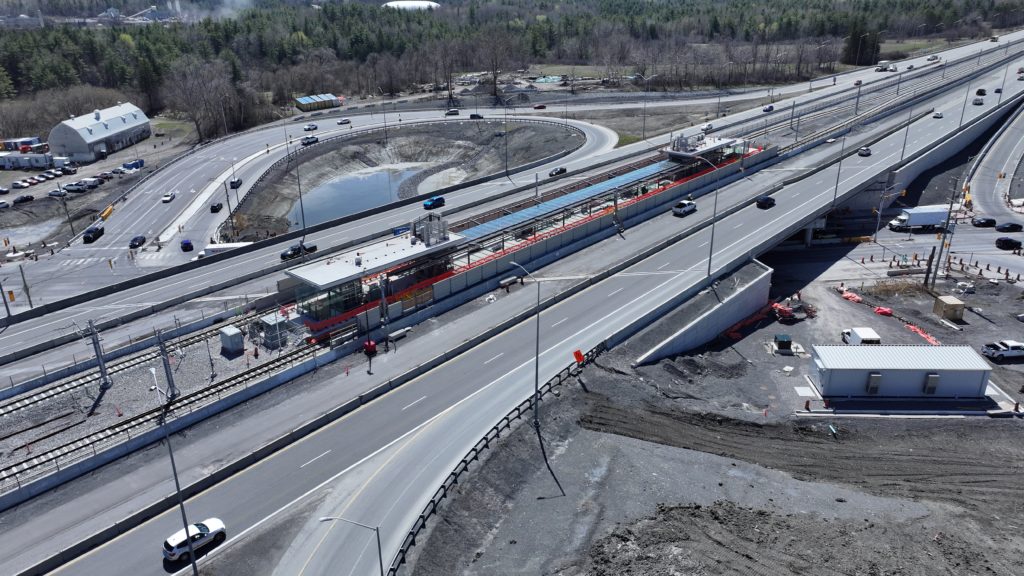
Progress on the O-Train East extension “continues to be impressive,” with construction advancing on all five transit stations, according to OC Transpo. Through the rest of the year, roadwork to complete final works on Highway 174 will continue requiring intermittent closures.
Residents in the east-end are also going to see a lot more trains running along the track as testing will expand over the course of the year. Testing has also begun of the Overhead Catenary System (OCS), power and train control equipment near Montréal Station.
O-Train West Extension
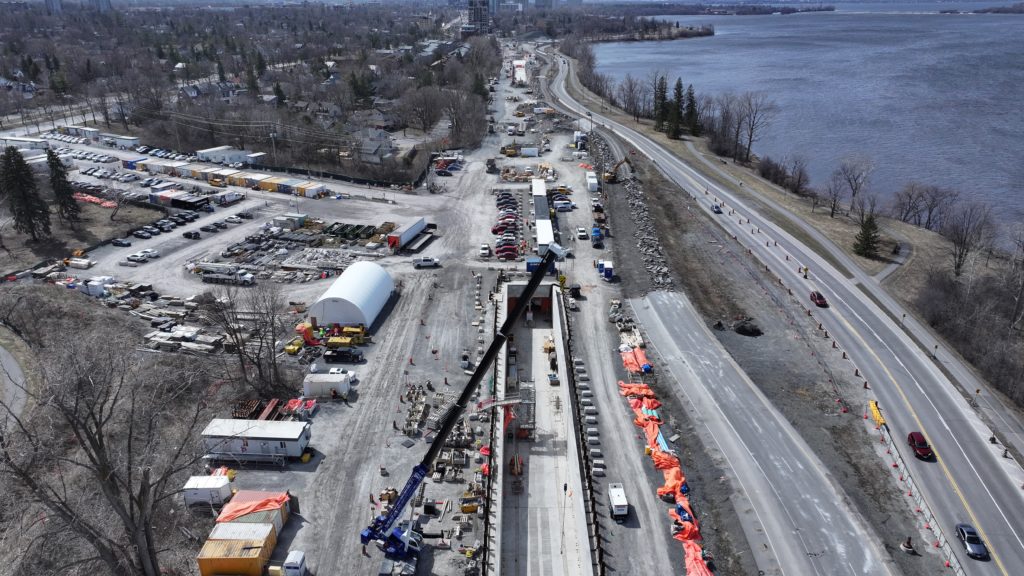
In the west, track installation and station construction “continues to progress,” according to the agency. The cut and cover tunnels are moving forward with structure work mostly complete, and preparations are now under way for installing track in the tunnels at Connaught Park and Byron Linear Park. This summer, the Pinecrest Stormwater Management Pond will open. This new facility, OC Transpo says, “will help manage stormwater in the community and mitigate the impacts of stormwater runoff to the Ottawa River.”
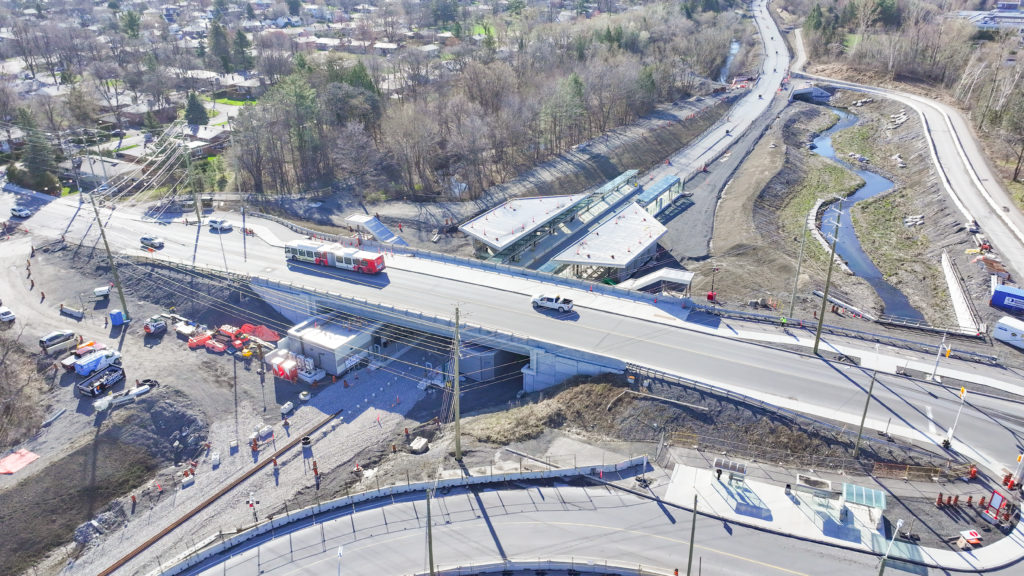
O-Train South Extension
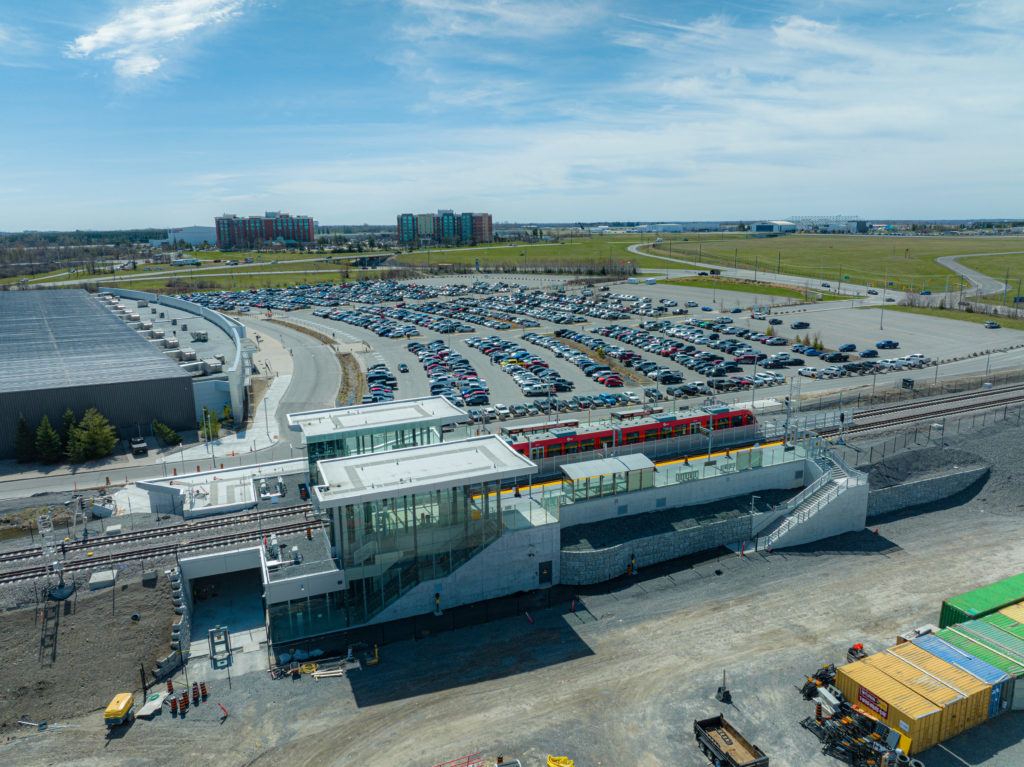
On the O-Train South extension, the agency says the focus remains on testing the new system and training OC Transpo operations staff.
Over the next several months, testing will continue with trains running on O-Train lines 2 and 4 at final service levels for several weeks. This period of operation, OC Transpo says, “offers the chance to demonstrate that the overall system is reliable and prepare it to open to the public.
Trial running will occur in this period. During the trial running phase, the agency says it will provide daily progress updates to Council.
O-Train Line 1 Long-Term Sustainability and Improved Service Reliability
Staff and representatives from Rideau Transit Group provided an overview of expert reports on additional corrective actions to Line 1 trains and infrastructure. Short-term closures of Line 1 will be required in October to make some of these corrective actions, such as rail grinding and ballast stabilization. Customers will receive more details on transit services before the work occurs. These measures, the agency says, “contribute to the long-term sustainability and improved service reliability on O-Train Line 1.”
The Committees also received an update on the vehicle and track infrastructure work under way since last October to improve Line 1 service reliability and sustainability. This work includes restraining rail gap management, rail flange lubrication, top of rail friction modifiers, and implementation of nut-pinning enhancements to the wheel hub assembly.
UTA
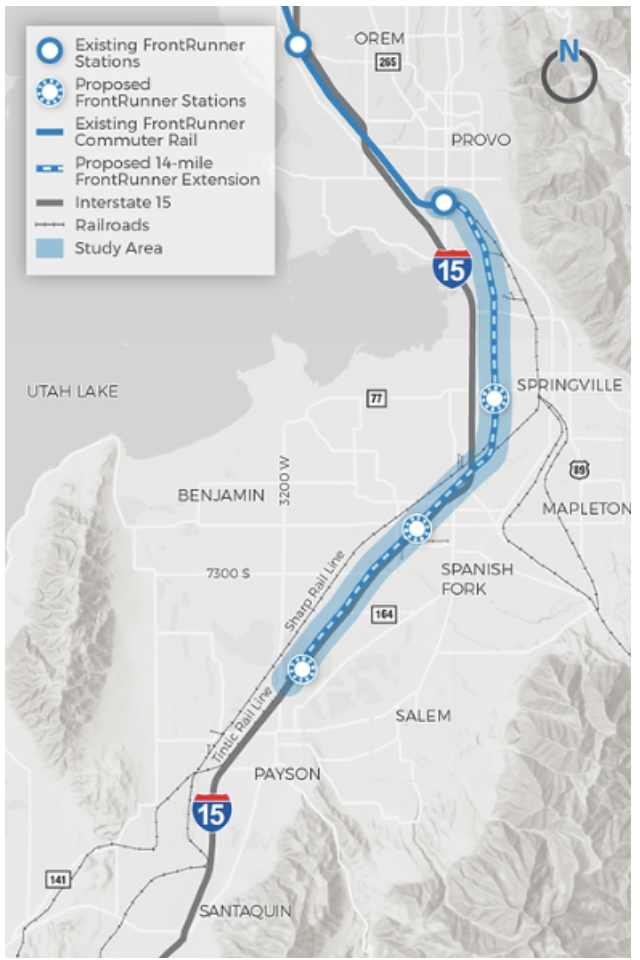
UTA is holding public information meetings and making plans to extend its commuter rail service, the FrontRunner, to stations in Springville, Spanish Fork and Payson.
UTA held meetings on May 22 in Payson, June 4 in Provo and June 6 in Spanish Fork. One more public information meeting will be held in Springville on Wednesday, June 12 from 5-7 p.m. in the Springville Civic Center Multipurpose Room at 110 S. Main St., according to UTA’s Instagram.
UTA said, via Instagram, that attendees can learn about what to expect regarding the project schedule, environmental review and the locations of each station at these public information meetings. Janelle Robertson, Project Manager of the FrontRunner south extension, said the meetings also inform attendees on any updates regarding the project.
“We do all of these projects in partnership with the communities that want them. “Just looking at …what their future transportation needs [are], and transit is one of those big needs that the communities see and UTA sees in the future as being very important to the region,” said Robertson, who added that the public is “mostly positive about the project.” “[People] are really excited to have the FrontRunner extended into their community,” she said.
This plan is currently in the environmental review and preliminary design stages. According to UTA, the preliminary design is projected to continue through 2026. There is no current timeline or funding for the final design and construction of the FrontRunner extension.
The track will primarily be built on UTA-owned property following I-15, according to UTA.
According to UTA, the plan arose from the South Valley Transit Study, completed in 2022, which identified the plan as the “Locally Preferred Alternative” to increase public transit options in south Utah Valley. The study also recommended an express bus service from Payson to Santaquin.
“By 2050, Utah County is expected to nearly double in population, adding 660,000 more people and surpassing 1.3 million people total,” UTA said regarding the South Valley Transit Study. “Planning ahead for this growth is imperative to meet current and future transportation demands.”
Shawn Seager, Director of Regional Planning at Mountainland Association of Governments, said the study had long been a part of their long-term transportation plans to improve public transit from Provo to Santaquin in a public information meeting on Oct. 21, 2021.
“We wanted to take a step back and just make sure that we are looking at the right transit project,” Seager said. “That’s why we hired this team of experts to go in and back us up a little bit and look at transit improvements from Provo to Santaquin, try to find a Locally Preferred Alternative, something that everyone would agree upon.”
The FrontRunner currently spans 89 miles with 16 stations between Ogden and Provo, according to UTA.
Detroit People Mover/TTC
Over the next year and a half, Detroit will install new passenger railcars purchased from the TTC, where the Commission operated a service similar to the Detroit People Mover until it was shut down in 2023, according to The Detroit News and the Detroit Free Press.
“It will be the first time the above-ground transit system is changing to its original railcars since launching almost 37 years ago,” General Manager Robert Cramer said on June 10, according to The Detroit News report.
“Our target is 18 months for, ideally, the process to be complete,” Cramer said. “Hopefully, we’ll have the first two cars a lot earlier than that. The first two will be critical because once you get those up, we’ll be able to see how these cars behave within our system. Each system is unique. So far, it’s only ever functioned with the cars we have. Once we get the first pair set, then it should be relatively quickly after that.”
According to the Detroit Free Press, the next step would be an “on-site inspection of Toronto’s 28-car fleet to choose which specific ones would head to Detroit.”
“The plan is to select those train cars and then sign a contract with a company to do any necessary modifications in a way that all of the work can be done before they head here,” according to Cramer.
According to The Detroit News report, “the Detroit City Council approved the contract on May 21 as part of $38.5 million in funding for the People Mover. That funding includes the initial $6 million to acquire a dozen train cars and then get them ready to use. The money also has the People Mover’s annual operating subsidy of $6.5 million for the next five years.”
The fleet of 12 railcars “are the same age as ours,” Cramer said. “They’re used but new to us.”
“The cars are basically the same. They’re the same size, they were even built in the same assembly plant in the ‘80s and have the same driverless computer system. That’s why this makes sense,” Cramer said, explaining that any other new cars would have to be “custom built because other rail systems don’t have cars that are this short,” according to the report.
One key difference with the Toronto cars is that they have a driver cab, something Detroit’s cars don’t have, according to the Detroit Free Press report. “The cabs won’t be needed, however, and both use the same driverless systems,” Cramer said. “Detroit’s cars do have manual controls that can be accessed if necessary by staff.”
What to do with the current People Mover fleet hasn’t been decided, according to the Detroit Free Press report. “They’d be replaced and retired, but whether they might find a home in storage for some possible future expansion is one of a number of ideas that have been floated. Space, however, is limited,” Cramer said.
“The People Mover has tight curves and short platforms of 80 feet long and that means we have to use unusually short cars,” he said. “It’s a dream come true because Toronto decided to shut their system down and had these cars that weren’t valuable to them or anyone else but of course, because of the uniqueness to our system …the parts on these cars are hard for us to find. To have this fall in our lap is pretty amazing.”
“While relatively the same, the Toronto fleet is in much better condition because its cars have had previous upgrades the People Mover cars have not,” said Cramer, who joined the Detroit Transportation Corp. from SMART—the suburban bus system—in 2022, according to The Detroit News report.
According to the report, the alternative was paying $4 million for each car without installation to be upgraded. In comparison, they’ve acquired the entire fleet from Toronto for $1 million and Detroit will receive a warehouse of spare parts, he said.
“Maybe 10 years down the road, we’ll still have to decide what we want to do about buying new cars,” Cramer said.
The Detroit Transportation Corp. (DTC), according to the report, “started shifting to its future model by making the People Mover free to ride for the entire year thanks to Priority Waste, which covered the roughly $450,000 in annual fare revenue as a corporate sponsor. But the city is not ripping out the fair gates and coin machines just yet.”
According to the report, since the beginning of the year, the DTC has spent $11 million on capital investments. Of that, $5 million is on technology upgrades at the stations, another $4 million replacing the track and $2 million to get all the escalators fixed before the NFL Draft. Track replacement is still under way.
The agency also is installing new security cameras, kiosks and video boards at each of the People Mover’s 13 stations, “trying to make the small three-mile looping train more friendly, welcoming and accessible as public transit,” according to The Detroit News report.
“It’s all being done to inject much-needed life into the monorail, which had 60,144 riders in January, nearly double from January 2023,” Cramer said. Since then, there have been 113,000 riders each month, a 150% increase compared with last year, according to the report.
Cramer said he will be requesting that the People Mover board “extend free fares using corporate sponsorship later this month.” The DTC will also be working on two separate studies involving the People Mover system launching later this year.
The People Mover System Plan and Downtown Mobility Study will start in the fall with $800,000 supported by the state, which is also “providing another grant of $250,000 to help them internally standardize how they collect data to improve operational management,” according to the report.
Further Reading:
Caltrain
Upon the substantial completion of all major construction for Caltrain Electrification, the agency recently conducted a successful test of eight trains running simultaneously on the corridor.
This, Caltrain says, “marks the final corridor wide test before the launch of electrified service in September, as well as the last weekend service change for the Electrification project.”
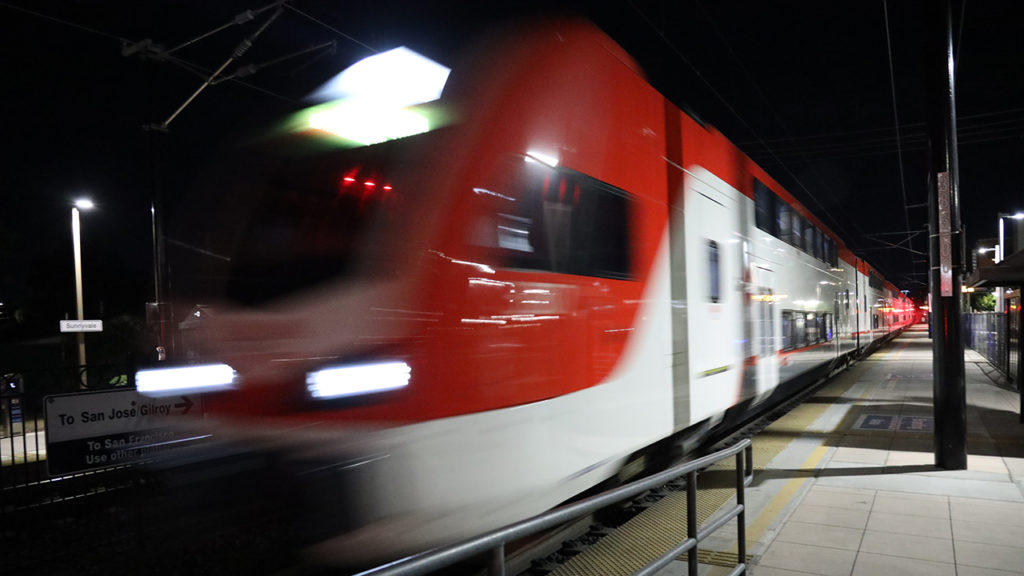
For the past eight years, construction has gone on day and night, including locating underground utilities, testing soil conditions, inspecting signal and communication equipment and pruning and removing trees. The project team installed more than 2,500 pre-engineered poles and strung more than 2.6 million feet of wire to support the Overhead Contact System (OCS), which provides power to the fleet of new, high-performing electric trains.
“This weekend’s test has proven that Caltrain is going to be ready to show our riders and the region a new and improved Caltrain,” said Caltrain Executive Director Michelle Bouchard. “I thank our riders for their patience as we completed this necessary construction, and I look forward to September when we can enjoy the benefits of a faster, greener and quieter Caltrain.”
Caltrain says it plans on launching its electric service on September 21, which will feature a San Francisco to San Jose trip in under an hour, peak hour trains every 15-20 minutes at 16 stations and trains every half hour during mid-day, evenings and weekends.
Additionally, 10 traction power facilities, which will provide, distribute and regulate electricity to the OCS and electric trains, were installed between the San Francisco and San Jose.
After the successful substantial completion of Electrification infrastructure throughout the 51-mile corridor between San Francisco and San Jose, Caltrain, Stadler and design-build contractor Balfour Beatty “could safely conduct the eight-train power contingency test to stress the electrical power system and simulate real time September full EMU service schedule,” according to the agency. The successful completion “ensures that eight EMU trainsets can properly perform under various power configurations.”
Caltrain’s historic electrification project is the first undertaking in North America in a generation in which diesel trains and their infrastructure components are transitioned to an electrified system. This year marks the 160th anniversary of San Francisco-San Jose rail service.