Rail transit taps local powers
Written by William C. Vantuono, Editor-in-ChiefGlobal trends, including tight oil supplies, almost guarantee more U.S. rail transit. Growth will come, even if federal support shrinks.
Federal capital grants for rail transit started in 1964 when Lyndon Johnson signed the Urban Mass Transit Act. To continue building rail transit new-starts and expansions at the robust level of the past half-century, billions of dollars in such funding will be required.
Though it now faces serious challenges in Congress (sidebar, p. 84), federal transit funding has been growing in recent years. For example, according to the American Public Transportation Association, annual federal capital investment funds for rail transit were $2.49 billion in 2001, $2.96 billion in 2002, and $3.33 billion in 2003.
The drumbeat of looming doom throughout the summer of 2011 can and did easily obscure more longer-range economic trends. Here’s one: U.S. municipalities continue to commit to passenger rail transit operations and expansion.
Leaders in those localities most likely know, or at least sense, that demand for rail transit will rise inexorably, given the competition for energy sources the U.S. and other developed nations now face from China, India, and other rapidly growing nations.
“It almost doesn’t matter who runs Congress or who the President is,” says one transit agency executive. “If China, for instance, consumes even just some of the oil the U.S. feels entitled to, that puts pressure on U.S. gasoline prices and on U.S. motorists. Americans can’t vote that economic reality away. And the Chinese aren’t really all that interested in what American voters, or motorists, might complain about.”
Rail transit critics or skeptics, intensifying calls to dismantle or scale back rail transit (often offering bus substitution as an option) still insist faulty federal economic stimulus packages provide artificial support to U.S. rail transit ridership, rising despite fare increases and service reductions—or they can claim that existing transit use doesn’t automatically translate into support for expanding a transit system.
But the critics might look deeper: One sees a resolve to initiate, grow, or cultivate passenger rail services, even if the federal fiscal future is uncertain. For one thing, the federal government long ago ceased providing operating support to U.S. transit agencies, limiting its assistance to capital grants for new systems and expansion.
Unlike federal operating support for Amtrak, which comes (or goes) on a year-by-year basis, some rail transit agencies or entities have adjusted to the ongoing reality. For example, Phoenix has tapped local and regional sources to advance the region’s ultimate plans for 57 miles of light rail. Such agencies rely on the political whims and fiscal health of cities or regions or (in the case of New Jersey) the state government. Those governments, in turn, are a lot closer to the end-product (and the voters that use them) than federal largesse might be.
Determination to build
Even the “big boys” like New York City are planning for the possibility. Though the Metropolitan Transportation Authority is tapping massive federal funding for big-ticket projects such as East Side Access or the Second Avenue Subway, the city itself is paying the full cost of the 1.25-mile, $1.4 billion No. 7 line extension to Manhattan’s West Side, in the belief that the extension is best for the city’s economic future.
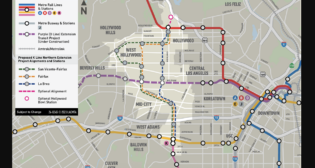
Across the continent, Los Angeles, once considered anything but rail transit friendly, continues expanding its light rail system, largely powered by Measure R, passed by 67% of Los Angeles County voters in 2008. The measure’s formal title is indicative of its intent: “Traffic Relief, Rail Extensions, Reduce Foreign Oil Dependence.” The tax, set for 30 years, is expected to generate $40 billion for roadway and transit projects. L.A. Mayor Antonio Villaraigosa has not shied from using his local funding to leverage federal matching funds, but he’s also made it clear the City of Angels and surrounding communities will develop rail transit, even without federal backing.
Voters in West Sacramento, Calif., voted in 2008 to tax themselves to establish a streetcar line designed to link up with neighboring Sacramento’s growing LRT system.
In the Bay Area, the Sonoma Marin Area Rail Transit (SMART) district board last month approved a financial plan that includes a $171 million bond sale to help start service on the first 37-mile segment of its diesel multiple-unit (DMU) rail line serving SMART’s namesake counties. SMART is applying for federal support, since the project’s cost is estimated at $360 million, but isn’t counting it.
California locales have counted on state government and voter-approved initiatives for varying amounts of fiscal support in recent decades. By contrast, Texas state government has left Lone Star State cities to largely fend for themselves when it comes to public transit. While Houston and Dallas, each with considerable local resources, continue to one-up each other in expanding their respective LRT systems, other Texas cities and suburbs have tapped local tax revenue and developed public-private partnerships to push rail transit capital projects forward.
Fort Worth and Tarrant County, Tex., have cobbled together funding from various local sources to advance TEX-Rail DMU rail service linking downtown Fort Worth with communities to the northeast of the city. An initial submittal for New Starts documentation was slated to be submitted late last month. TEX-Rail currently is set to begin revenue operation in 2015.
Beating its neighbor to the punch, nearby Denton County debuted its A-Train DMU service on June 18, linking the cities of Denton and Carrollton and including a transfer to and from Dallas Area Rapid Transit’s newly extended Green Line light rail service in Carrollton.
Last month, Bexar County, Tex., commissioners voted to commit five years’ worth of advanced transportation district funds, or about $55 million, to San Antonio’s VIA Metropolitan Transit, in large measure to advance a $180 million plan including a downtown streetcar line and two downtown transit centers. The city itself has yet to commit to such effort, noting VIA’s contributions of up to $70 million are subject to the whims of federal support.
Still, “We are very pleased that Bexar County is leading this effort, and we know that these decisions aren’t easy,” VIA board Chairman Henry Muñoz said, adding, “I think the city recognizes that, as our partner, VIA has been underfunded historically and that it’s time for that to change.”
East no longer least?
Back east, the summer of 2011 included the much anticipated, oft-delayed debut of Norfolk, Va.’s 7.4-mile light rail transit line, criticized for cost overruns (though its estimated cost dropped by $20 million, to $318 million, days before it opened). But operator Hampton Roads Transit is steadfastly optimistic that ridership will justify the project. HRT officially expects 2,900 daily riders after one year, but “we’ll beat the 2,900,” says Philip Shucet, HRT president and CEO. HRT also expects about 7,130 daily rides by 2030, but Shucet adds, “We stand a very good chance of beating that in the first few years.”
Shucet has precedent for such optimism. Ridership on nearby Charlotte, N.C.’s LYNX LRT already carries 15,000 daily riders, with a 2020 estimated target of 18,000.
That still pales compared with the success of some western U.S. cities: Phoenix’s Metro projected 46,000 daily rides by 2025 and already has 42,000. Houston’s MetroRail projected 33,000 daily riders by 2020 and already transports 35,000. Rising Salt Lake City LRT star TRAX initially was expected to handle 33,000 daily riders by 2020; TRAX officials now anticipate 58,000 daily riders by the end of this year. Across the U.S., LRT is attracting riders—and voter sentiment to expand the systems.
Streetcar development may ride a similar wave in the East, much as it has in Portland, Seattle, and Tucson, Ariz. Arlington, Va., is pushing one of three streetcar projects in the Washington, D.C. area, whether the federal government offers Small Starts fiscal support or not. Arlington County Board Chairman Chris Zimmerman acknowledges that, absent federal funding, the county “would have to find some other way.”
“Some other way” will not be the only way for the foreseeable future, as federal funding is not going to go away completely. But it is an alternative.