Commentary
RUN Conference Calls for More Amtrak L-D
Written by David Peter Alan, Contributing Editor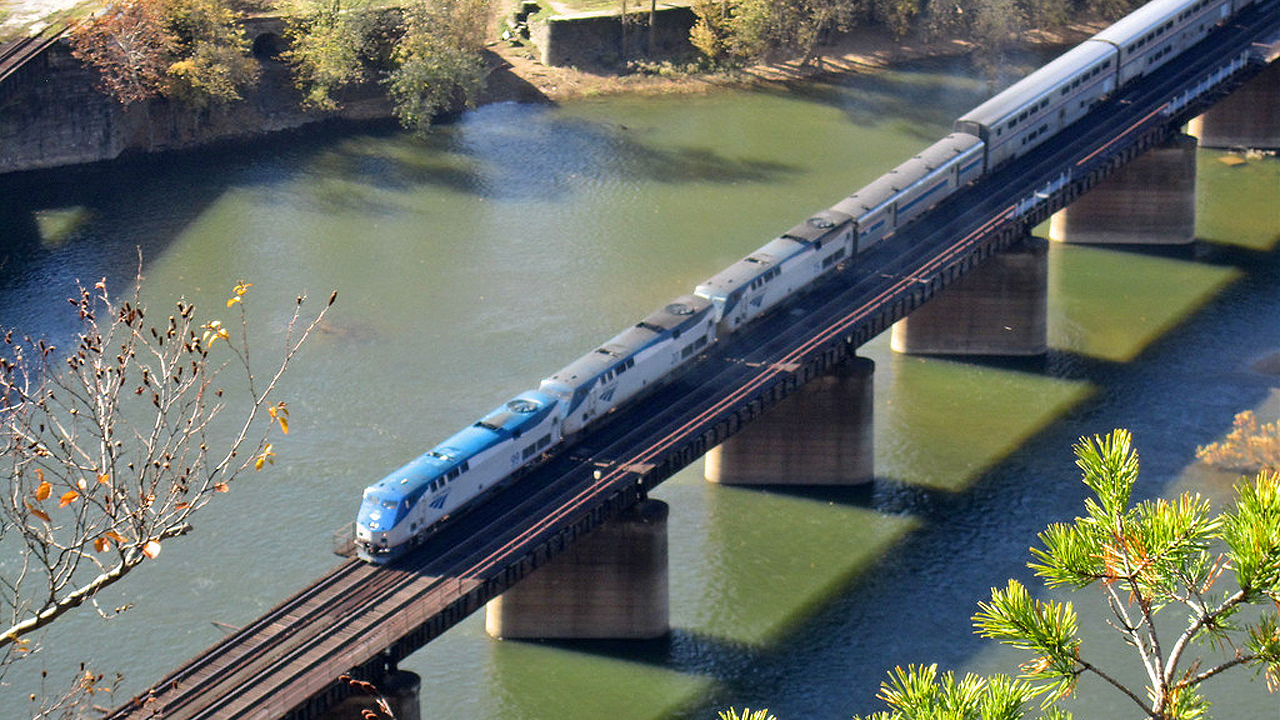
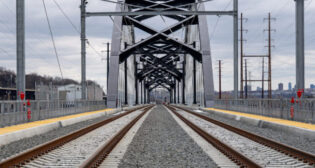
Amtrak long-distance train crossing Long Bridge over the Potomac River. Amtrak photo.
When Amtrak began operations in 1971, two-thirds of the long-distance and corridor-length trains that had previously run in the United States were discontinued. Amtrak’s original long-distance network consisted of only 14 routes. A few were added and taken away again during the 1970s, and there have been other changes since then, but the network today also numbers 14 routes, and has for decades. Advocates around the country are pushing for the network to expand.
On Friday, May 17, the Rail Users’ Network (RUN) held an on-line conference that featured some of the best-known advocates who are promoting restoration of specific routes, as well as a panel featuring longtime railroaders who gave attendees information about what it takes to get a new train (including on a restored route) on the rails. RUN described the theme of the conference as Expanding Long-Distance Rail Service. Why Amtrak Service to More Towns and Cities is Important to the Entire U.S.!
RUN Chair Richard Rudolph opened the conference by saying that, since it was founded in 2001, RUN has consistently called for more Amtrak long-distance trains and for all of them to run every day. He said that the primary purpose of the conference is to highlight the work that the advocates are doing to expand the network but warned: “Nothing is going to happen unless they pony up some money.”
FRA Study, Three “Priority” Restorations
The Federal Railroad Administration (FRA) is conducting a study about expanding the Amtrak long-distance network, considering 15 new or restored routes. While the study has some drawbacks (see the companion commentary to this story), it has at least inspired advocates to again dare to dream and to step up their campaigns to get trains on new or restored routes operating in their regions.
The FRA study named three service expansions as priority projects, albeit with a 15-year planning frontier. The two that seem the most obvious call for running the Sunset Limited (New Orleans – Los Angeles) and the Cardinal (New York – Chicago through West Virginia, an indirect route that picks up a part of the country that is otherwise unserved) every day, which last happened decades ago. The only other suggested priority route is a restored version of the North Coast Limited on the historic Northern Pacific route, running south of the Empire Builder route in North Dakota and Montana. Amtrak called the train the North Coast Hiawatha during the 1970s, and it was discontinued in 1979.
Todd Liebman, President of All Aboard Arizona, is involved with the campaign to make the Sunset Limited a daily train. His advice was “Know the territory and organize locally, it’s about opportunity, mobility, and economy.” He said that the Sunset has a good constituency and now makes better on-time performance (OTP), but contrasted Southern Arizona as served by the Southern Pacific (SP) with Northern Arizona as served by the Santa Fe, a better service both historically and today. He called restoration of the Wilton Cutoff so the Sunset can serve Phoenix again, and also for other capital improvements, and concluded by saying: “The legislature will do what the local politicians want.”
Huntington, West Virginia Mayor Steve Williams advocates for a daily Cardinal. He touted the train’s service to stations in the newly formed New River Gorge National Park, and mentioned support from the Municipal League in his state and T4America, a national organization. He also said the application for daily service is getting a Corridor ID grant. He added that the train “fosters diversification of the economy” in the region and has asked West Virginia Republicans to support a daily Cardinal, too. In his home city, he called for the train to move away from the current station, which he said looks like “a double-wide trailer” and back to the classic C&O station about four blocks away.
The historic NP North Coast Limited route seems to be the best candidate to be restored, and David Strohmaier told the conference about his efforts to bring the train back. He was one of very few advocates that the FRA study team had contacted. He is Chair of the Big Sky Passenger Rail Authority in Montana (a regional authority and subdivision of state government) and a County Commissioner in Missoula, home of the University of Montana. He said that the authority he heads started in 2020 and grew by gaining the cooperation of Montana’s counties and some Native tribes. Beyond that support, it entered into a partnership with Amtrak and a Federal-State partnership to make improvements at Malta, a stop on the Empire Builder route further north. He told the conference: “A local government can team up with Amtrak and make something tangible happen on the ground.” They are also planning to push for passenger service to Calgary, Alberta, which has not hosted a scheduled passenger train since 1990, and that one ran only within Canada. Strohmaier advised his audience that “You can’t roll up your sleeves while you’re wringing your hands” and “Look for opportunities to create additional authorities” like the one for Big Sky Passenger Rail. He concluded by reminding attendees to make sure that a Service Development Plan (a step in getting a train onto the rails) should include First Mile and Last Mile connections to and from the stations.
Advocating to Restore Other Trains
While there is little or no reason to believe that all the routes mentioned in the FRA study will ever host a passenger train again (the agency has a disclaimer about that), some of the routes that were part of the Amtrak system in the early days, and some that were discontinued before Amtrak started in 1971, have their champions. Some of them presented updates at the conference about their activities.
One train mentioned in the FRA study for possible restoration is the Pioneer, which ran from 1979 until 1997 (and which I rode three weeks before it was discontinued). It ran on UP between Portland and Salt Lake City in the earlier part of its life, and through Wyoming to Denver after that. Mike Christensen, a planner and Executive Director of the Utah Passenger Rail Association, described the efforts to bring the Pioneer back. He started by saying that Utah is a fast-growing state, and that sports have become a major attraction bringing tourists to the Salt Lake City area. He said that 75% of the state’s residents the city and its suburbs, four counties of the 29 in the state, and 33% live in Salt Lake County alone.
Christensen also described local initiatives to upgrade the city’s TRAX light rail lines and streetcar, along with Front Runner, a regional passenger line that runs between Ogden and Provo, through downtown Salt Lake City. He reported an initiative to extend regional rail further, to Cedar City and Moab, south of the capital region, and possibly to St. George, toward Las Vegas. He complained that “UP routinely blocks grade crossings for unnecessary reasons” and suggested building new tracks to the historic station that the Denver & Rio Grande (D&RG) once used, and then restoring service there.
Mississippian Knox Ross, Chair of the Southern Rail Commission (SRC), is known for advocating strongly for the long-hoped-for Gulf Coast Service between New Orleans and Mobile, with intermediate stops in Mississippi, a service that he hopes will run this October. Along with potential service between New Orleans and the Louisiana capital of Baton Rouge, he is also pushing for a train on the “I-20 Corridor” between Meridian, Mississippi and Dallas. It would run as a part of the Crescent between New York and New Orleans as far as Meridian. Ross said that the I-20 train would be “an easy project to sell to conservative members of Congress” and added that Amtrak agreed to push for the train as part of its deal to support the merger that created CPKC. He also said that the mayors of Ruston, Shreveport, Vicksburg, and Jackson support the project, and that support for it is also growing in East Texas. He gave the SRC credit for garnering much of that support, and said that it was founded in 1982 by an act of Congress. It has commissioners from Louisiana, Mississippi, and Alabama. Ross also mentioned the importance of scheduling and complained about the current schedule of Train 20, which now arrives at cities along the NEC several hours later than on the traditional schedule.
Ken Buehler, Executive Director of the Lake Superior Railroad Museum in Duluth, presented a case study of efforts to get a shorter route going: the proposed Northern Lights Express between Duluth and Minneapolis, for which he has been advocating for 23 years. He mentioned how iron mining was the activity that prompted the growth of rail lines in northern Minnesota, and then described the Northern Lights trains as anticipated. There would be four daily runs in each direction, with five intermediate stops, and taking 2½ hours from end to end. The service would operate with two three-car trains sets, plus a spare. He said that the new Borealis train between Chicago and St. Paul “was not a coincidence” and went on to mention the benefits of rail service. He said: “Workforce development IS economic development” (emphasis in original) and described the role of Minnesota, with support from Wisconsin for the stop at Superior: matching federal grants, buying equipment, and developing depots. He added that with a tax law change, half of the state taxes that the railroad pays will support passenger service.
RUN Board member J.W. Madison, who is also President of Rails, Inc. in New Mexico, described his conception of the Rocky Mountain Flyer, a train from El Paso, north through Albuquerque, La Junta, Denver, and Cheyenne, and through Wyoming to Montana. The FRA study which proposed new routes included that route on its own list, going as far as Billings. That city was a stop on the old North Coast route, until the train was discontinued in 1979. While Madison has suggested that the proposed Flyer should connect with the Empire Builder further north, that could also happen if the Big Sky Passenger Rail Authority succeeds in getting the North Coast back, and maybe someday going as far as Alberta.
Madison described how his organization got started in 2000, and said it was instrumental in helping get the New Mexico Rail Runner line between Belen and Santa Fe going, with its midpoint at Albuquerque. He also called for “a publicly owned pervasive track network” for both passenger and freight trains.
New Floridian By a New Route?
Amtrak ran the Floridian between Chicago and Miami until it was discontinued in 1979. It ran through Louisville, Nashville, Birmingham, and further south to get to Jacksonville on its way to South Florida. The recent FRA study proposed it as one of 15 suggested new or restored routes, but the proposed routing would instead serve Chattanooga, Atlanta, and Savannah on the way to Florida points.
RUN Chair Richard Rudolph moderated a panel about segments of that proposed route. The panelists were Director of the Office of Planning at Louisville Mike King, Mayor Tim Kelly of Chattanooga, and Clement Solomon, Division Director for Intermodal at the Georgia Department of Transportation (GaDOT). King said that Louisville is the second-largest city in the nation without a passenger train, exceeded only by Nashville. He mentioned partnering with Indianapolis, and suggested Detroit as another northern destination, in addition to the Chicago – Florida route. He said that “people in Louisville are clamoring for train service” and suggested that it might be necessary to change funding laws to make it easier to raise money for passenger-rail projects. Kelly said that his city is pushing for infrastructure grants, along with Nashville and Savannah through state-level transportation departments in Tennessee and Georgia. Solomon said he was “excited about the study” and glad to see that his department is “venturing into passenger rail.” He mentioned the Atlanta – Savannah segment particularly, as offering “practicality” and additional travel alternatives. A route between Nashville and Atlanta through Chattanooga is one of the proposed routes in Amtrak’s Connects US plan to develop new corridor-length routes by 2035 and would comprise a portion of a restored and rerouted Floridian.
A Word from Amtrak About Equipment
While Amtrak is replacing much of its equipment on trains running corridor-length routes, most of its long-distance cars are old by passenger railroad standards. Some of the Superliner cars on trains west of Chicago and New Orleans and on the Capitol Limited are 40 years old, and many are in their late 30s. Some of the Amfleet II cars running on long-distance trains east of Chicago and New Orleans are even older. Some advocates have expressed concern about how long Amtrak will be able to run even its current skeletal national network with equipment that old, as trains have been getting shorter lately.
Federico Gozzolo, Amtrak’s Vice President for Product Development and Customer Analytics, presented Amtrak’s view on the equipment situation. He described a Request for Information (RFI) issued in 2022 and a Request for Proposals (RFP) issued in 2023. The 1000-page specification document was approved on December 22. Gozzolo said that demand for space on the trains is growing, that Amtrak will be the biggest construction operation in the country next year, and that Amtrak hopes to double current long-distance ridership by 2040. He said that Amtrak expects to have 55 more cars (35 for long-distance routes) in FY24 and 27 (16 for long-distance routes) in FY 25. He also said that the railroad is spending $28 million to upgrade Superliner cars, and that food offerings will improve.
Getting New Trains Onto the Rails
The last panel of the conference was not about what is happening on the advocacy front but was instead a “skills and methods” presentation that focused on what is needed for a startup of new service. All three presenters have a half-century or more of railroading experience, and each made suggestions within his area of experience on the railroad. RUN Vice Chair Andrew Albert, who is also a rider-representative on the Board of New York’s Metropolitan Transportation Authority (MTA), moderated the panel. He started the discussion by mentioning “issues common to all advocacy efforts”: equipment, funding, relations with host railroads, and the political scene along each proposed route.
Josh Coran, a RUN Board member from Seattle who served as Director of Product Development and Compliance at Talgo and stints as Chief Mechanical Officer at the Alaska Railroad and Trinity Rail Express (TRE) in Texas, discussed equipment issues. He mentioned where cars can be found: Amtrak’s Amfleet and Horizon cars, privately-owned heritage equipment, and bi-level or multi-level equipment that regional railroads are now replacing, but added that some of it is in bad condition or very old. He noted that equipment types have to be compatible with each other, as well as with station platforms. He said that Genesis or EMD locomotives can be found, and Stadler is attempting to break into the market in this country. He also cautioned against untried technologies like hydrogen-powered units.
Phil Streby, a RUN Board member who retired from Amtrak and had also been a railroad officer in the Army Transportation Corps, focused on crews and the time required to train them. He mentioned that new routes will require new crew bases and stations, along with other property, and that crews must be hired, trained, and certified. He noted that Amtrak used host-railroad crews until 1986.
Railroad economist and Railway Age Contributing Editor Jim Blaze focused on the economic aspects of getting a new route started. He advised advocates to “take advantage of a negotiating strategy that thinks like railroad executives do.” He said that the outlook for intermodal freight appears flat, and that host railroads need investment, suggesting that potential passenger operators need to pay for capital improvements and suggested using innovative financing like sale-leaseback transactions.
Commentary
Since I have been writing for Railway Age, I have often delivered the closing remarks at the on-line mini-conferences that the Rail Users’ Network (RUN) holds in the spring and fall. This conference was no exception.
Most of the presenters were advocates who are pushing for a new or restored Amtrak route that would run through the region where they live. Some are public officials, while others lead organizations of citizen-advocates who want a train they can ride and believe that such a train would benefit their regions in terms of the economy, as well as more transportation choices and environmental benefits.
The salient fact is that Amtrak’s long-distance network consisted of 14 routes when Amtrak started in 1971, and is the same size today, although there were some expansions in the 1970s and a few other changes since that time. There has been no net growth, and trains are shorter today than they were in the past, so there has been a net decrease in capacity. Advocates and their constituents want more trains.
That has not happened, even though there has been talk about expanding the long-distance network for decades. The most-recently added long-distance train is the Capitol Limited, which was restored in 1985. There has been much talk and many studies through the decades, like the ongoing FRA study. I reported on it, and then criticized it for ignoring the advocacy community, almost in its entirety, and for proposing a 2060 planning frontier. By that time, any train that was discontinued when Amtrak began its skeletal network in 1971 will have been absent from the rails for 89 years!
Too many advocates have become excited about grants for infrastructure improvements under the Infrastructure Investment & Jobs Act (IIJA), also known as the Bipartisan Infrastructure Law (BIL). When grants are given out, the recipients always get a benefit, but managers, planners, and advocates should not conflate infrastructure grants with getting a new train to ride. There is a lot that must happen first, and it always seems to take an extremely long time to go through those steps.
The advocates, planners, and elected officials on the program all did a competent job, as they showed a diversity of styles, along with general agreement about what should be done. Some expressed a level of optimism that appeared to be unfounded. Still, it’s not easy to stay enthusiastic for many years without results. The fact remains that everything that concerns Amtrak, or even local transit, depends on politics. Nothing happens without political support, and there are probably not many elected officials who ride trains. President Biden commuted between Wilmington and Washington, D.C. on Amtrak’s Northeast Corridor (NEC) when he was a senator, but he appears to be one of the few exceptions.
One of the biggest obstacles to an expanded long-distance Amtrak network is lack of equipment. The few Amtrak long-distance trains that still run have been shorter lately than they were before the COVID-19 virus struck, due in large part to shortages of equipment. Demand for travel has boomed since last year, but Amtrak is not able to take advantage of the new demand, as more potential riders end up disappointed because they can’t take the trips they planned. They can’t wait while Amtrak orders new equipment pursuant to a 1,000-page specification, and has it built and delivered. It’s not even clear that the existing Amfleet II and Superliner equipment on existing long-distance trains, which is now 40 years old, or even older, will last until new equipment can be built, delivered, tested, and certified for service. Does this mean that most or all of the existing network will disappear by attrition over the next ten years or so? We don’t know, but it’s possible. That cannot be a satisfactory answer.
One panel discussed a new Floridian train between Chicago and Miami, re-routed as a successor to the previous incarnation of a similar train, which was discontinued in 1979. The restored route would again run southeasterly from Chicago, filling a huge gap in the Amtrak map. One key component is the segment between Louisville and Nashville, which almost ran in the early 2000s, but the initiative to restart it failed.
Knox Ross of the Southern Rail Commission is pushing hard for several new routes in the South, including the topic of his presentation at the conference: a train between Meridian and Dallas that would split from or join the Crescent between New York and New Orleans to form or join two sections. It’s a good idea, but John Robert Smith, former Chair of the Amtrak Board and Mayor of Meridian, first proposed it more than 20 years ago. If circumstances have changed enough that a current initiative can now get that train running when a prior initiative failed to do that, at least the train would run. The question is, though: how have circumstances changed since the century began, and what can advocates and elected officials do to achieve success when previous efforts did not?
The “skills and methods” panel about what must be done to get a train going was an experiment that I suggested. I still believe that it contained useful information about equipment, crews, and economic factors that are all important considerations toward success with a new or restored service. Advocates and officials often argue well for the concept of adding a new route, or more trains to an existing route, but they need to know the fundamentals of what must be done and how much it would cost to do it, to convince the decision-makers to go along with their suggestions.
Anyone who advocates for more trains or better rail transit must have extensive knowledge of what is needed and how to get it done. They also need to be prepared to make several arguments that would cover many issues of concern, especially when attempting to convince a group composed almost exclusively of motorists to invest scarce public funds to improve mobility for non-motorists as well as motorists, but which most persons with their own vehicles never use. The key is to make the “business case”: that trains bring benefits to the local economy. Democrats and Republicans both want economic benefits for their constituents. That does not mean that the role of trains in supporting a better environment, improving mobility generally, and promoting social equity and justice should be ignored. Still, not all officials agree with those arguments. If the “numbers” show economic benefits, politicians are more likely to listen to quantitative arguments than to ideas that are not so easily quantified.
There is one factor that seems to separate some advocates from others and, sadly, it almost always seems to give some a chance of success, while precluding others from achieving it, no matter how beneficial or achievable their ideas are. Two advocates who presented at the conference provide a case in point. David Strohmaier of the Big Sky Passenger Rail Authority in Montana is advocating for the restoration of the train on the historic Northern Pacific line that was known for most of its history as the North Coast Limited, and which Amtrak called the North Coast Hiawatha in the 1970s. He is a competent advocate and an elected official in Missoula County and his organization is a state agency, rather than a group of private citizens who came together to advocate for more trains. The other is J.W. Madison, head of Rails, Inc. in New Mexico. He is also a competent advocate, although his style is different from Strohmaier’s. He has been a member of the RUN Board for many years, and he helped get the New Mexico Rail Runner started. He has proposed and is advocating for the Rocky Mountain Flyer, a train that would fill a large gap in the Amtrak map by running north from El Paso to Montana, through Albuquerque, Denver, and Wyoming. Madison is a private citizen and not an elected official, and his organization is also private, with no state support or official standing. Both proposed routes have made the list of potential suggestion mentioned in the recent FRA study. That study proposed expanding the number of long-distance routes in the country, perhaps even doubling them.
That seems to be where the similarity ends. In a rare conversation with an advocate, the FRA study had reached out to Strohmaier. Almost no other advocates were similarly contacted, and only a train on the North Coast route has the same priority as daily operation of the Sunset Limited and the Cardinal (the only two Amtrak trains that run only three times a week today), according to the most-recent FRA study report. Of course, the timeline for that priority is 15 years from now, which raises new questions. In contrast, the FRA study team did not reach out to Madison or many other advocates, including some who are also elected officials. But, as much as the proposed Rocky Mountain Flyer would also improve regional mobility in the West, it will be subjected to a 2060 planning frontier, like the other proposals.
Does this mean that advocates should give up if they are not also elected or appointed officials? Of course not. All advocates should push for improvements, but there appears to be a severe problem with the process that ignores many worthy ideas and the people who advocate for them (including RUN members), merely because they are not entrenched in politics. Some of the presenters at the conference have political credentials, while others do not. That factor alone does not affect their knowledge or the quality of their advocacy or their recommendations, even though it will probably affect the final results.
All in all, the RUN conference was an “artistic success” and a useful educational experience, especially with the inclusion of material about what must be done to get a train on the rails. Still, the process is long and difficult, and it will be years before Amtrak adds any routes to its long-distance network. At the moment, many of the COVID-inspired cuts in frequency have been restored, while capacity has not. Advocates have their work cut out for them, and there is hope that exchanging information might help.
For more information about RUN and the conference, see the RUN website: www.railusers.net.
David Peter Alan is one of North America’s most experienced transit users and advocates, having ridden every rail transit line in the U.S., and most Canadian systems. He has also ridden the entire Amtrak and VIA Rail network. His advocacy on the national scene focuses on the Rail Users’ Network (RUN), where he has been a Board member since 2005. Locally in New Jersey, he served as Chair of the Lackawanna Coalition for 21 years and remains a member. He is also a member of NJ Transit’s Senior Citizens and Disabled Residents Transportation Advisory Committee (SCDRTAC). When not writing or traveling, he practices law in the fields of Intellectual Property (Patents, Trademarks and Copyright) and business law. Opinions expressed here are his own.