Proposal for New Maine Passenger Trains
Written by David Peter Alan, Contributing Editor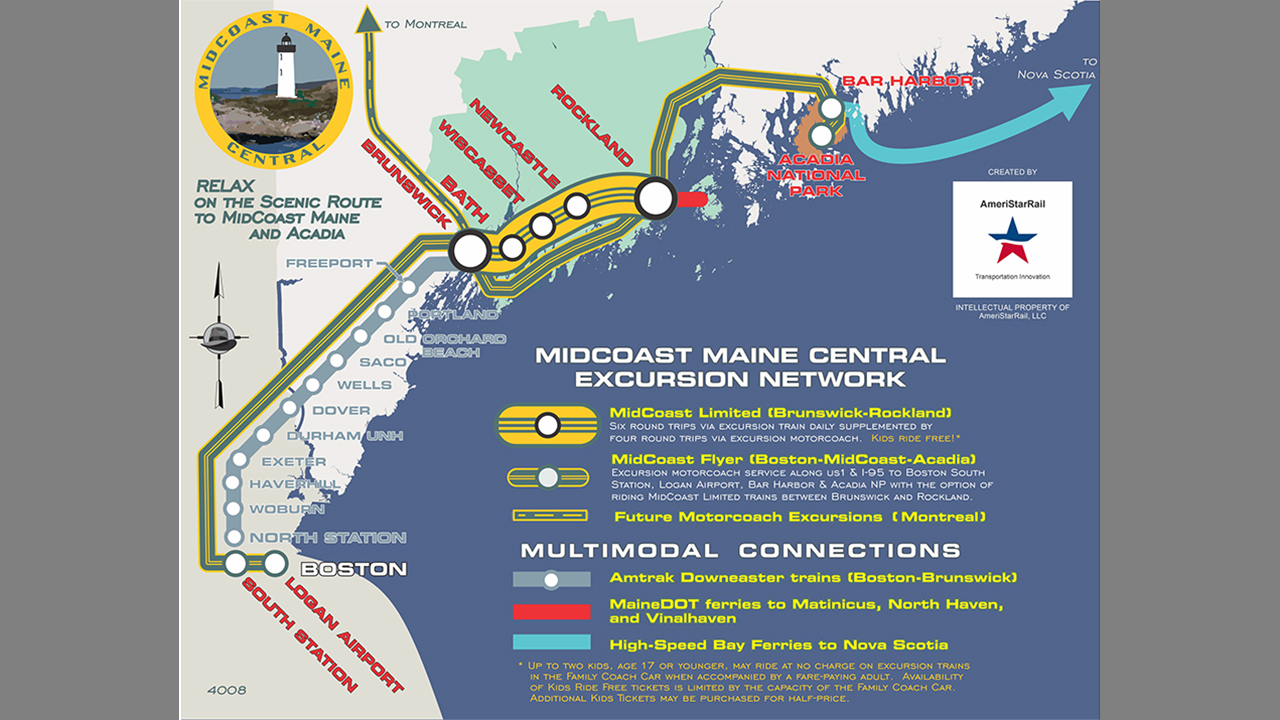
How do you save a freight rail line when it loses its primary shipper? Many cycling enthusiasts will tell you to rip up the tracks and turn it into a bike trail, but Scott R. Spencer, Chief Operating Officer of AmeriStarRail, has a better idea. He suggests running passenger trains on the line and using connecting buses to bring tourists from where they live to the excursion trains he is planning to run.
In addition, Spencer would run other bus routes from the trains to other tourist attractions that are popular, but not accessible by rail. While this might sound like an academic exercise from a course in transportation planning, Spencer is serious. He and his Senior Adviser, former Amtrak President Paul Reistrup, have such a network in mind, and they are working toward getting an operation going as soon as May 1, just weeks from now. The big question is: Can he and his colleagues do what is required to start service by then?
That line is the Rockland Branch, which was historically part of the Maine Central Railroad (MEC). It branches off from the former MEC main at Brunswick, which is now the northern terminal of Amtrak’s Downeaster trains from Boston, which run on the historic Boston & Maine (B&M) as far as Portland and on the historic MEC to Brunswick. The 56.6-mile line includes scenic and historic places like Bath, Wiscasset and Newcastle on the way to Rockland, which also fits that description. A one-way trip would about two hours end-to-end on the railroad, which is currently rated for a 59-mph speed limit. The line was purchased by the State of Maine in 1987 and has been leased to different operators through the years. Some ran passenger excursions from Brunswick that allowed a few hours in Rockland or an intermediate stop before returning to Brunswick. The final season for such excursions was 2015, when the Maine Eastern, a subsidiary of New Jersey short line Morristown & Erie, ran them.
Spencer and Reistrup are particularly interested in the Rockland Branch, because it is losing much of its freight business from the loss of Dragon Products as a local shipper, so it appears to face an uncertain future. On Sept. 6, 2023, the Portland Press-Herald reported that the company plans to phase out the 96-year-old cement plant in Thomaston, closing it completely in early 2025. Thomaston is at the east end of the line, about 4.2 miles west of Rockland.
AmeriStarRail plans to run more than the typical tourist railroad schedule of one or two trains in season, on certain days of the week. Instead, they plan to run their proposed MidCoast Limited route with six round trips per day, including one run with an overnight bus connection to Boston’s South Station and Logan Airport, in addition to four daily round trips by bus. Trains would also connect with Downeaster service at Brunswick, and schedules would be coordinated for such connections. There would be other bus connections, too, besides the extra trips between Brunswick and Rockland, and MidCoast Flyer buses to South Station and Logan Airport in Boston, and to Acadia National Park and Bar Harbor. According to Spencer, Acadia rivals some of the most famous parks in the West, including Yellowstone and Yosemite, for popularity among visitors. Bar Harbor is a quaint resort town that also features ferry connections, including a high-speed ferry to Nova Scotia. There are ferries from Rockland to local destinations, too. The buses that AmeriStarRail plans to use would be chartered motorcoaches (the type used for intercity service) and there are plans to run to Montreal eventually, too.
Spencer says the food service on the proposed trains would exceed that usually offered on tourist excursions, and even on many Amtrak trains. His plan calls for serving meals in a dining car and snacks in a lounge car, catered by local restaurants. While the scenic line is an experience in itself (I rode one of the last excursions operated by Maine Eastern in 2015), AmeriStarRail believes that offering fresh food with a local flavor will enhance its appeal.
The rail and bus network would be operated as an integrated system called the MidCoast Maine Central Excursion Network. Even though the plan calls for an integrated system of trains and intercity-style buses, Spencer told Railway Age that he expects more than 80% of the riders to take inter-regional trips, including side trips during a vacation, because many of those riders are already visiting the region. Some locals would ride, too, and there would be travelers from further south or from as far as overseas, so the network of connecting modes would be available for riders who need them to complete their trip.
On Jan. 12, Spencer wrote to Nathan Moulton, Director of the Office of Freight and Passenger Services at MaineDOT, to introduce the plan. He began by saying: “We share the vision of the State of Maine that safe, reliable rail transportation is vital to support economic opportunity, quality of life and environmental sustainability for the residents and visitors of Maine … The commitment that the State of Maine has made to preserve its rail assets for future freight and passenger service is vital to achieving this vision. As you know, the recent closure of Dragon Cement on the Brunswick – Rockland branch has resulted in the loss of most of the freight traffic on the line. Although this creates uncertainty about the future of the Rockland Branch, we are interested to create an opportunity thanks to the State of Maine’s commitment and investment to maintain the track infrastructure on the branch to FRA Class III standards that make passenger train speeds up to 59 mph possible.” (Download letter below.)
Spencer told Railway Age, “The loss of a major shipper on a branch line often spells the end of that line.” He believes that now is an opportune time to start a passenger service, because the rent for trackage rights “will buy time for Midcoast Railservice to build up its freight business again.” While the line is State-owned, Midcoast is leasing it and has operating rights for both freight and passenger service, so it would be the MidCoast Maine Central Excursion Network’s host railroad. He added, “If they have to abandon the railroad, the rail-to-trail advocates and snowmobilers will swoop down on it like vultures.”
In a press release dated Jan. 18, Spencer said, “The goal of the MidCoast Maine Central Excursion Network is to enhance tourism experiences, economic revenues and provide a traffic-free alternative for the 2 million-plus tourists who depend on the two-lane U.S. Route 1 to visit most tourist attractions along Maine’s MidCoast.” Describing the service, the release said, “Plans are to operate, daily, 6 roundtrip train excursions and 4 roundtrips by motorcoach between Brunswick and Rockland with stops at Bath, Wiscasset and Newcastle from May 1 to Oct. 27. Coach, First Class and Dining service will be available on the trains. For each Adult ticket purchased, two kids 17 and under,will be able to ride train excursions free in Coach.”
Spencer believes that AmeriStarRail will have sufficient funds available from investors to operate the proposed network without any subsidy from the State, at least on a seasonal basis in late spring, summer, and early fall. He also claims to have identified a pool of locomotives and cars for lease or purchase, which are available to run the proposed service. In addition, Spencer said that AmeriStarRail has identified a source of available insurance that would cover the train excursions. He told Moulton, “Although MaineDOT has $3 million available for a two-year demonstration of rail passenger service on the Rockland Branch, MidCoast Maine Central train excursions will run without operating subsidies. This will allow those funds to be utilized to create jobs and purchase materials in Maine for track and station infrastructure improvements on the Rockland Branch.”
While Spencer touted freedom from seasonal traffic on the highway as a core benefit of the plan, it would also benefit non-motorists by introducing a rail/bus alternative that runs far more often than the one available today on local bus lines in Maine. At this writing, the only option to get to Bar Harbor and the park requires travelers to take the first bus of the day from Boston’s South Station bus terminal to Bangor on Concord Coach, which leaves at 8:00 AM and arrives at 12:10 PM. Downeast Transportation, which runs local buses in Hancock County (which includes Bar Harbor and Ellsworth, in addition to serving Acadia National Park), runs once a day from Bangor to Bar Harbor, leaving at 1:30 and arriving at Bar Harbor at 3:10. That run operates on weekdays only, not on weekends or holidays. From there, Downeast plans to operate several Island Explorer routes around the park seasonally, from June 23 to Oct. 14, 2024, with reduced service starting in late August. Returning, the bus leaves Bar Harbor at 8:20 AM and connects at Bangor with a Concord Coach bus that leaves for Boston at 11:00 and arrives at the South Station bus terminal at 3:25.
The Maine Rail Group has been pushing for rail service to Bangor and has talked with Downeast Transportation about connecting bus service to Bar Harbor. Russell Barber, who is President of that organization, told Railway Age, “The state [population] is getting older and poorer, especially north of Augusta, so they need as much rail transportation as they can get, both on the Rockland Branch and to other places like Bangor.” He works on the ferries in Rockland and says that a ferry can go from Rockland to Acadia in 2½ hours. He touted the Island Explorer buses, which provide local service to the park, and said they would connect well with either AmeriStarRail’s proposed intermodal network or with ferries.
On Jan. 24, Spencer was interviewed on Metro Matters, an hour-long public affairs show on Rockland’s community radio station, WRFR. He made the same points previously mentioned in this article and said that taking the train would be “more comfortable than being stopped in your car, and better for the environment” and “an opportunity to enjoy some traffic-free tourism.” He mentioned a plan proposed by the Northern New England Passenger Rail Authority (NNEPRA), which operates the Downeaster trains, to extend some of those trains to Rockland, but said that his plan would run more frequently and carry 200 to 300 persons per train. There have also been other proposals made since 2015 to run passenger trains between Brunswick and Rockland, but none have been implemented.
One of the interviewers on the program was Nate Davis, a member of Rockland’s City Council. He liked the idea of frequent rail service with connections to more places and said, “We want to create an opportunity for more people to live in Rockland.” He suggested that the trains should run year-round, rather than only on a seasonal basis. Spencer replied that AmeriStarRail could operate from May 1 until Oct. 27 (the proposal for 2024) without an operating subsidy, but added that he expects that such funding would be needed to operate during the other half of the year. While Spencer is concentrating on a seasonal operation, he did not rule out year-round operation in the future, but said it is not in AmeriStarRail’s immediate plans. If year-round operation is eventually implemented, it will mark the first such operation since the Maine Central discontinued passenger service on April 4, 1959.
The proposed schedule calls for two hours’ running time between Brunswick and Rockland, a distance of 56.6 miles. It also calls for relatively convenient connections, ranging from 5 to 35 minutes, with Downeaster trains in both directions at Brunswick. There are slots for freight in the schedule, and it appears that the four passing sidings on the line should be enough to accommodate meets with freight and other passenger trains. Running speeds would approximate those on “commuter trains,” and vacationers often appreciate a slower speed that gives them time to look at the passing scenery.
Richard Rudolph, Chair of the Rail Users’ Network (RUN) and a longtime Maine resident and advocate for passenger rail in the Pine Tree State, called the idea of trains and buses in the region “a no-brainer.” He said that it makes sense to get more people out of their cars and onto trains, especially with climate change threatening the environment. “With four million people a year visiting Acadia, it’s ludicrous to depend solely on one state highway highway to get them there,” he said
Rudolph supplied some additional background. He said NNEPRA got a Corridor ID grant from the FRA to study the line as a proposed corridor, but nothing has been done for more than four years to get it started. He said that MaineDOT disapproved of those plans. He noted that, about three or four years ago, NNEPRA appeared to favor running seasonal weekend trains and had Amtrak send an inspection car over the line, but the Commissioner was concerned about passenger trains going over the Kennebec River Bridge, even though Rudolph considers that segment of the line to be a scenic part of the railroad. That proposal would have run the trains as an extension of the existing Downeaster service.
More recently, a different plan to run Budd RDC cars on a seasonal schedule also fell through. Midcoast Railservice’s parent company, the Finger Lakes Railway based in Upstate New York, proposed running one daily round trip on a year-round basis for 2022 and 2023, with a second round trip on Fridays, Saturdays, and Sundays from May through October. Mike Smith, President of Finger Lakes and Midcoast Railservice, confirmed that the cars that would have been used for that operation have been sold. He said that the current owner plans to run them on the Gaspé Peninsula in Quebec, the region where the Chaleur train once ran on CN and was later operated by VIA Rail.
According to Smith, whether or not AmeriStarRail gets the proposed service going depends on MaineDOT and the NNEPRA, which operates the Downeaster service. He said the Downeaster trains are doing well, but the big question is “What is MaineDOT willing to do and support?” Smith raised the issue of whether AmeriStarRail could get enough qualified engineers and conductors to run the proposed service, especially on short notice. He also mentioned a quirk about liability insurance in Maine: a train would need $75 million in liability coverage, while a bus would only need $5 million. While he also explained that the Budd cars that he had planned to use “would be the right vehicles” for the service he proposed, they hold about 80 passengers per car, while an intercity-style bus holds 50, and the amount of insurance coverage required for the railcar is 15 times as much as the bus requires.
Still, Smith said that if Spencer and his colleagues can get MaineDOT and the NNEPRA on board with their proposal, he would give it a “serious review.” So it appears clear that AmeriStarRail would need to bring all three parties on board before the proposed service can start running. We reached out to NNEPRA head Patricia Quinn, but our call has not been returned, at least not at this writing.
Nate Moulton of MaineDOT stressed that Mainecoast Railservice has a right of first refusal on any proposed operation on the line. He told Railway Age, “They have a lease with Finger Lakes (the parent railroad), so they have the rights to operate on the line, and are considering running some trips this summer.” He said that there is an ongoing initiative for an Amtrak extension on the line for later this year that has already been in the works for a year or two, adding, “We continue to work on that, with all parties, to get some trains going.” Moulton sees AmeriStarRail’s plan as being at the “idea” stage at the present time, but there are several pages of requirements, so a more-detailed proposal would be needed before any further action. In the meantime, he is working on getting the Amtrak extension going. He said, “We want to find out if it’s something we can do for a reasonable cost, so we can run a pilot program down there.” Currently, he is hoping for a couple of trips a day, maybe more, through Amtrak’s Downeaster. “It’s a matter of putting all the pieces together and making sure it works,” he said.
Despite his enthusiasm for the concept and the anticipated desire on the part of many Mainers to get the service gong, Rudolph also mentioned some challenges. He said that there are no crossing gates, except at Brunswick, so somebody would have to flag the grade crossings. He added that insurance could be a problem, too, as it often is with tourist railroad operations, although Spencer claims that it is available. Altogether, there are lot of challenges that AmeriStarRail must face before the proposed trains can run.
In the meantime, the proverbial clock is ticking if AmeriStarRail is to start the operation on May 1 as planned. Aside from securing equipment, funding from investors, chartered buses and other items that form part of a passenger rail operation, which Spencer says are coming, AmeriStarRail must negotiate an operating agreement with Midcoast Railservice as host railroad, secure whatever approvals are necessary from MaineDOT, NNEPRA and anyone else whose permission might be needed, secure necessary crews and other support services, and get the equipment ready and staged for operation. Spencer analogized getting a new train service started to producing a Broadway play, with all of the tasks required to get the job done, and the complicated logistics involved. He is facing a tight deadline for launching the service, but he remains confident that he and his colleagues can make it.
AmeriStarRail’s motto is “Transportation Innovation,” and Spencer and Reistrup have proposed other services that seem to fit the description. The most extensive one is their plan to change the operation of Amtrak’s Northeast Corridor and its branches, adding new line configurations and running more trains than Amtrak runs on those lines today. There are others, including a high-level bridge between Perryville and Havre-de-Grace, Md., two new “modern streetcar” lines for Wilmington (“Wilmington Trolley CityLink”), and a new crosstown rail tunnel proposal in Baltimore that would improve speed and connections for riders in that city (the “Baltimore Grand Slam”).
These proposals are relatively new, and it will take time before any or all of them are implemented. Still, Spencer and his team at AmeriStarRail have set a tight deadline for starting a new train service, coordinated with connecting buses, that will not require new construction or the high capital costs that go with it. If they manage to get the MidCoast Limited trains and the MidCoast Flyer bus network going, they will have established not only strong credibility on the rail scene, but proof-of-concept that a robust passenger-carrying network with trains cannot only provide a pleasant travel experience that has not existed for decades, but can also keep a rail line going after it loses its biggest freight shipper. It will also improve the environment while giving motorists relief from being stuck on a crowded highway and giving non-motorists from places like Boston and New York a new travel experience.
Even if this coming spring is too soon for them to meet all these challenges and start running, 2025 is not that far away, at least compared to the span of time it usually takes to get a new start going, and that includes restoring a line that had been discontinued. The challenges to any new start, including this one, are formidable, and the process of getting the trains running can take a long time. The Downeaster trains brought passenger service between Boston and Portland back in 2001, 36 years after the Boston & Maine discontinued it in 1965. Even if it takes an extra year to bring scheduled service back to Maine’s Midcoast, AmeriStarRail will still have proven their point and their fitness to bring more of their ideas from that stage to the start of actual service. The enthusiasm is certainly there, but time will tell if the plan comes to fruition. If it does, or if a less-ambitious plan is implemented instead, it appears that residents and visitors to the area will ride the trains they are given.
That should be the case as long as those Mainers and visitors to the Pine Tree State don’t have to keep waiting for as long as Red Sox and Mets fans having been waiting for another World Series title.

David Peter Alan is one of North America’s most experienced transit users and advocates, having ridden every rail transit line in the U.S., and most Canadian systems. He has also ridden the entire Amtrak and VIA Rail network. His advocacy on the national scene focuses on the Rail Users’ Network (RUN), where he has been a Board member since 2005. Locally in New Jersey, he served as Chair of the Lackawanna Coalition for 21 years and remains a member. He is also Chair of NJ Transit’s Senior Citizens and Disabled Residents Transportation Advisory Committee (SCDRTAC). When not writing or traveling, he practices law in the fields of Intellectual Property (Patents, Trademarks and Copyright) and business law. Opinions expressed here are his own.