Commentary
Four Days on VIA’s Canadian
Written by David Peter Alan, Contributing Editor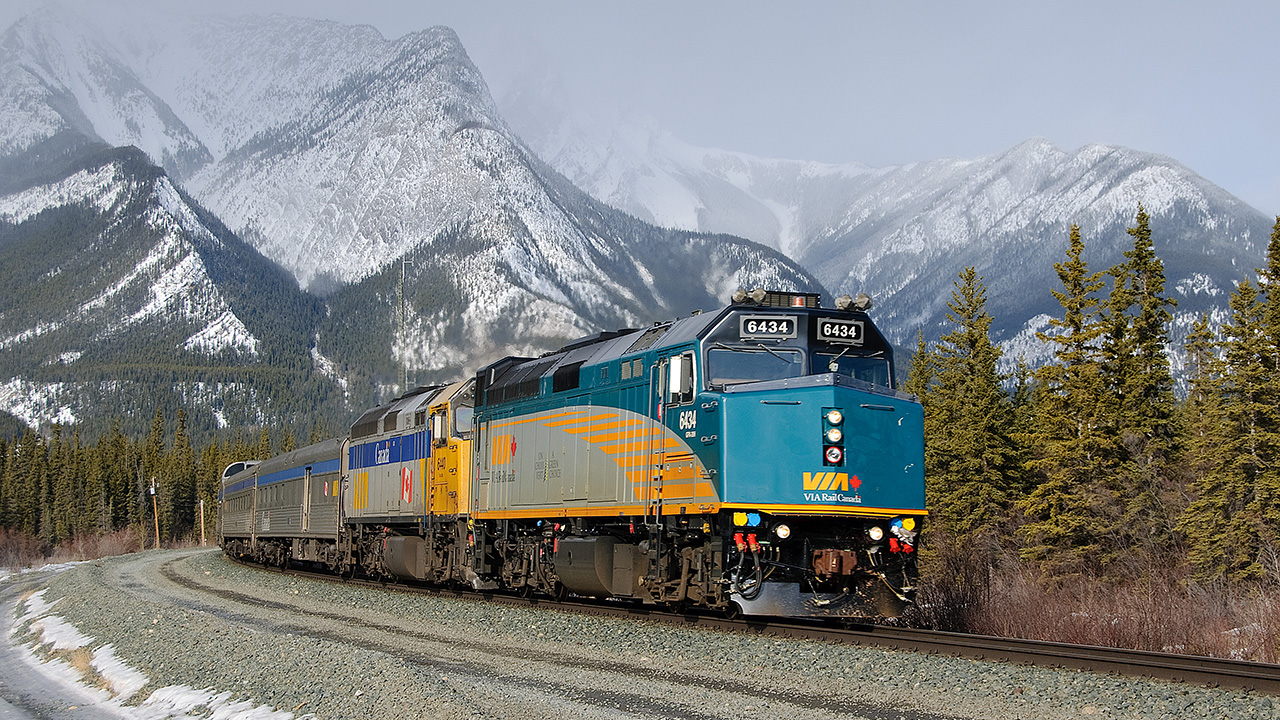
2011: VIA #1, The Canadian is led by newly rebuilt F40PH 6434 near Jasper, Alberta. Tim Stevens/Wikimedia Commons
Last summer I finished riding the entire VIA Rail system, including the railroad’s remote “Adventure” routes. It was not easy, and I reported those trips in a series collectively titled Adventures on VIA Rail. This is another trip report about VIA Rail, but it reflects a travel experience totally different from the adventures I had last summer. It was a trip on the transcontinental Canadian train, the last train in North America that offers an experience reminiscent of rail travel during the mode’s “Golden Age” during the past century.
The trip can easily be described as a “land cruise” rather than a train that a traveler would use to go somewhere. There are some travelers who use the train for that purpose, but it’s not easy. The train only runs twice a week, and its running time from end to end has been extended to four days. Historically it was three days, then it was lengthened to 3½, and now it’s four. Class segregation is rigidly enforced. “Economy Class” (coach passengers) are never permitted to enter the domain of the sleeping car passengers, and the reverse holds, too. Before the train left Vancouver, I walked on the platform toward the head end as far as I was allowed to go, and then boarded a coach to walk back to my sleeping car accommodation. I was told by an attendant that I was not supposed to be there. Rather than alighting from the train, I walked back to my car and counted 49 passengers in the two coaches.
As I recently reported, I traveled to Seattle on Amtrak’s Lake Shore Limited and Empire Builder.While there, I rode the recently expanded T-Line, the light-rail line in Tacoma. I also covered the first day of service on Sound Transit’s “2” line between Bellevue and Redmond. On Saturday, April 27, I took Train 518 to Vancouver. It did not arrive until after midnight, so I missed the last bus to where I was staying and had to take a taxi. To their credit (and to mine, in a different context), Amtrak gave me a voucher in the amount of the fare I had paid. I spent Sunday sightseeing in downtown Vancouver and nearby neighborhoods like Chinatown and Yaletown. I also rode the entire three-line Skytrain system and the Seabus ferry to North Vancouver at just the right time to enjoy a magnificent sunset. The one drawback was that, even though it was almost May, the weather in Seattle and Vancouver was chilly. It would be even colder for most of the trip, only warming up to springlike temperatures near Toronto.
An Unusual Train, for Several Reasons
By North American standards, the train is a monster. Consists are seasonal, and the warm-weather consist is very long, far longer than anything on Amtrak, including the portion of the Auto-Train where the passengers ride. Our consist started with three EMD F40PH-2 locomotives. Apparently, one of them was a helper unit running through the mountains, because it was taken off at Jasper, Alberta. Behind it were a baggage car, two coaches, a dome lounge car (VIA Rail calls them “Skyline” cars) for coach passengers, another Skyline car and dining car for sleeping car passengers, six sleeping cars, another Skyline car and diner for sleeping car passengers, and three more sleeping cars. Each of them consisted of four roomettes, six bedrooms, and three open sections with upper and lower berths. There was originally a fourth section, but VIA Rail converted it into a shower room. At the rear of the train were two “Prestige Class” sleeping cars that had been converted to consist of seven staterooms each. A round-end observation car (called a “Park Car”) completed the consist.
Apparently one of the sleeping cars was a crew car, accommodating the on-board service crew, which numbered 27 employees. VIA Rail does not have “conductors,” the boss of the train is a “service manager” who rides the entire route. Head-end crews still change at designated points and are subject to hours-of-service rules, which are similar in the United States and Canada.
VIA Rail began offering Prestige Class service a few years ago. Fares start at about C$7000, about $5000 U.S. and roughly three times the fare in “regular” sleeping car roomettes and bedrooms. For the extra fare, those passengers get some special dishes along with their regular dining-car meals, and the exclusive use of the Park Car while the train makes its way through the Rockies in British Columbia.
The equipment itself has been in service for 70 years. It was built by the Budd Company for CP Rail and was used on that railroad’s flagship train, the Canadian. After the CP route was discontinued and the train moved onto the CN main in 1990, VIA Rail kept the name, apparently to honor the equipment.
In many respects, the experience resembled rail travel from the middle of the past century, when host railroads were still proud of their passenger trains and promoted them as a good way to enjoy the trip on the way to a traveler’s final destination. On this particular train, that experience began at Vancouver’s Pacific Central Station, which comes alive twice a week for an hour or two before the train’s scheduled 3:00 departure on Mondays and Fridays.
This specific trip, which left on April 29, was a transitional run. It was the last one that offered “off-season” fares, which apparently expire at the end of April. It was also the first trip that featured a longer consist than runs in the off-season. A second dining car, Skyline car, and set of sleeping cars had been added, and several crew members whose employment appeared to be seasonal were returning to their jobs on the train.
The dining service was unlike any other in the Continental United States or elsewhere in Canada on a scheduled train that is not specifically an excursion between endpoints (I have not yet ridden the Alaska Railroad, whose trains also carry a dining car). Meals are included and, although the soups and desserts were not freshly prepared, the main courses and salads were. Three meals a day were included from Monday dinner until Friday noon, and even the flavor of the pancakes changed every morning. Dinner selections included salmon, sliced steak, roast beef (I requested the end cut and got it), and roast pork with berry sauce. The lunches were not quite as elaborate, but everything was a cut above the meals offered on Amtrak or on VIA Rail’s Ocean between Montreal and Halifax.
There are two crew bases for the train. The one at Winnipeg serves primarily the Toronto portion of the trip, as well as the train to Churchill. Most of the crew members for the Vancouver side of the trip are based at Vancouver, and the train changes crews at Winnipeg. While there is a crew base at Toronto, it serves the corridor-length routes that originate and terminate at that city. One outstanding crew member was James, the dining car steward, who reminded me of the stewards who ran the dining cars a half-century ago, when a meal on the train was an event that many passengers eagerly anticipated. James and his entire crew did an outstanding job, and all the food I had during the entire journey was good.
Strange Schedule and Route
Amtrak’s passengers and their advocates often complain about how host railroads delay passenger trains to give priority to their freight trains. The situation is even worse on VIA Rail. The U.S. has a statute that mandates priority for Amtrak trains over freight, but compliance with that provision and enforcement of it are questionable. There is no counterpart to it in Canada, so VIA Rail trains are always at the mercy of CN (and CPKC in a few places). Freight delays started shortly after we left Vancouver, and our train lost three hours on Monday evening alone. Some of the scenery during that time was interesting, and we caught a glimpse of the Rocky Mountaineer tourist train that had left Alberta the day before, after an overnight stop at Kamloops. It was also a long train, pulled by three units and consisting of a mix of heritage-style coaches and dome cars, plus equipment built by the now-defunct Colorado Railcar Company that had a full-length upper level for viewing the passing scenery.
Tuesday was the day to see the splendor of the Canadian Rockies in British Columbia, and to be pummeled by CN. Our train was held for 105 minutes before arriving at the mountain town of Jasper, Alberta, one of the two intermediate stops with a “downtown” station location. The other is Winnipeg. We arrived in Jasper at 3:05, slightly more than four hours behind schedule, and we did not leave until 6:18 (departure scheduled for 12:30). There was a further delay 24 miles west of Edson, as the head-end crew went dead, and we had to wait for a fresh crew. It also snowed between Edson and Evansburg, a town east of there and still west of Edmonton.
I had ridden the train a few times during the past few years, and some of the other passengers were railroaders or retired railroaders. It was fun talking with them about the railroad and hearing their stories. This trip was different. It turned out that someone I know from the advocacy movement was on board from Vancouver to Edmonton, with plans to stay in a hotel in Edmonton, take a taxi to the airport, and go home on an airliner. We were due into Edmonton at 6:50 PM but did not arrive until 3:48 on Wednesday morning, essentially nine hours behind schedule. The “Edmonton station” is no longer located downtown, but is now in a yard several miles away, so my friend probably had very little time to enjoy some rest in his hotel room before leaving for the airport. He did get to use his room in the sleeping car until our train reached the Edmonton station, though.
By Wednesday, the interesting scenery was gone. We spent the day rolling along the prairie in Saskatchewan. That included an hour at the Saskatoon Station, which is also located far from the city’s downtown area. At that time, we were 6½ hours behind schedule. We did not arrive at Winnipeg until 3:30 the next morning, 5½ hours behind schedule. Except for Jasper, Winnipeg is the only intermediate stop located downtown in a city. Winnipeg Union Station is beautiful and historic, but its only purpose for many passengers was to provide a place to sit up for most of the night waiting for the eventual 4:50 departure (scheduled for 11:30 the previous evening) or getting off the train in the middle of the night, rather than at 10:00 the previous evening, as scheduled. By that time, it was Thursday.
A new on-board service crew relieved the crew that had worked from Vancouver. The scenery had changed to the endless procession of woods and lakes of the Canadian Shield. There were opportunities to get off the train and stretch our legs on the platforms at the railroad towns of Sioux Lookout, Armstrong, and Hornpayne. We left Hornepayne at 11:03 PM, almost 4½ hours behind schedule.
Friday was our arrival day in Toronto. We arrived at Capreol at 7:10 and left at 7:45, although our scheduled times were 3:42 and 4:27, respectively, in the middle of the night. There was time to walk on the platform there, too, but I had visited the town last summer as a side trip from Sudbury after riding the “Budd train” and before catching a bus to Ottawa. After a light lunch and time to say good-bye to fellow passengers and the crew, we arrived in Toronto at 3:33 PM, a mere 64 minutes behind schedule. A crew member had told me that the schedule had eleven hours of slack. We had used eight of them.
Trip Impressions
In the late 1990s and until 2009, Amtrak and VIA Rail jointly offered the North America Rail Pass. It was valid for 30 days of unlimited travel on both railroads, and it required at least one segment on each. During that time, I made several trips on Trains 1 and 2, always riding in coach. The coaches were the same then as they are now, and they are comfortable. The rules were different then, and coach passengers were allowed to purchase meals in the dining car if there was room for them to eat. Sleeping car passengers had priority, but the classes were not rigidly segregated, as they are today. On one occasion there was no seat for me at any time during lunch, so the crew prepared a meal for me and served it in the adjacent lounge car. That would not be allowed under today’s rules.
The passengers were different then, too. Because I was riding coach but eating lunches and dinners in the dining car, I got to meet my fellow riders form both classes (Prestige Class did not exist then). It made the trip more interesting, because the passengers in the two classes were very different. Most of the coach passengers were Canadians or Americans, and many were looking for an adventure. Some were taking the train to go somewhere, which was easier then. It ran three times a week rather than twice, and the trip was scheduled to take three days end-to-end, rather than four. The people with whom I ate were very different. While there were some Canadian and American passengers in the sleeping cars, many were from Great Britain and Ireland, where VIA Rail promoted the train as a “land cruise.” I felt like I was riding on British Rail, rather than on a train in Canada when I had those meals.
The sleeping car passengers I encountered on this trip did not seem particularly different from the coach passengers I encountered last summer. They were pleasant, and they represented a diversified mix. There were a few Canadians whose primary language is French, although most riders spoke primarily English. VIA Rail crew members always make announcements in both languages. I was in a lower birth, and my “bunkmate” in the upper was a young man of Filipino heritage who lives in Vancouver and was going to Toronto to visit his family. He told me that his father had been a journalist and that he wanted to follow in his father’s footsteps. I felt some kinship with him because of that, and I wished him well.
The lounge (“Skyline”) cars have not changed much. They have a lounge section at one end of the car and six dining tables at the other end. There is a dome section in the middle, seven steps above the floors at the end sections, and a galley and an attendant’s area below it. Cars of that sort are now extinct in the United States, except on tourist railroads, although Amtrak owns one or two and occasionally places one into a consist. The Alaska Railroad and the Rocky Mountaineer (a luxury land-cruise train that sells a package which includes a hotel stay in Kamloops) have some, too. The only other train on VIA Rail that has one is the Skeena (the name is now only used unofficially) between Jasper and Prince Rupert, B.C. (just south of the tip of the Alaska Panhandle), with an overnight stop at Prince George.
The attendant in the Skyline cars for sleeping car passengers are now called “activity coordinators,” apparently similar to their counterparts on cruise ships. They were personable and knowledgeable. They showed videos about the places where the train goes, as well as the train and its equipment. They also gave talks and coordinated games for their riders. That gave us something extra to do, especially on the part of the trip east of Edmonton, where the scenery is far from spectacular.
Closing Advice
Traveling on the Canadian is truly a “blast from the past,” a sample of what rail travel was like a half-century or more ago, when the railroads promoted the comfort and services available on their passenger trains, including freshly cooked meals in the dining car. That experience is no longer available on Amtrak or on other VIA Rail trains. If for no other reason, it is worthwhile to take the trip. The full experience is only available to sleeping car passengers, and the most-comfortable accommodation is not the most expensive. It is the lower berth, a remnant left over from the heyday of rail travel. The bed is wider than in a roomette or bedroom and, although the level of privacy is reduced during the day, the Skyline car, with its dome, is available during the time between meals.
It probably makes sense to go westbound on Train 1, rather than eastbound on Train 2. The scenery is concentrated in the western part of the route, and there is very little to see east of Edmonton. Vancouver and Toronto are both interesting cities, and a trip should include time to explore both of them. A full tour of Canada should also include Montreal and Ottawa, and maybe Quebec City, as well. VIA Rail offers relatively frequent service on its corridors between those cities and Toronto, so it is not difficult to travel in that part of Canada. There are also Amtrak trains from New York to Toronto and Montreal, which is not currently running, but is scheduled to return to service soon. These are day trains, so more overnight stays are required. There are also two daily Amtrak trains between Seattle and Vancouver.
Winnipeg is the connection point for the Churchill train, while Jasper is the transfer point for the Prince Rupert train, which requires getting a room (on your own) for the overnight layover in Prince George. There are no guaranteed same-day connections between VIA Rail trains outside the places along the corridors in Ontario and Quebec, so a trip requires a great deal of advance planning.
Frankly, four days is a lot of time to spend on the train, especially since it goes through interesting scenery for only one of those days. The three-day trip on the old schedule did not feel nearly as long. There is no valid reason to expect that the tri-weekly three-day schedule will ever return, though, at least not in the foreseeable future.
After my ride, I spent the rest of Friday in downtown Toronto. On Saturday, I bought a day pass on GO Transit through their app for C$10, and took round trips to Niagara Falls and Allandale, near Barrie. I needed to be home on Sunday, so I took a bus on New York Trailways. If Amtrak had offered a night train between Toronto and New York, I would have used it. Some advocates have called for Amtrak to run overnight trains on routes that are shorter than the 750-mile minimum for a “long-distance route” designation, but longer than corridors. Sadly, that does not appear likely in the foreseeable future.
Still, VIA Rail’s Canadian provides an interesting travel experience that is now unique in North America, and it’s a trip worth taking at least once, while its vintage equipment is still in service.
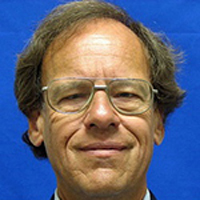
David Peter Alan is one of North America’s most experienced transit users and advocates, having ridden every rail transit line in the U.S., and most Canadian systems. He has also ridden the entire Amtrak and VIA Rail network. His advocacy on the national scene focuses on the Rail Users’ Network (RUN), where he has been a Board member since 2005. Locally in New Jersey, he served as Chair of the Lackawanna Coalition for 21 years and remains a member. He is also a member of NJ Transit’s Senior Citizens and Disabled Residents Transportation Advisory Committee (SCDRTAC). When not writing or traveling, he practices law in the fields of Intellectual Property (Patents, Trademarks and Copyright) and business law. Opinions expressed here are his own