CHSRA Releases Draft 2024 Business Plan
Written by Marybeth Luczak, Executive Editor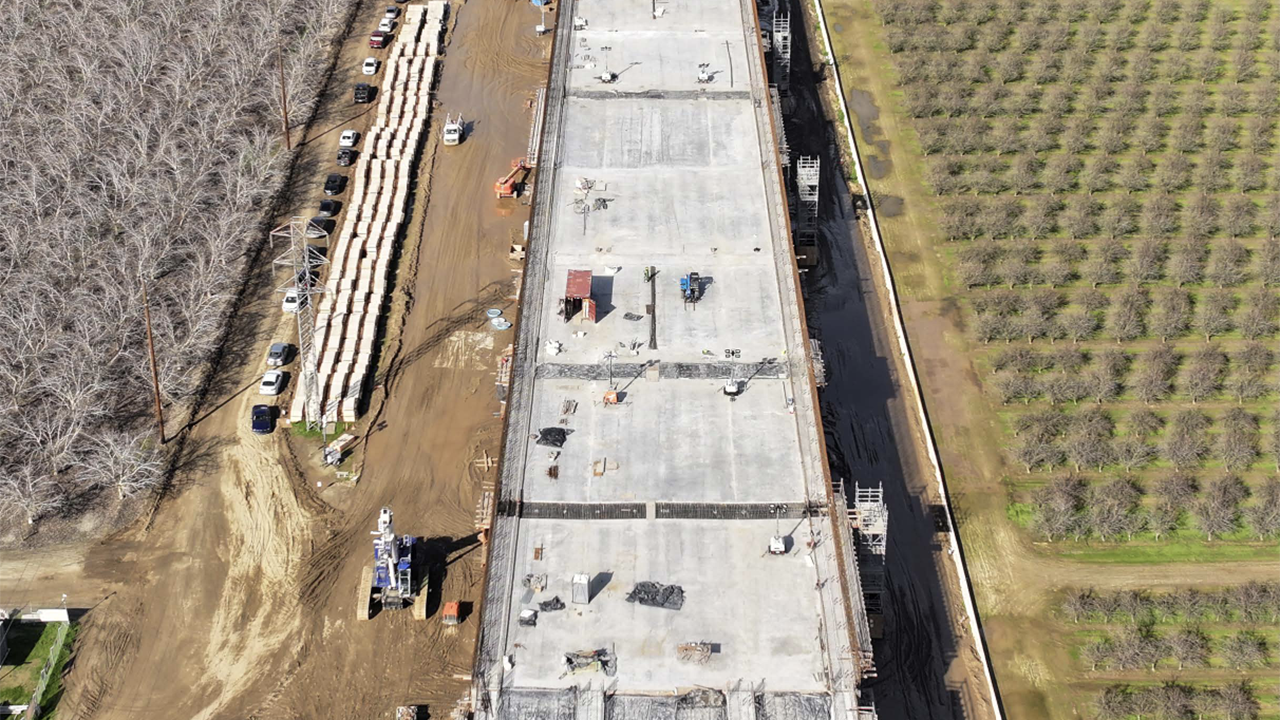
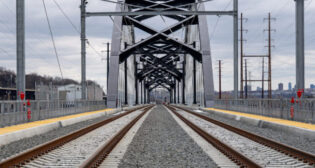
Pictured: Hanford Viaduct in Kings County (CHSRA Photograph)
The California High-Speed Rail Authority (CHSRA) on Feb. 9 issued its draft 2024 Business Plan for public review and comment. It covers major program progress in Northern California, the Central Valley and Southern California, as well as updates on federal funding, ridership and construction status. It also maintains cost and schedules from the 2023 Project Update Report (PUR), released in March 2023.
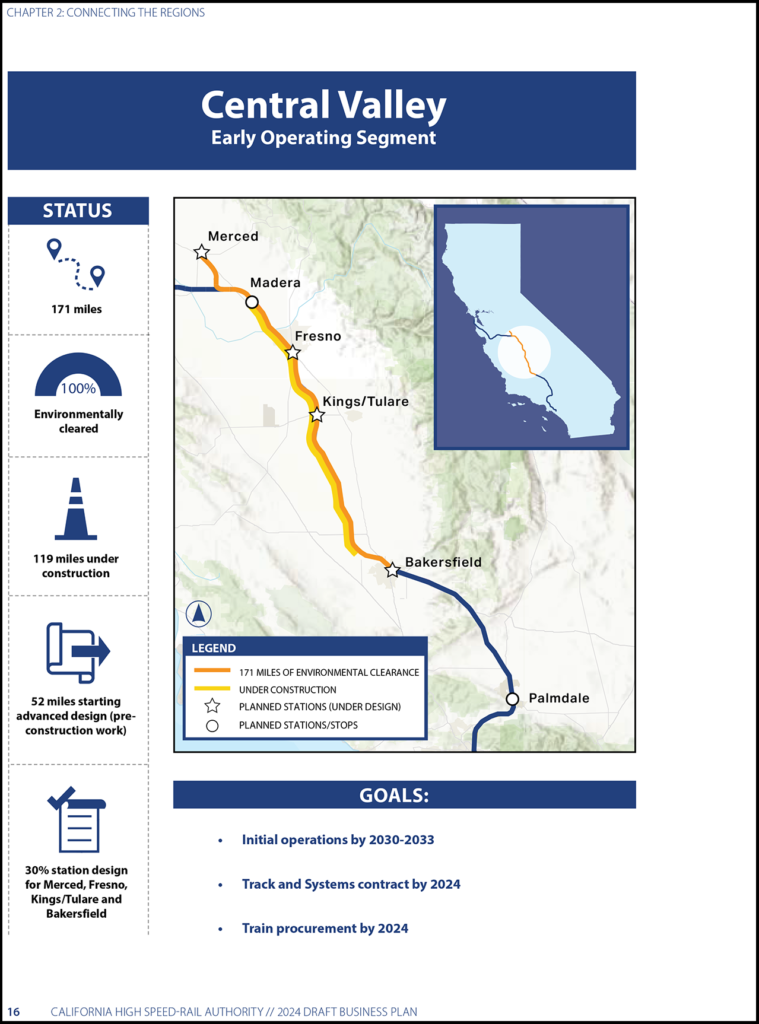
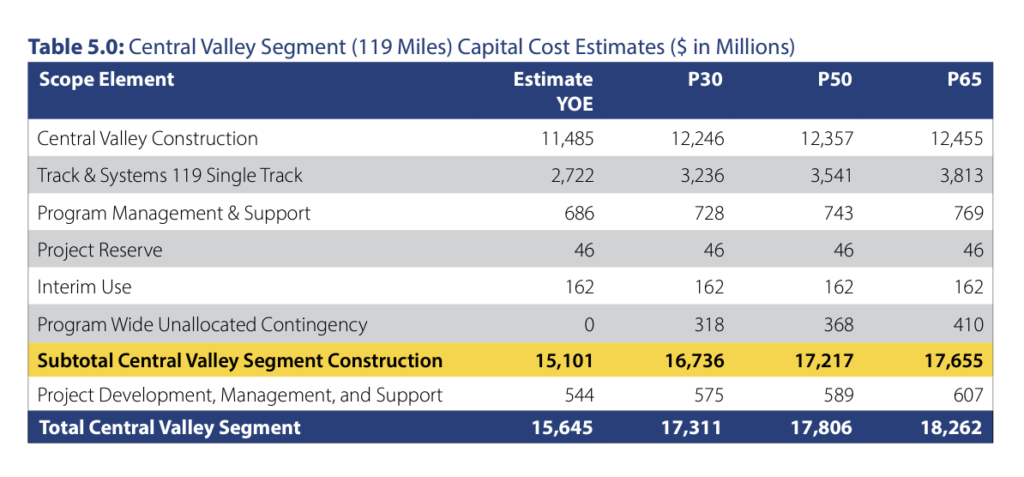
California high-speed rail is currently under construction along 119 miles in the Central Valley, where there are more than 25 active job sites (see map below). Additional advanced design is proceeding on stations and the 52 miles of extensions into downtown Merced and into downtown Bakersfield. The 494-mile, Phase I system will extend from San Francisco to Los Angeles/Anaheim; 422 miles have already been environmentally cleared. The system could eventually extend to Sacramento and San Diego, totaling 800 miles with up to 24 stations. The 171-mile Merced-to-Bakersfield segment is anticipated to start operations between 2030 and 2033.
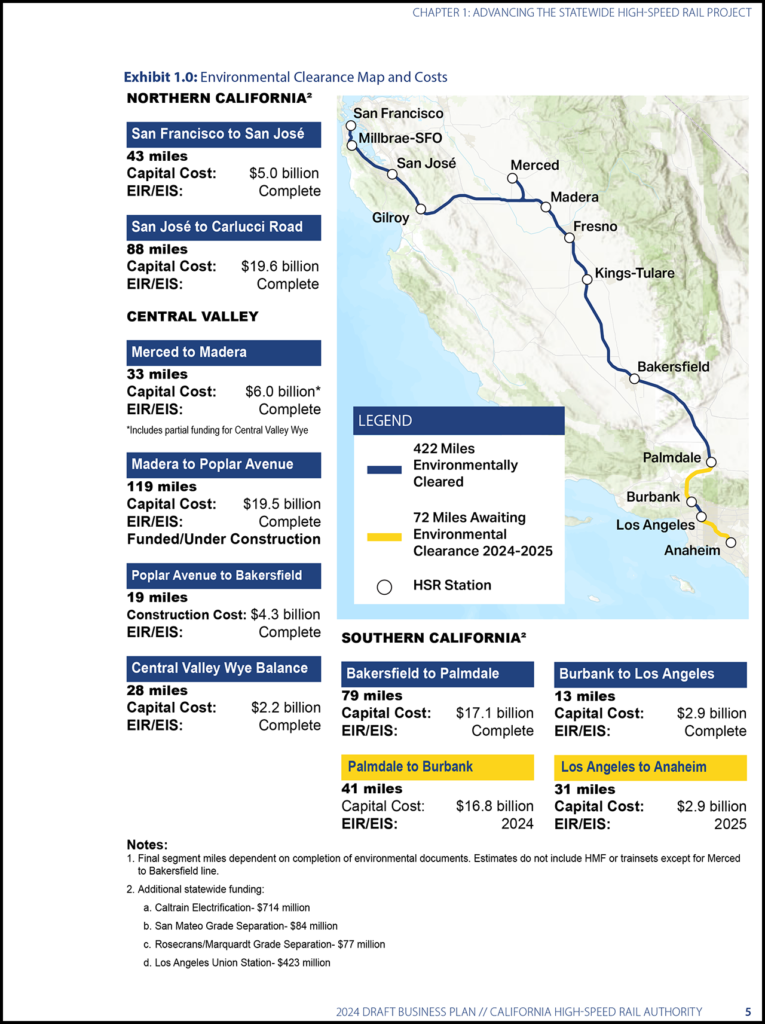
According to CHSRA, highlights between the 2023 PUR and the draft 2024 Business Plan (download below) include:
- The Authority was awarded $3.3 billion in new federal funds to advance work on the initial operating segment between Merced and Bakersfield. This includes nearly $3.1 billion from the U.S. Department of Transportation’s Federal-State Partnership for Intercity Passenger Rail Program and almost $602 million from the Federal Railroad Administration’s Consolidated Rail Infrastructure and Safety Improvements program.
- The Authority is advancing necessary procurements to move the project from construction into operations, including purchasing electrified trains and designing the track and systems needed for passenger service.
- The first construction package (CP 4) covering 22.5 miles in the Central Valley has reached substantial completion.
- The Authority’s construction jobs exceeded 12,200 in 2023 and set records for the number of daily workers on the job sites.
- The designs for the extensions to Merced and Bakersfield, as well as the four Central Valley stations, are on schedule, meeting contract milestones for 2023.
“With the re-investment from our federal partner, it is increasingly urgent to stabilize state funding for the program beyond 2030,” CHSRA reported. “In light of constrained funding, we continue to be laser-focused on delivering our project in building blocks by adhering to the following priorities to get the Merced to Bakersfield system operational between 2030 and 2033:
- “Complete civil and track and systems construction of the 119-mile segment currently under construction in the Central Valley.
- “Extend civil and track and systems construction work to Merced and Bakersfield for a total of 171 miles.
- “Continue to complete environmental reviews of remaining project sections between San Francisco and Los Angeles—in 2024, 463 of 494 miles of the project will be environmentally cleared.
- “Advance geotechnical and design work where environmental work is completed.
- “Continue important work with our partners on bookend projects, including the Caltrain electrification project and the LinkUS project.”
Funding
According to CHSRA, estimated costs to build a double-tracked, electrified high-speed service connecting Merced, Fresno and Bakersfield remain within the $30 billion to $33 billion range as identified in the 2023 PUR. It noted that high-speed rail is “the best value investment” with a cost range of $89 billion to $128 billion (base: $106 billion) compared with the cost range of $179 billion to $253 billion (base: $211 billion) that would be necessary to construct the equivalent highway and air passenger capacity.
CHSRA reported that it “remains committed to securing remaining funding for the construction and operation of the 171-mile Merced to Bakersfield segment.” Funding efforts, it said, have included $4.2 billion from Proposition 1A in 2022 and allocations from Cap-and-Trade auctions, which range from $750 million to $1.25 billion annually. “Despite these funding sources, there is still a gap between the available funds and the total capital costs,” CHSRA said. “To bridge this gap, we developed a federal funding strategy and approach to secure $8 billion in new federal grants over the next five years. The Authority was awarded a total of $3.3 billion in federal funds in 2023, and efforts are ongoing to secure additional funding. As new federal grants are received, we adjust our program baseline budget.” CHSRA said that its budget has been increased to accommodate funds received for building six grade separations in the city of Shafter and the Federal-State grant received in December 2023. “A stable federal funding commitment is key to developing a high-speed rail system in accordance with international standards,” it said. “We are also pursuing state funding stability as existing funding sources approach expiration [in 2030].”
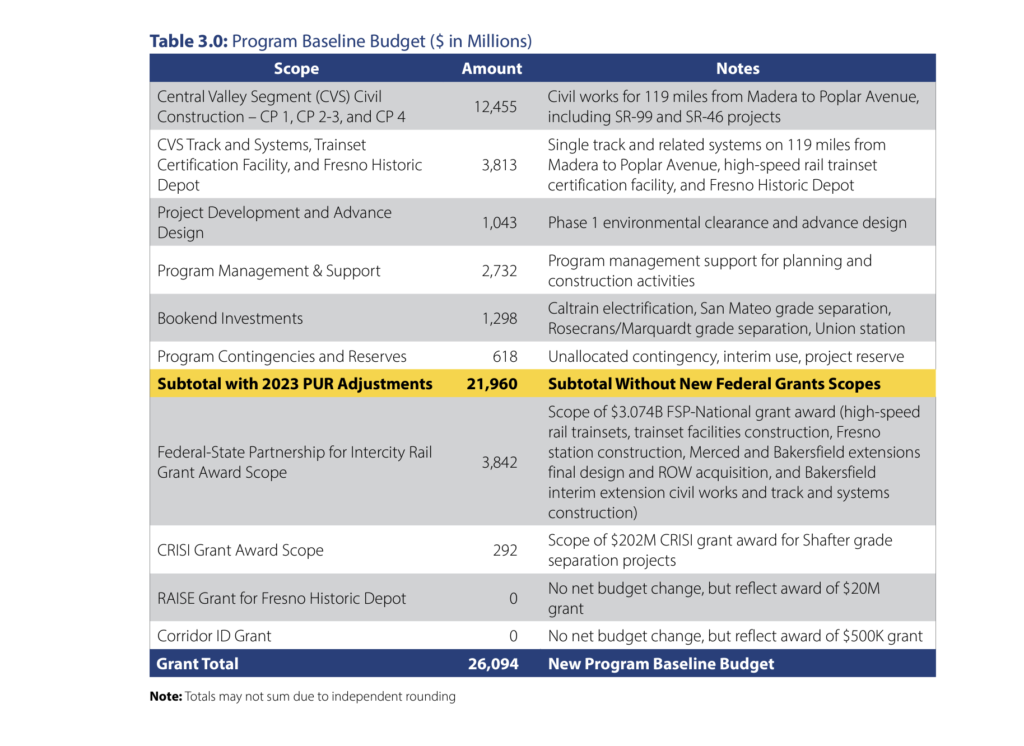
In January, the CHSRA Board adopted a revised program baseline budge (see table below). “The program baseline budget will continue to evolve as new federal grants are received and the Authority advances new contracts,” CHSRA reported.
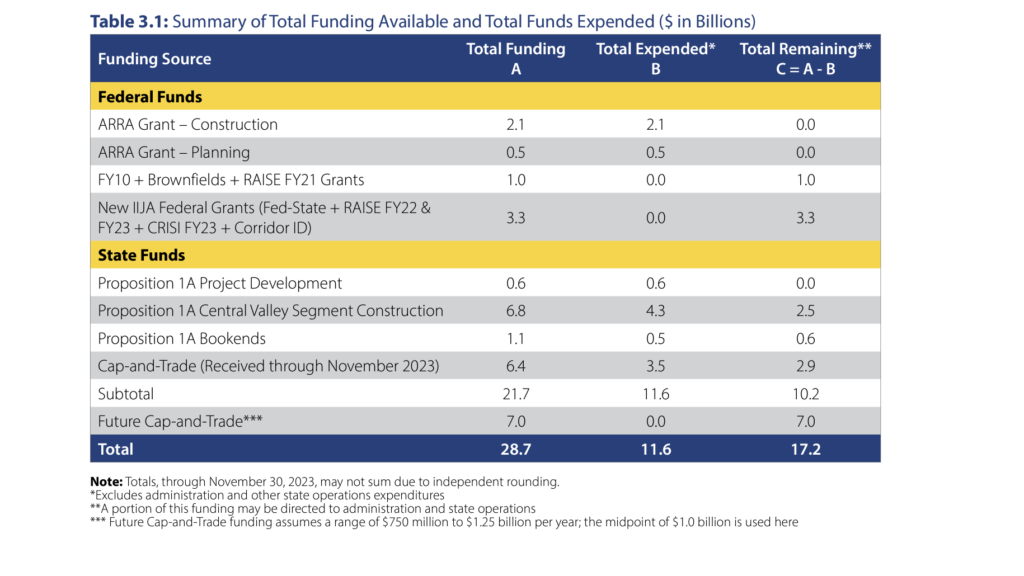
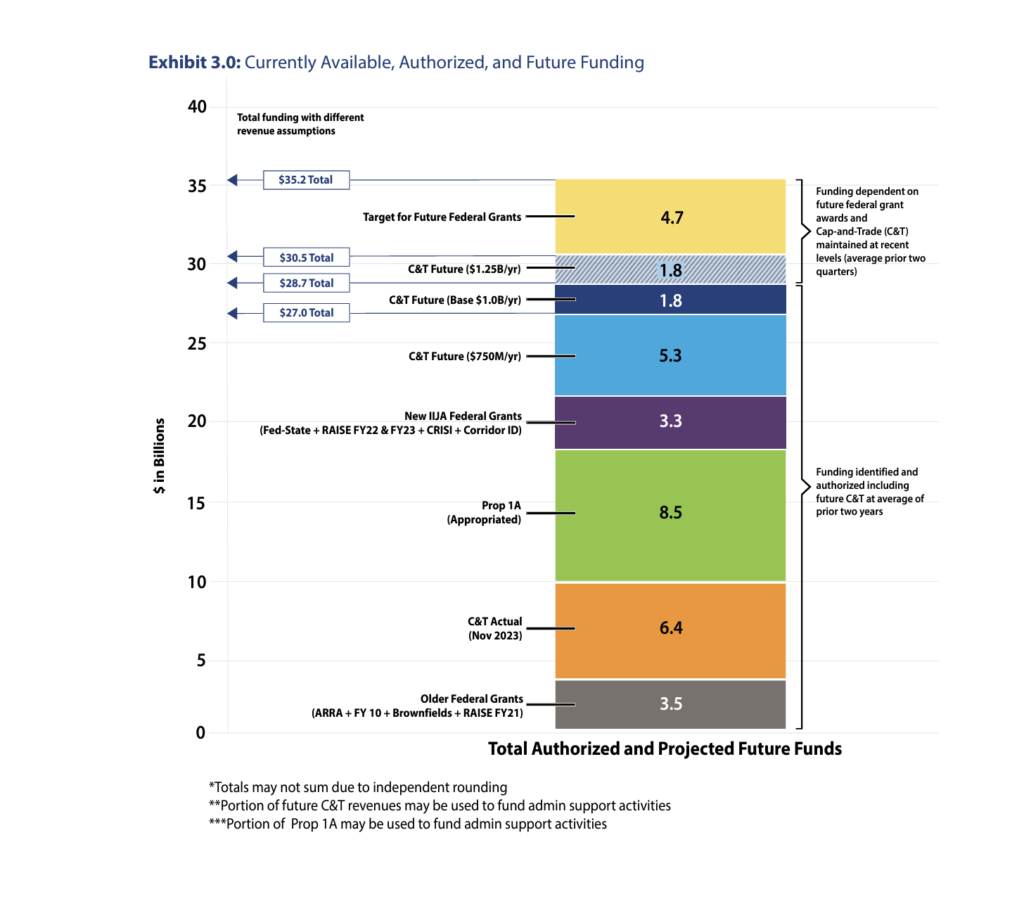
The draft Business Plan provided an overview of the current and projected funding available to the high-speed rail program through 2030 (see tables below). The total amount of identified revenue for the capital program is currently estimated in the range of $27.0 billion to $30.5 billion, CHSRA said, assuming Cap-and-Trade annual revenue scenarios of $750 million and $1.25 billion per year through 2030, respectively.
Ridership
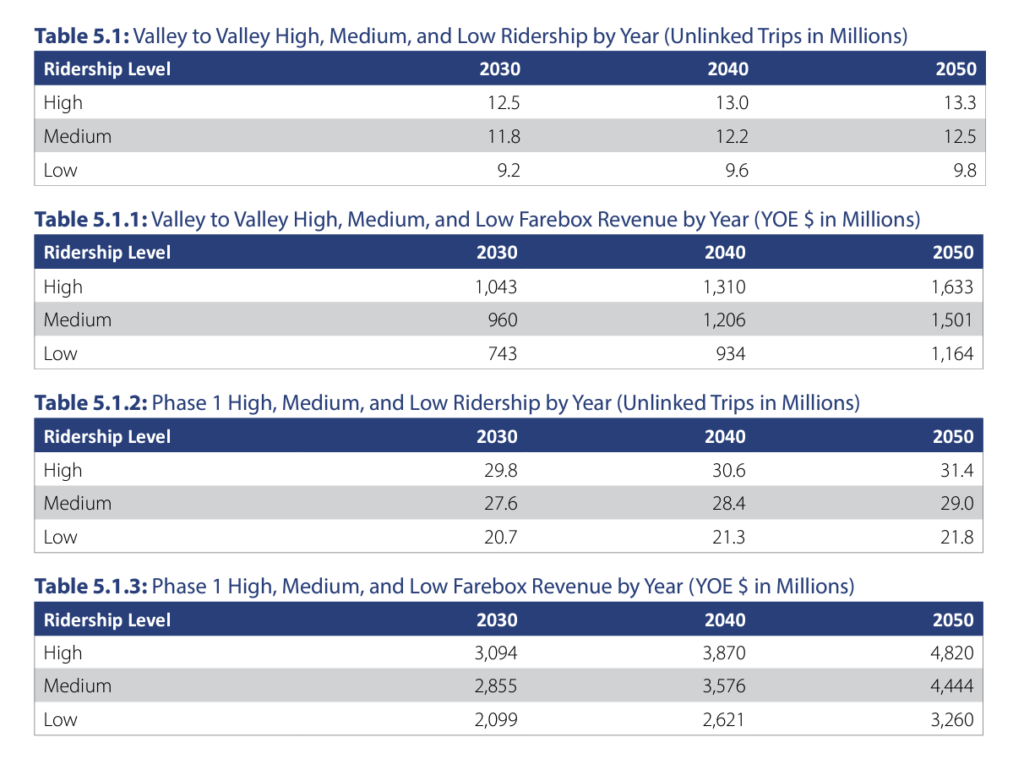
“While there has been a modest uptick in projected ridership in the Valley to Valley (Silicon Valley to Central Valley) segment from the 2023 PUR, the numbers remain lower than reported before the pandemic, primarily due to a decrease in California population projections,” CHSRA reported. The full 494-mile system is now projected to serve 28.4 million riders by 2040. The Authority noted that moving forward, “efforts will be focused on refining the integrated service plan, modernizing fare policies, and engaging in necessary agreements to further enhance ridership.”
Risk
CHSRA said it has implemented a “robust risk management program, establishing core processes, tools, and practices to identify and address risks that could impact our project.” It noted that it has “successfully improved planning, management, and collaboration with stakeholders, resulting in achievements such as improved property acquisition in the Central Valley, resolution of commercial issues, a settlement with the Burbank-Glendale-Pasadena Airport Authority, stay agreements in Bay Area litigation, and completion of the Semitropic Water Storage District canal realignment in Kern County.” While uncertainties and risks have decreased, new risks continue to emerge, it said.
The top risks include:
- Funding Uncertainty: If CHSRA receives new funding, it said it can make more timely decisions to advance construction or other program elements, reducing risk to the program schedule and budget.
- Third-Party Management: Interface, dependencies, changing conditions, and approvals related to third parties “pose substantial risk to the design and construction of the project and the program schedule,” CHSRA said. “Clear and constant communication” with third-party partners leads to more timely decision-making, and more efficient project delivery, it noted.
- Workforce Planning: “The Authority will be unable to deliver the high-speed rail project if it cannot secure appropriate staffing to meet its demands and requirements,” it said. “This can be achieved by successfully securing additional positions through the budget change proposal (BCP) process, reclassifying existing positions, and/or efficiently managing staffing priorities to support the future demands and requirements of the project.”
- Program Integration Management: CHSRA said if it is unable to “efficiently and effectively move from the construction phase to the rail operations phase of the project, then significant schedule delays, increased costs, and other adverse impacts could result.”
Construction
According to CHSRA, construction efforts in the Central Valley remain on schedule:
- Construction Package 4 (22.5 miles from the Tulare-Kern County line to Poplar Avenue in Kern County) is substantially complete, with the guideway and structures all but done. One land-rights dispute affecting just 400 feet remains to be solved, the Authority reported.
- Construction Package 2-3 (65 miles from Fresno to the Tulare-Kern County line) is set to be completed in 2026.
- Construction Package 1 (32 miles from Avenue 19 in Madera County to East American Avenue in Fresno County) is set to be completed in 2026.
CHSRA said that the project’s highest priority is to complete the Merced to Bakersfield line (consisting of the above three construction packages and the Merced and Bakersfield extensions), “with an aggressive goal to initiate service between 2030 and 2033.”
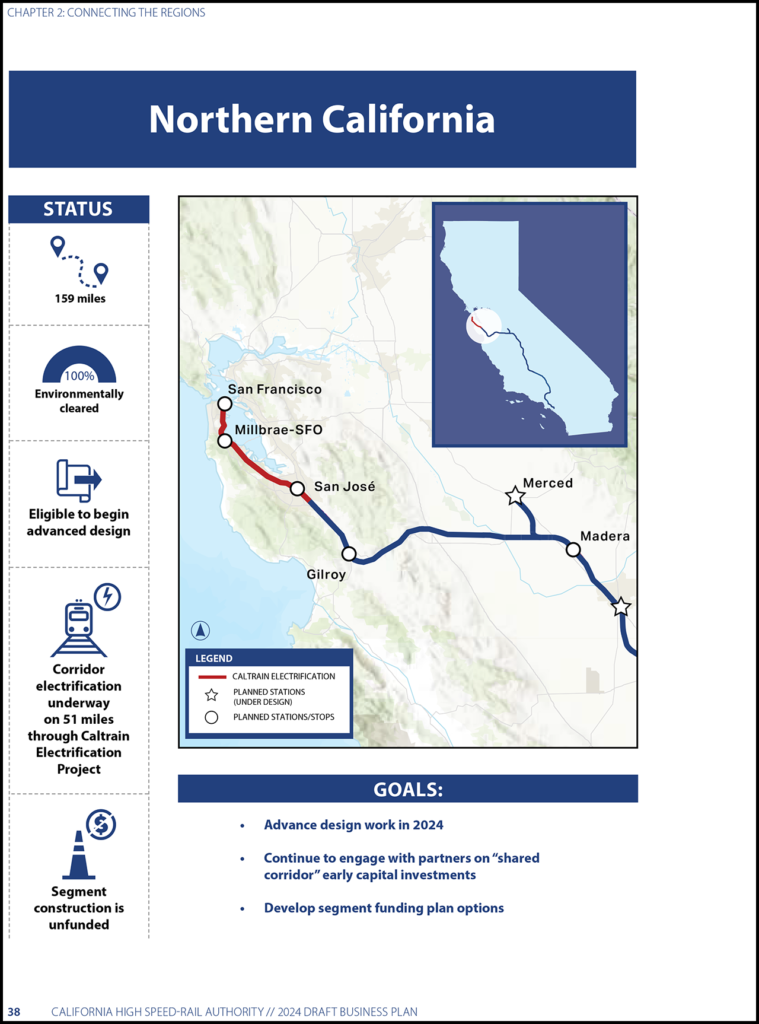
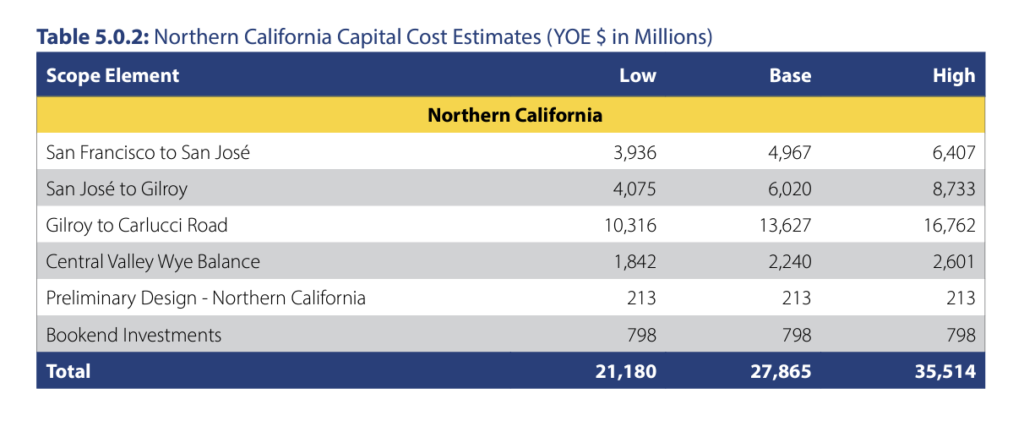
In Northern California, environmental clearance has been completed and the region is preparing for advanced design as funding becomes available, according to CHSRA. The project includes the integration of high-speed rail with existing rail networks, which the Authority said is highlighted by an investment of more than $700 million for the electrification of the Caltrain corridor between San Francisco and San José. The project also includes collaborative ventures like the Portal (formerly known as the Downtown Extension Project), aimed at linking the current rail line to downtown San Francisco’s Salesforce Transit Center, and the Diridon Integrated Concept Plan for transforming Diridon Station in San José into a key intermodal hub, CHSRA said. The Authority reported that it is “actively seeking additional funding to continue design work and begin critical geotechnical studies in the Pacheco Pass, a key step for linking to the Central Valley.”
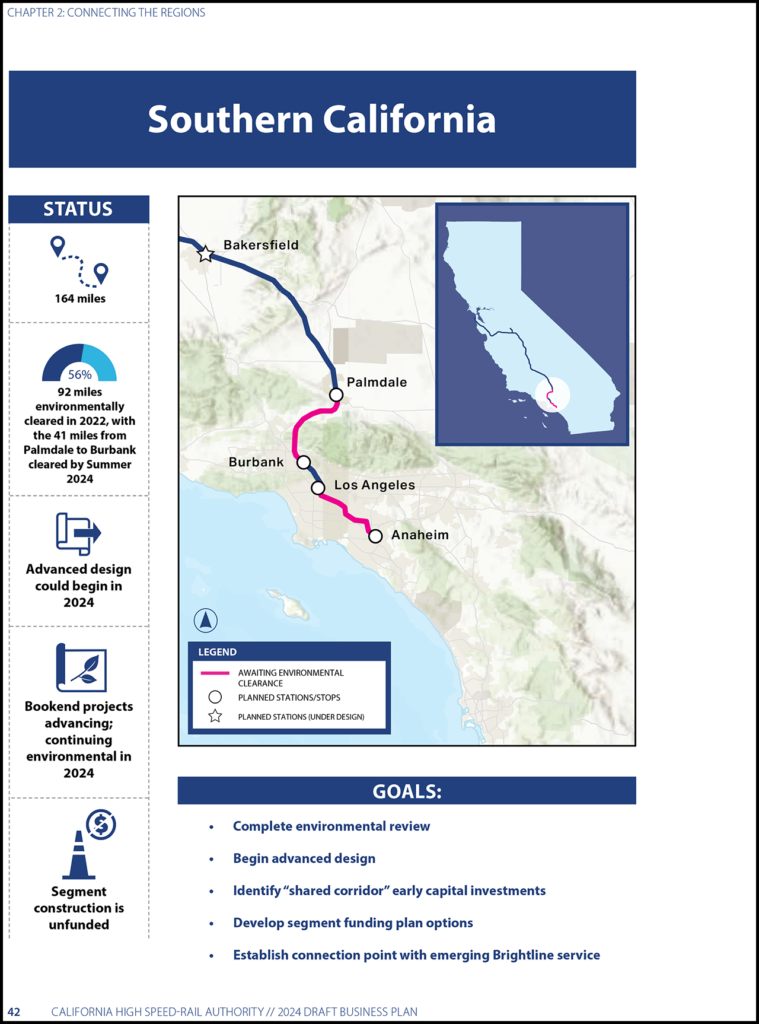
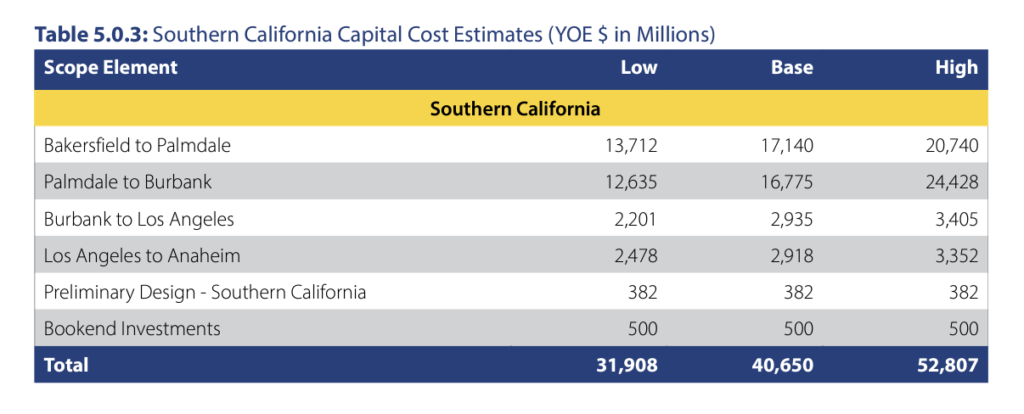
Work in Southern California is progressing, CHSRA said. This includes funding “important early projects, meeting environmental clearance goals, and working on grade separations to improve traffic flow,” it noted. The LA Metro grade separation at Rosecrans and Marquardt avenues is set for completion in early 2025. Funded with $78 million from the Authority, this project addresses the “previously high-risk railroad crossing, which caused vehicles, including trucks, to idle for an average of 21 hours weekly, exacerbating greenhouse gas emissions in an area already suffering from poor air quality,” according to CHSRA. In the Palmdale to Burbank project section, the Authority reported that the Draft Environmental Impact Report (EIR) and Environmental Impact Statement (EIS) were released in fall 2022 and the final EIR/EIS is expected to be completed soon. This will fully complete environmental clearance from San Francisco to Los Angeles. Additional plans in Southern California involve connecting the high-speed rail line to Brightline West via the High Desert Corridor, extending to Las Vegas.
“In sum, the short-term funding picture is improved, but long-term funding stability still must be addressed,” CHSRA CEO Brian P. Kelly wrote in the draft Business Plan. “While the Central Valley remains the center of our construction and early operations work, this is very much a statewide project. The Authority is advancing work in three distinct segments of roughly equal distance—the Bay Area (159 miles), Central Valley (171 miles), and Southern California (164 miles). In the early part of 2024, the Authority Board will consider certifying the environmental document for the Palmdale to Burbank segment. With that work completed, the entire Phase 1 system from downtown San Francisco to downtown Los Angeles will be environmentally cleared. As we move construction forward in the Central Valley, the Authority will be looking to advance design work in the Bay Area and Southern California, as well as complete more of the ‘bookend’ projects in those regions. With the combination of federal reinvestment in this project, new federal investment in the Brightline project between Rancho Cucamonga and Las Vegas, and the full environmental clearance from downtown San Francisco to downtown Los Angeles, the Authority will look to advance four key activities outside the Central Valley work:
- “Pursue funding to advance design and geotechnical work on the segments to the Bay Area and into the Los Angeles Basin.
- “Work closely with Brightline and the High Desert Corridor Joint Powers Authority to identify, optimize and ensure interoperability among the systems.
- “Release a new Request for Expression of Interest for private parties to participate in project funding for segments between San Francisco and Los Angeles.
- “Work with Early Train Operator (ETO) and other experts to holistically evaluate Phase 1 costs and construction methods to ensure efficiency as the project expands.”
Kelly, who has announced that he will step down this year as CHSRA leader, concluded that the draft Business Plan “reflects a transformative transportation mega-project on the move, with a renewed federal partnership.” He said it provides policymakers and the public “with a look at the promise, challenges, risks, and opportunities that are behind us and before us.”
“The last year saw project advancement like no year prior, but make no mistake—just as the country was built, it will take courage, imagination, and an unbeatable determination to complete this job at hand,” Kelly reported.
With the release of the draft business plan, the CHSRA Board will review it and seek input as part of a 60-day public comment period that started Feb. 9 and closes at 5 p.m. on April 9.
Further Reading:
- Watch: CHSRA Releases Renderings, Mock-Ups of Potential Train Interiors
- Network Rail Consulting Lands CHSRA Contract
- CHSRA Shortlists Alstom, Siemens as Potential Suppliers
- Watch: CHSRA Releases 2023 Retrospective
- CHSRA Issues Design Services RFQ for Track, Overhead Contact Systems
- Arup Awarded CHSRA Contract