FLIRT H2 Sets a Guinness World Record at TTC
Written by Matthew Dick, P.E., Chief of Strategy & Development, ENSCO, Inc.; and Stefan Bernsdorf, C.Eng., Senior Project Manager, Stadler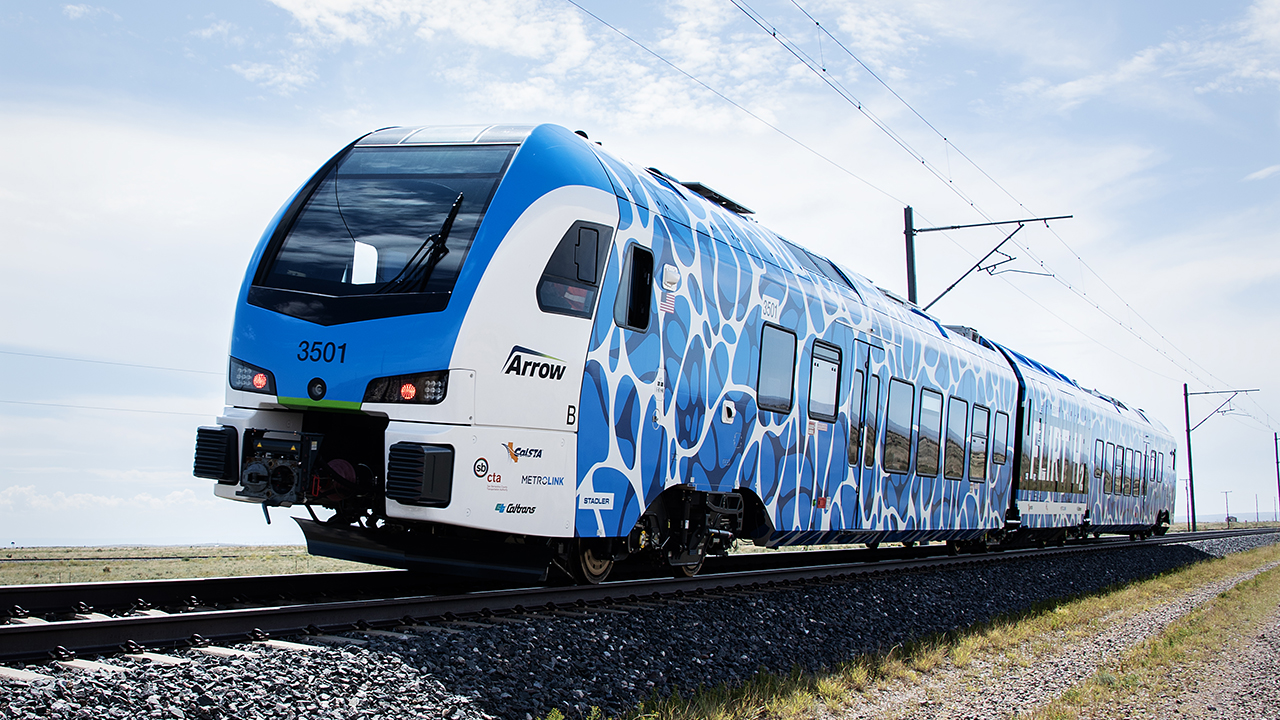
TTC OPERATED BY ENSCO, RAILWAY AGE JUNE 2024 ISSUE: Rail transportation has recently achieved a groundbreaking milestone with Stadler’s hydrogen-powered FLIRT H2 train. On March 22, 2024, the Zero-Emission Multiple Unit (ZEMU) secured a prestigious Guinness World Record by completing the longest distance ever traveled by a hydrogen fuel cell (HFC)-powered electric multiple unit train without refueling. This event took place at the high-speed test track at the Transportation Technology Center (TTC) achieving an impressive distance of 1,742.025 miles (2,803.518 kilometers), which is approximately the same distance from St. Louis, Mo., to the ZEMU’s final delivery location at San Bernardino County Transit Authority (SBCTA) in California.
The FLIRT H2’s journey not only showcases the remarkable capabilities of hydrogen-powered trains but also highlights the critical role of the TTC in fostering innovation and advancing rail technology. Additionally, this new world record aligns with the 50th anniversary of the first world record achieved at the TTC. On Aug. 14, 1974, the speed record of a rail vehicle was broken achieving 255.4 mph (411.0 kph) by the Linear Induction Motor Research Vehicle (LIMRV), a wheeled rail vehicle operating on standard track and outfitted with a gas turbine.
Record-Breaking Test
Stadler strategically utilized the world record opportunity to showcase the start of the new era of railway transportation with hydrogen fuel. Before, during and after the test, Stadler kept a close coordination with the Guinness World Record officials to ensure that all requirements were met. The test was monitored closely through various means including accurately measuring the length of the lap and final stopping location, keeping timestamps of each lap, counting laps, GPS trace of the train travel, and recording witness statements of personnel involved. As an extra precaution, the hydrogen fueling station at the TTC was physically closed off to prevent any doubt that the test was conducted without refueling.
Testing started on March 20, 2024, at 7:03 p.m. Mountain Daylight Time and continued non-stop until the train was stopped and recorded for its final distance traveled, which occurred on March 22, 2024, at 5:23 p.m. MDT. The team had approximately 46 hours of operation where train operators took turns with eight-hour shifts driving the train. A total of 129 full laps of the 13.5-mile (21.7-km) Rail Transit Track (RTT) was traveled during the test. After the conclusion of the test, the entire team congratulated each other for having completed the pivotal milestone (and completing the challenging marathon test). Soon after, the Guinness World Record officials gave notice of the world record award to Stadler.
Advancing Sustainable Solutions
Rail transport has long been an energy efficient mode of transportation with high carrying capacity and low emergency consumption per passenger or ton-mile. With the move toward sustainable energy sources, rail transportation now has an even greater opportunity to be part of the sustainable transportation solution.
One standout technology is HFC-powered trains. HFCs create electricity through a chemical reaction between hydrogen and oxygen, emitting only water vapor. When hydrogen is produced in an emissions-free method, it offers a genuine zero-emission transportation system. This technology holds immense potential for decarbonizing rail transport and reducing urban air pollution.
At the first annual TTC Conference & Tour in November 2023, Stadler US CEO Martin Ritter presented key insights. He highlighted the federal government’s push to enhance air quality and reduce CO2 emissions by subsidizing hydrogen production. Seven regional clean hydrogen hubs, benefiting from $7 billion in funding, are set to catalyze more than $40 billion in private investments. These hubs aim to produce more than three million metric tons of hydrogen annually, with two-thirds generated via sustainable electrolysis, cutting 25 million metric tons of CO2 emissions—equivalent to the annual emissions of 5.5 million gasoline-powered cars.
Ritter also delved into Stadler’s FLIRT and its variations, emphasizing the benefits of hydrogen propulsion for long-range journeys and its role as a range extender in hybrid systems. The presentation emphasized how HFC trains complement existing propulsion options, offering extended range and higher power while minimizing environmental impact. With dynamic testing and optimization conducted at the TTC, these innovations are paving the way for a greener, more efficient future in rail transport.
Joining the Sustainability Movement
The TTC is supporting the shift toward sustainable rail transport with groundbreaking initiatives like Stadler’s FLIRT H2 through on-track service testing. At the heart of this transformation lies the TTC’s fully operational hydrogen fueling capability, a critical resource enabling the testing and deployment of hydrogen-powered trains.
On April 4, 2024, U.S. Senator John Hickenlooper (D-Colo.) toured the TTC to observe safety and sustainability initiatives. During his visit, Hickenlooper experienced firsthand North America’s first hydrogen-powered passenger train by taking a ride on the Stadler ZEMU around the RTT loop, the same track used for the Guinness World Record. His visit and the historic ride signify the growing importance of sustainable rail transportation technology and TTC’s role to support it.
Conclusion
Stadler’s FLIRT H2 train achieving the Guinness World Records title is an historic milestone for sustainable rail transportation. Collaborations with innovative companies like Stadler, supported by the TTC, drive the transition to a greener, more efficient future for rail transportation.
Sustainable rail transport is crucial in global efforts to combat climate change and reduce greenhouse gas emissions. As governments and industries worldwide shift to cleaner energy sources, rail transportation’s role in sustainability is increasingly vital. By exploring alternative energy sources, adopting energy-efficient technologies, and electrifying rail networks, the rail sector can make substantial contributions toward mitigating environmental impact and fostering a greener future.
Stay tuned for updates on the 2nd Annual TTC Conference & Tour, scheduled for Oct. 22-23, 2024, in Pueblo. Discover more at ttc-conference.com, where this year’s conference will spotlight railway technologies supporting greenhouse gas emission reduction and sustainability.