


STB Orders Mediation for UP, Metra (UPDATED 8/15)
Written by William C. Vantuono, Editor-in-Chief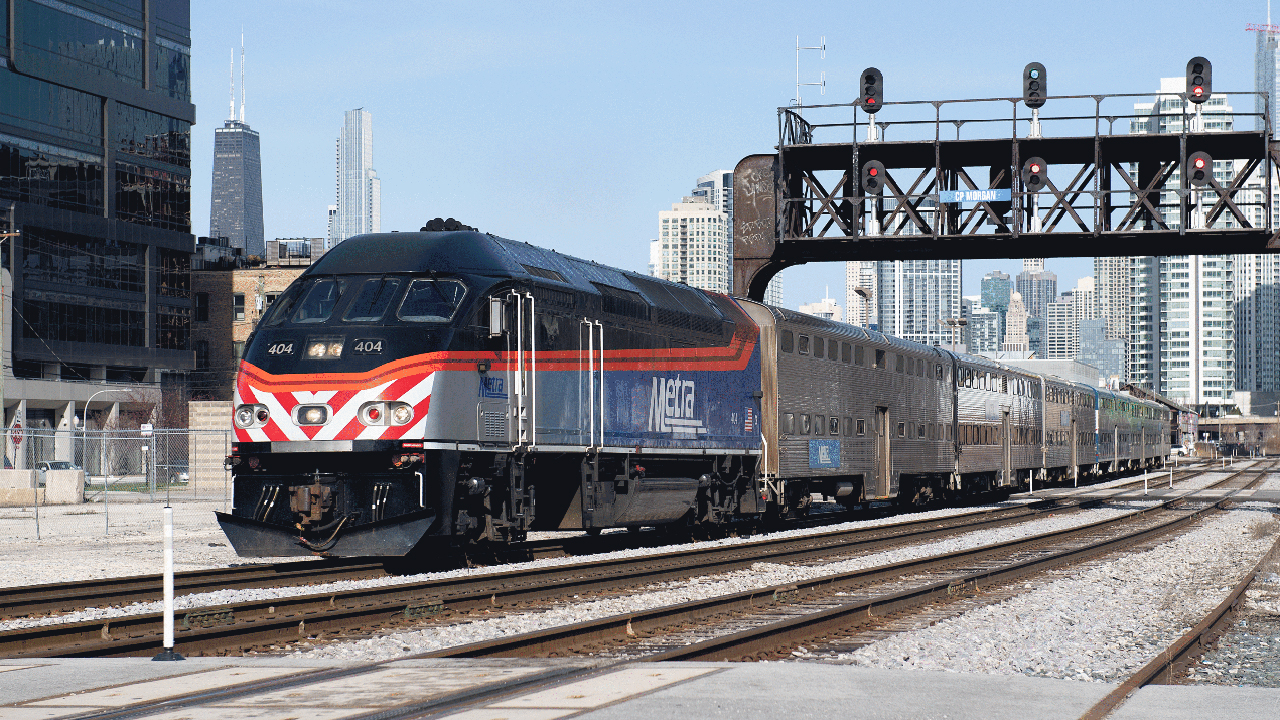
Metra UP-North Line. David C. Lester photo.
Union Pacific (UP) recently sought mediation through the Surface Transportation Board (STB) to resolve two “fundamental issues”—track access and maintenance fees—that have become a sticking point in forging a new contract with Chicago regional/commuter rail operator Metra. The agency filed a Response in Opposition. In an Aug. 14 decision, the STB ordered the parties to engage in Board-sponsored mediation.
In Docket No. FD 36800, APPLICATION OF UNION PACIFIC RAILROAD COMPANY FOR MEDIATION UNDER 49 U.S.C. § 28502 (download below), UP outlines its services to Metra running the UP North, Northwest and West Lines under a purchase-of-service agreement (PSA) that took effect in 2010, has been amended over the years and is currently set to expire Sept. 30, 2024. UP said it advised Metra in August 2019 that it was “willing to enter into a new arrangement for making its trackage and other property available for continued commuter rail service” and “proposed that it would continue to own the tracks, bridges, signal systems, and property … and provide certain limited services, including line maintenance and dispatching, while Metra would take responsibility for operating its commuter trains, maintaining its locomotive and car fleet, maintaining certain leased yard facilities and performing administrative and customer service functions.”
UP said negotiations “intensified in late 2021, after a federal district court ruled that Union Pacific has no obligation to provide commuter passenger services to Metra in the absence of an agreement.” Now, UP told the STB, it and Metra “have made meaningful progress toward implementing a new arrangement. On June 3, 2024, Metra assumed responsibility for maintaining its locomotive and car fleet and associated administrative functions, and both “are currently working on plans to transfer responsibility for ticketing and train operations, and certain engineering and other services from Union Pacific to Metra.”
“However, despite engaging in good faith negotiations over many years, Metra and Union Pacific have been unable to make progress on two fundamental issues: the fee Metra will pay for access to Union Pacific’s tracks and other property used for commuter rail service, and the fees and costs Metra will pay for engineering maintenance services that Union Pacific will continue to provide—primarily maintaining main lines used by Metra’s commuter trains,” the Class I said. “Since 2019, Union Pacific and Metra have exchanged multiple offers and engaged in multiple-in person discussions regarding the financial terms of the arrangement, but they have been unable to reach agreement.”
UP, saying it “strongly desires to reach an agreement with Metra,” has applied to the STB for mediation, citing that “as part of the Rail Safety Improvement Act of 2008, Congress established a mediation process to help rail carriers such as Union Pacific, and public transportation authorities such as Metra, reach agreement under circumstances like those present here.”
Railway Age reached out to Metra for comment. The agency provided the following statement:
“On [July 31], Union Pacific filed for non-binding mediation at the Surface Transportation Board (STB) over Union Pacific’s proposal for a new agreement that would significantly increase Metra’s costs and fees for providing passenger service in the Chicago area on three Union Pacific lines. Metra has engaged in extensive discussions with Union Pacific for several years over the proposed new agreement, whereby Metra would absorb certain operational functions and UP employees, but Union Pacific would continue to own the rail lines. The two sides have made progress on various non-financial matters, including the transfer of more than 390 Union Pacific employees to Metra. To date, Metra has not received sufficient information from Union Pacific to evaluate whether the increased costs and fees under Union Pacific’s proposed new agreement are in the public interest to justify the increase in expenditure of public funds. Metra previously had asked Union Pacific to engage in the STB’s informal process to resolve disputes with rail carriers without the use of litigation or the Board’s formal processes. Union Pacific declined. If the STB determines the parties should proceed with mediation, Metra will work collaboratively within the agency’s mediation process to try to reach a resolution on outstanding issues. Throughout the transition process with Union Pacific, Metra’s priorities have been and will remain maintaining a safe, quality service to our passengers and being good stewards of taxpayer dollars.”
Metra on Aug. 8 filed a Response in Opposition (download below) stating UP’s mediation application is “premature” and that Metra “did not join in.”
“Metra and UP have been engaged in negotiations for several years over the terms and conditions under which UP will continue to provide access to three of its interstate rail lines and related services to Metra for the agency’s passenger operations,” the agency wrote. “Progress in the negotiations has stalled because UP has not provided Metra with complete and sufficiently detailed financial information to support the substantially increased fees and costs that UP seeks to have Metra pay and assume under a new agreement. Metra repeatedly has requested but has not yet received the basic financial information necessary to evaluate the reasonableness of UP’s proposal. As a public-sector agency, Metra cannot meaningfully assess, and ultimately request or obtain approval for UP’s proposal without transparent and complete contract information. In lieu of and certainly prior to formal mediation, Metra has proposed and recommends that the parties initially proceed to work through the information sharing and financial aspects of their proposed agreement with assistance from the Board’s Office of Public Affairs, Government Assistance and Compliance.
“Metra acknowledges that UP has provided some proposed costing and pricing information in support of its proposal, but the information provided to date largely has been piecemeal and/or summary in form. Metra repeatedly has asked UP to provide a further breakdown and support for its current offer, including all of the individualized components of the proposed costing and pricing for Metra’s operations on the UP lines and UP’s calculation of the reimbursable costs and expenses associated with the operation of Metra’s passenger service. UP has exclusive control over this information, and Metra cannot properly evaluate and respond to UP’s proposal—much less request approval from its public-sector stakeholders for the ultimate agreement—until it has complete and transparent supporting information. The issue is not so much ‘the fees and costs Metra will pay’ as UP suggests, but more the total of fees and costs that UP is demanding Metra pay in the future, which would represent a substantial increase from Metra’s historical payments for the same services under the PSA.”
In a Aug. 9 Reply filing, UP expressed “disagreement with Metra’s view of the reason why the negotiations have not yet reached a successful conclusion,” and reiterated its position that Board-sponsored mediation “would be better suited to providing the ‘facilitation and focus needed to bridge the remaining gaps between the parties’ positions’ than more informal assistance would be,” the STB summarized in its Aug. 14 decision (download below).
STB Calls for Mediation
The STB on Aug. 14 directed UP and Metra to engage in mediation relating to the use of three UP rail lines for Metra’s commuter rail service.
“Under 49 U.S.C. § 28502, ‘[i]f, after a reasonable period of negotiation, a public transportation authority cannot reach agreement with a rail carrier to use trackage of, and have related services provided by, the rail carrier for purposes of commuter rail passenger transportation,’ either party may apply to the Board for nonbinding mediation,” the STB explained in its decision. “The statute also provides that ‘[t]he Board shall conduct the nonbinding mediation in accordance with the mediation process’ set forth in the version of 49 C.F.R. § 1109.4 in effect on the date of the statute’s enactment.”
According to the STB, both parties “acknowledge that they have been engaged in good faith negotiations for several years but have yet to reach agreement on ‘critical issues.’” The Board noted that “Metra does not argue that this years-long negotiation period without a resolution does not constitute ‘a reasonable period’ under § 28502, or that the statute is otherwise inapplicable here”; additionally, it reported that “[a]lthough Metra believes that informal assistance from OPAGAC [the STB’s Office of Public Assistance, Governmental Affairs, and Compliance] would be more effective at this
time, Metra also states that it ‘will participate fully and constructively’ in Board-sponsored
mediation if so directed.”
“Under the circumstances,” the STB reported, mediation will be ordered, and Board Chairman Robert E. Primus will appoint one or more mediators pursuant to 49 C.F.R. § 1109.3(a). The mediator(s), once appointed, will contact the parties to discuss the timing and logistics for conducting the mediation, and other matters. While mediation is expected to be completed within 60 days of the appointment of the mediator(s), according to the STB, the Board may extend it pursuant to mutual written requests of all parties to the mediation proceeding. Additionally, the mediation may be terminated prior to the 60-day period with certification of the mediator(s) to the Board. The mediator(s) must inform the STB when mediation has ended, “with or without a resolution,” the STB said.


