Commentary
Third of a Series: New York’s Plan and Why Officials Want It
Written by David Peter Alan, Contributing Editor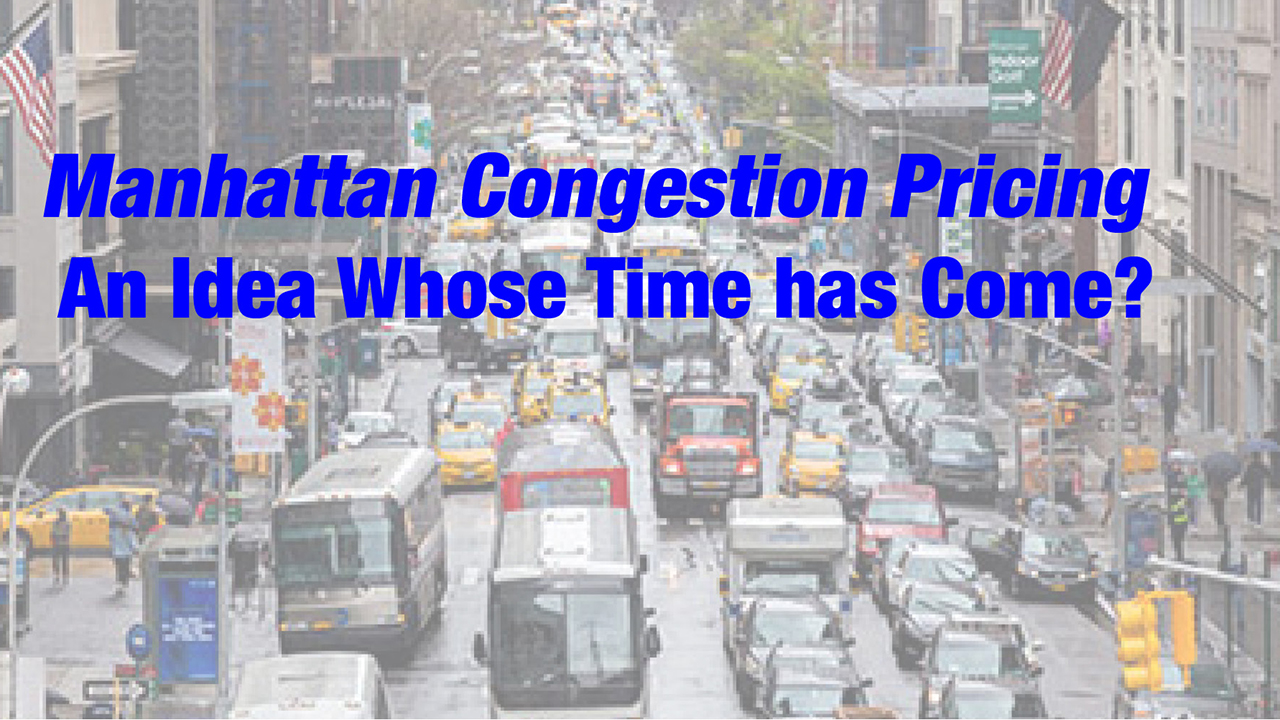
The theory behind congestion pricing is that city streets are clogged with vehicles, and something should be done about it. Transit systems everywhere are in trouble, too. They need money to keep operating, an acute problem, about which we plan to report in a major series soon. At the same time, there is a chronic need for capital funds to keep infrastructure and rolling stock in a state of good repair. Congestion pricing helps on both fronts, by reducing demand for street space for vehicles, while using the revenue from the tolls to support transit. A cleaner environment is an additional benefit, and the experiences in Singapore, London and Stockholm show that programs there have been successful.
Toll Money Needed for Capital Projects
It is a fact of life on the transit scene that budgets are divided into capital and operating sides. The FTA provides grants for the capital side under several statutory programs, but there is no similar support for the operating side, except for temporary relief granted in the American Rescue Plan Act of 2021 and other COVID-19 relief measures which provided funds that, for many providers, will soon run out. Some transit agencies have used “flexible” funding to keep their operations going, a practice that some representatives of the consulting and construction industries decry. Rider-advocates are divided, some saying that the practice weakens transit infrastructure, while others say that the money must be used to keep operations going, preserving mobility and the affected region’s economic future.
New York’s program is called the Central Business District Tolling Program (CBDTP). Information about it can be found on the MTA’s website. The MTA’s introduction says: “The Central Business District (CBD) Tolling Program, also known as congestion pricing, will improve quality of life for millions of people by reducing traffic in Manhattan’s most congested areas and funding improvements to New York’s transit system. Fewer cars mean cleaner air, less traffic, safer streets, and better transit throughout the region.”
The revenue collected for vehicles entering the cordon zone below 60th Street in Manhattan will be used exclusively for capital projects: 80% for New York City’s subways and buses and the Staten Island Railway, and 10% each for Metro-North and the Long Island Rail Road, the two regional railroads in the state. The Metropolitan Transportation Authority (MTA), which operates the transit agencies and the railroads, considers the money from the tolling program vital and, as Railway Age Senior Editor Carolina Worrell reported on Feb. 16, the agency suspended construction contracts for transit upgrades because of court cases challenging the program (which we will examine later in this series) causing uncertainly about when (and, perhaps, if) the money will become available. She reported: “According to the MTA, congestion pricing is set to raise $15 billion for subway, buses and commuter rail project, ‘but multiple legal challenges have delayed the launch date and jeopardized revenue to fund critical infrastructure work,’ Crain’s reports. The result, according to the report, ‘is a pause on projects to improve the city’s mass transit: an expansion of the Second Avenue subway, upgrades to signals for more reliable subway service, disability-friendly upgrades and other initiatives’” citing a report that appeared in Crain’s New York Business.
The suspension does not affect contracts supported by federal funds, but Crain’s reported that congestion pricing is expected to represent 27% of the currentcapital plan’s $51.5 billion total cost. The MTA plans to use $1 billion a year in toll revenue to issue bonds to finance $15 billion for infrastructure projects. The 2020-24 plan includes building three new stations on the Second Avenue Subway to extend it to 125th Street, signal improvements, new subway cars and upgrades to some existing cars, station accessibility projects and other station improvements, along with some track improvements.
A Look at the Tolls
We reported on the plan in the first article in this series; here is a summary: The automobile toll is slated to be $15.00 between 5:00 AM and 9:00 PM on weekdays and starting at 9:00 AM on weekends. The overnight toll at other times would be $3.75. Small trucks and charter and intercity buses would pay $24.00 at daytime hours and $6.00 overnight, with larger trucks and tour buses paying $36.00 and $9.00, respectively. Motorcycles would be charged half of the rate that passenger cars would pay. There would also be a lower rate for vehicles that enter the tolling zone from a bridge or tunnel from Brooklyn or Queens, or from New Jersey on the Holland or Lincoln Tunnels. Those credits would be $5.00 for passenger cars, $12.00 for small trucks and intercity or charter buses, and $20.00 for large trucks and tour buses. The credits would not apply during overnight hours. There would be no such discount for vehicles coming on the George Washington Bridge, which enters Manhattan far north of 60th Street, a sticking point for some New Jerseyans, because they would have to pay the “GW” toll and another toll to go below 60th Street. The toll would be collected once a day for each vehicle, using overhead gantries. Motorists could use the highways on the East and West edges of Manhattan without stopping to avoid the toll. Taxis would be charged a $1.25 surcharge per ride, and other “for hire” vehicles would be changed $2.50 per ride. Motorists whose adjusted gross income (AGI) is less than $50,000 per year would be able to apply for half-rate on the daytime toll after paying full rate for the first ten trips into the tolling zone during a calendar month. Those whose AGI is less than $60,000 could apply to credit tolls they paid toward their New York State tax.
MTA Information
The toll rates quoted above came from the section of the MTA’s website that pertains to the tolling program. It also contains much other information, including reasons why the MTA believes it needs the program, fact sheets about it, information about the Traffic Mobility Review Board (the group that determined the amount of the tolls), Environmental Justice Communities, accessibility services, and assistance services. The site also includes FAQs, updates, and more about the tolls themselves.
The longest and most important document on that portion of the MTA site is the Finding of No Significant Impact (FONSI), which includes the Final Environmental Assessment (EA). The FONSI report was completed on June 23, 2023. The Federal Highway Administration (FHWA) was the lead agency. Other sponsors were the Triborough Bridge and Tunnel Authority (TBTA, a component of the MTA), and the New York State and New York City Departments of Transportation.
The FONSI document itself runs 41 pages, and includes many tables. The critical paragraph is on Page 3, which states: “FWHA has determined that the Proposed Action (the CBD Tolling Alternative), described in the Final EA and identified as the Selective Alternative, will have no significant impact on the human or natural environment. This FONSI is based on the Final EA, including appropriate mitigation measures. FHWA has independently evaluated the Final EA and determined it to adequately and accurately document the purpose and need, environmental issues, and impact of the Proposed Action and appropriate mitigation measures. The Final EA provides sufficient evidence and analysis for determining that an environmental impact statement is not required. FHWA takes full responsibility for the accuracy, scope, and content of the Final EA.” Richard J. Marquis, Division Administrator for the New York Office of the FHWA approved and signed off on the FONSI on June 23. 2023.
The EA is a massive document, organized into 28 chapters, with 30 exhibits in the Appendix. The Executive Summary alone is 50 pages long. We will report on it as necessary, later in this series.
Opinions Run the Gamut
New Yorkers and others concerned have not necessarily expressed much love for the congestion pricing program, but many believe that it is needed to keep the city’s transit going and help the local railroads. Transit riders and their advocates are among the strongest supporters. A November 30 report on WCBS-TV quoted Gov. Kathy Hochul as saying: “I believe we’ll be a model for the nation without creating an undue financial burden because we have public transportation at a very affordable cost for those families that are in need.” Not everybody agreed. Mayor Eric Adams complained about the lack of exemptions to the toll, including for people going to hospitals in the congestion zone. Other groups representing public employees, including police and teachers, have also complained about a similar lack of exemptions for public employees. According to the report from the Traffic Mobility Review Board, the body “has been guided by its goal of keeping overall toll rates low … by limiting the number of discounts and exemptions.” As seen in the other cities that have congestion pricing, the more exemptions that are allowed, the higher the toll is for everybody else. Carl Weisbrod, who heads the Board, was quoted as saying: “How do we satisfy, in the first instance, the many not the few … and for that, we really recognized that the many are the million-plus people who take mass transit into the CBD every day, and the relatively few, at least in one category, are the 150,000 or so people who drive.”
The WCBS-TV report mentioned views from members of the public, including a restaurant owner who expressed concern that tolls for trucks will raise the cost of doing business, another called for a lower subway fare, and another expressed the belief that people would get used to it, and the result would be that the city would become less polluted, an attitude that seems to reflect the experience overseas.
Transport Workers Union President John Samuelson resigned from the review board, complaining that the revenue from the toll would not improve transit service, saying: “we have a congestion pricing plan that is all stick and no carrot, a half-way scheme that falls well sort of the mark. It will definitely raise revenue. But raising revenue should not have been given priority status over persuading as many New Yorkers as possible to switch from cars to public transit, thus more significantly reducing traffic congestion.” Samuelson continues to express strong opposition to the congestion tolling plan.
Murphy Rallies New Jersey Opponents
One of the most outspoken critics of the plan, and perhaps of the entire concept of congestion pricing is New Jersey Gov. Phil Murphy. On Nov. 29, he posted: “[Wednesday night’s] leaked report demonstrates the rushed and opaque process that the MTA and the Traffic Mobility Review Board have pursued to impose an unfair and ill-conceived congestion pricing tolling scheme on New Jersey’s commuters.” Other elected officials from the Garden State have joined him in opposing the plan, even though far more New Jerseyans head toward “The City” on New Jersey Transit’s trains and buses than drive their personal vehicles into the tolling zone.
The MTA Board voted its final approval of the plan on March 27. The following day, Chair and CEO Janno Lieber told WNYC, New York’s NPR station, that most of the people who come to the City from New Jersey take transit rather than driving, and that the tolls would give them a better transit experience on the New York side. He said that the tolling program is a matter of “New York City and New York State sovereignty.” He also noted that New Jersey is having trouble funding NJ Transit, while New York is making big decisions. Lieber reiterated that he expects that the toll will be implemented in June, but a legal battle continues, a fight that renders his expectation questionable. Murphy and other New Jersey officials have demonstrated their displeasure with the plan by suing to have it invalidated. We will begin our examination of this litigation in the next article in this series.
First of a Series: A New Congestion Remedy, with Help for Transit
Second of a Series: Congestion Pricing Around the World