


Commentary
Sixth of a Series: Higher Fares, Service Cuts at WMATA
Written by David Peter Alan, Contributing Editor
Our most recent feature article on transit in the Nation’s Capital appeared in the August 2023 issue of Railway Age. Editor-in-Chief William C. Vantuono described the politics surrounding the agency as a “Jurisdictional Jumble,” and it is difficult to imagine a more accurate or succinct description.
The Washington Metropolitan Area Transit Authority (WMATA, or “Metro” as many locals call it) must answer to the city-like government in the District, the state governments in Maryland and Virginia, and federal officials from Congress to the Federal Transit Administration (FTA). In that context, the agency continues to battle revenue shortfalls. With the fiscal cliff that comes to each agency as it runs out of the temporary operating funding that came with the COVID-19 relief money at the height of the pandemic, the agencies must get more funding from government or other sources, raise fares, cut service, or a combination of those unpleasant options. Riders on Metro are now paying more for their transit, but the situation could have been worse.
Looming Catastrophe?
Beginning last year, Metro expressed its fear that it would be worse. A release from the agency dated Dec. 14, 2023 warned: “Metro faces a $750 million funding gap for Fiscal Year 2025, which begins July 1, 2024. The budget gap is a result of several factors, including lower ridership revenue that is still recovering from the pandemic, the depletion of federal pandemic relief funds, a subsidy credit provided to jurisdictions in 2020, and historic inflation.” Along with a link to its proposed budget, the agency said: “Metro is unique among transit agencies in the United States in that it was structured without any independent funding and is legally required to pass a balanced budget every year. Despite an exhaustive effort to find internal savings, including $95 million in one-time savings carried over from FY24, $50 million in recurring annual savings and efficiencies, and a hiring and salary freeze, closing a gap of this size to pass a legally-required balanced budget requires drastically reducing rail, bus, and paratransit service, increasing fares, slashing Metro’s workforce, and deferring maintenance and modernization projects, ultimately making the system less safe and reliable.”
The “doomsday scenario” that Metro proposed would have ended Metrorail service at 10:00 every night, reduced frequencies to every 15 minutes on weekdays and 20 minutes on weekends on all lines except part of the Red Line, eliminated purportedly duplicative service on some segments served by the Red and Silver Lines, closed ten stations, and raised fares 20% for the riders who were still on the system. Bus service would be slashed, too: 67 of 135 bus routes would have been eliminated, with cuts to 41 of the survivors. The 91-slide presentation scan be downloaded below. Slide 23, which graphs funding sources and the anticipated deficit, was reproduced earlier in this series. The agency described proposed bus and rail service cuts as “severe.”
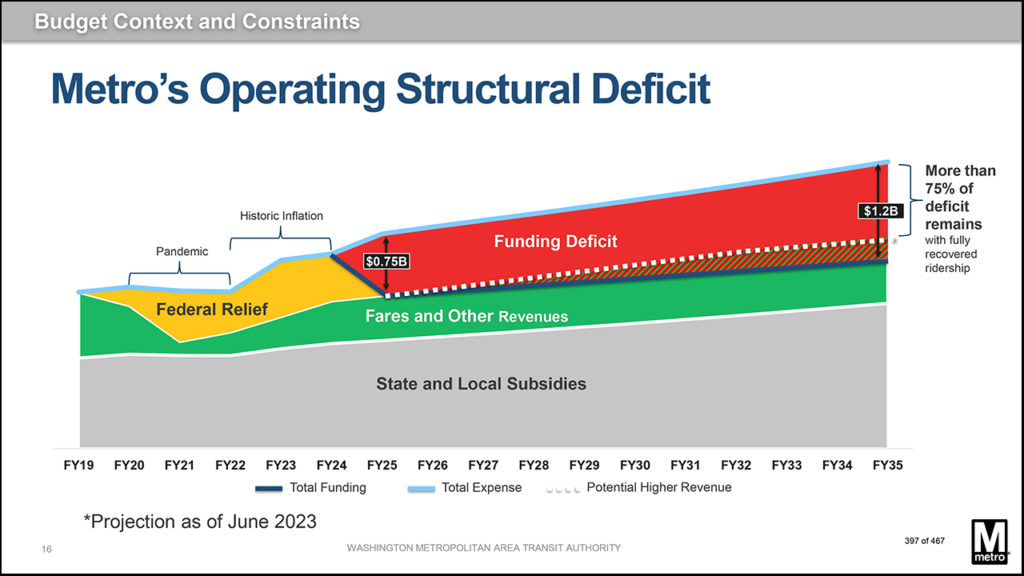
On Dec. 12, Mike Murillo reported on WTOP: “Federal dollars are not available to help, so to avoid this, [Metro General Manager Randy] Clarke said Maryland, Virginia and D.C. would all have to take action.” According to Murillo’s numbers: “Currently, D.C. is set to pay $448 million to help fund the system, with Maryland close behind at $474 million and Virginia at $330 million. To avoid the cuts, D.C. would need to commit an additional $275 million, Maryland $209 million and Virginia $180 million.” He also reported that the legal situation makes it more difficult for the states to come up with that money: “While D.C. could make that commitment without a law change, the same isn’t true for Maryland and Virginia. Both would need state lawmakers to change existing laws, because of an existing 3% cap on annual operating budget subsidy increases.” One state official who is familiar with the situation is Maryland’s Transportation Secretary Paul Wiedefeld, whose previous job was General Manager at Metro.
Another COVID-19 Victim
According to Wyatt Gordon, the senior policy manager for land use and transportation at the Virginia Conservation Network, the jurisdictions began to come up with money at the beginning of the year to keep Metro going. Gordon took a deep dive into Metro’s financial woes in a series at Greater Greater Washington (GGWash). He began by explaining how Metro got into its current difficulties: “WMATA was established in 1976 as part of a second wave of great American public transit systems alongside the likes of BART in San Francisco and MARTA in Atlanta, but unlike any of its peers, Metro receives zero dedicated operating dollars.” He explained the complexity among the jurisdictions, especially Virginia: “While the District and Maryland cut Metro a check each year, the commonwealth uses a much more complicated system to scrape together its contribution from across state and local funding sources. Virginia’s Metro money comes from three entities: the state Department of Rail and Public Transportation (DRPT), the six local jurisdictions (counties and independent cities) with Metrorail stations, and the Northern Virginia Transportation Commission (NVTC). While the full explanation of this complexity in the Old Dominion State lies beyond the purview of this article, it serves as perhaps the worst example of Metro’s “Jurisdictional Jumble” in action. Even the Passenger Rail Investment and Improvement Act of 2008 (PRIIA), with its own complexity, is also part of the picture.
Jurisdictional Jumble Rules
As we noted last year, the federal government is part of the Jurisdictional Jumble, and Gordon explained where the feds come in: “Although the Metro was explicitly built to bring suburban commuters downtown to work for the federal government, historically, the feds’ only contribution to the system’s operating costs has been to pay its workers’ fares via employee transit benefits. That worked well enough until the COVID-19 pandemic kept the federal workforce at home for years.” He explained the reason for that, too: “By the end of 2023, Metrorail’s average daily ridership was just 56% of what it was in 2019, generating nearly $100 million less in fares today than in 2019. For the current fiscal year, fares and other Metro-generated revenue such as parking and advertising comprise just 22% of WMATA’s budget. Increased off-peak service and streamlined fares have recently helped weekend ridership bounce back to 90% of pre-pandemic levels, but the classic commute is still only at 55% of what it once was.”
Gordon added that forcing employees back into their offices to the pre-COVID extent “would not fix the majority of WMATA’s budgetary woes.” Neither would implementing $100 million in cost savings that General Manager Randy Clarke said that the agency had identified. As with other transit providers, according to both Gordon and Metro itself, insufficient funding leads to service cuts, which decreases ridership (especially among motorists who make discretionary trips), which results in revenue shrinking further. This is the classic “Transit Death Spiral” that many agencies could be facing.
Gordon came up with some numbers: “This year D.C. is set to contribute $448 million for capital and operating expenses to WMATA while Maryland pays the most with a $474 million contribution, and Virginia puts in $330 million. To close the current $750 million budget hole in a proportional manner, DC would need to increase its contribution by $275 million, Maryland would have to up its commitment by $209 million, and Virginia would need to find an additional $180 million for WMATA.” He also explained why acquiring such large sums could be a tall order: “With D.C. down on itself and wracked by infighting between Mayor Muriel Bowser and its council, Maryland’s Department of Transportation hamstrung by a $3.3 billion budget shortfall, and Virginia’s potential to pay into Metro increasingly contingent on a controversial sports arena deal, the timing could not be worse to find more funding than ever to help WMATA avert its impending fiscal cliff—let alone to permanently resolve the transit agency’s structural funding issues.”
Gordon wrote on Feb. 15: “If the mechanics of coordinating a Metro rescue across three jurisdictions sound complicated, imagine the complex politics, especially in an era where D.C., Maryland, and Virginia seem set on competing to see who can take home which large federal employers and regional entertainment amenities. Although few leaders across the region appear focused on fixing the long-running structural issues inherent to WMATA’s financial distress, the prospect of a transit death spiral has turned officials’ attention to the question of how to fill the transit agency’s glaring budget gap for at least the next few years, with growing calls for additional federal support.”
Part of Metro’s Jurisdictional Jumble is a set of funding rules that vary widely among the jurisdictions within Metro’s service area. The District is a single entity, so there is nothing complex about the act of the city paying its share, although its ability to do so could be a different story. Maryland works through MDOT on a statewide basis, which brings some advantages because of the state’s transportation leaders. Transportation Secretary Paul Wiedefeld was the head of Metro before taking his current job. Gov. Wes Moore comes from Baltimore and has expressed support for improving transit in his home city and elsewhere in the state, including for Marylanders going to the District. He would also have reason to know what would happen to transit in Baltimore and the effect it would have on the city if Metro were to fall upon the hard times that agency has described.
In Virginia, though, half of the money for Metro would come from the state, while the other half would come directly from the cities and counties served by the agency. Securing that sort of funding has also gotten caught up in contentious politics in Richmond, where other issues are keeping the legislature busy. Gordon explained: “So far, discussions towards a long-term fix for WMATA’s structural budget crisis have yet to extend beyond a handful of senior NoVA [Northern Virginia] lawmakers. However, a demographics report out last week that showed Fairfax County losing population fast has certainly focused minds on the need to keep NoVA as attractive as possible.” Virginia has recently become a “purple state” where power shifts between Democrats concentrated in the Northern Virginia suburbs and cities like Richmond and Norfolk, and Republicans concentrated in the state’s smaller towns and rural counties.
Jurisdictions Pitch In
Gordon reported that, early in February, D.C. Mayor Muriel Bowser and two Council members expressed the District’s willingness to increase its operating aid to Metro by $200 million for FY2025, but it would be a one-time additional subsidy to avoid the impending crisis, and it came with conditions like nor reducing service within the District, reducing personnel costs, and freezing capital projects that are not necessary for a state of good repair. There would also have to be efforts toward stabilizing the agency’s financial picture in the long run. Gordon also quoted Council member Charles Allen as saying: “The future of downtown is not a commuter rail. The future of downtown is a thriving neighborhood where people live, work, and play, and to do that, you’ve got to have robust transit that moves you around just the way transit is moving people around in other parts of our city.”
There is precedent for Allen’s scenario. With the improvements in transit in Los Angeles, especially rail transit, the city’s downtown has come back to life during the past two decades, in sharp contrast to its moribund appearance and atmosphere for decades after the city’s previous rail transit incarnation ended roughly 60 years ago. Downtown Detroit has made a comeback lately, too, but that can’t reasonably be attributed to the city’s transit, which remains weak. Still, the District still has historic and cultural attractions including the Smithsonian and other museums, buildings that can be re-purposed if necessary, and an urban culture that accommodates city living.
Fewer employees are working at the office five days a week in other cities, too, especially San Francisco and New York, so many city governments and transit agencies are facing a similar situation.
As Senior Editor Carolina Worrell reported for Railway Age on April 26, Metro announced its budget for the current fiscal year (FY2025). Its announcement began: “Today, Metro’s Board of Directors approved a $4.8 billion capital and operating budget which largely maintains bus and rail service levels when the new budget year begins on July 1. With investments from around the region, Metro will be able to continue to provide great transit service customers are familiar with today.” The operating budget is $2.335 billion (at 3), while the capital budget is $2.567 billion (at 4).
Fares went up as part of the package, generally by 12.5%. The base fare increased from $2.00 to $2.25. Fares on Metrorail are zoned, and the maximum fare went from $6.00 to $6.75 on weekdays. The highest fare on weeknights after 9:30 and on weekends is now $2.50. Fares for pre-registered seniors and persons with disabilities rose from $1.00 to $1.10, with zone fares increasing proportionately. In all, the picture could have been worse, although some “off-peak” riders on weekdays will see a big increase. Those fares are no longer valid until 9:30 PM. The new fares went into effect on June 16.
The three jurisdictions came through with money to keep Metro going, and the resulting fare increases were not as steep as hand been previously proposed, with the possible exception of weekday “off-peak” riders. Nonetheless, most of the service that ran during FY2024 was saved, at least for this year.
The Future
After breathing the customary sigh of relief from having avoided the catastrophe that loomed during the prior year, Metro’s April 24 release warned: “Next fiscal year, Metro will face a similarly difficult budget without dedicated funding. Metro is the only major transit system in the country that does not have some form of predictable, sustainable funding.”
At the conclusion of his report, Gordon cautioned: “WMATA was built on the false premise that fares could cover costs (and with no mention of bus or paratransit service). It owns only a small proportion of developable land around its stations, so has limited options for using land to raise revenue, plus no ability to levy taxes to support its service. Solutions to the immediate financial gap come down to reducing costs and bringing in more funding from compact members and riders, with more complex and creative revenue-raisers part of the longer-term conversation” (parenthetical in original). D.C. Council member Charles Allen said: “My fear is that too many politicians like to find a short-term solution and pat themselves on the back and not fix the long-term solution.”
According to Gordon: “Clarke believes the WMATA Compact of 1966 (the governing document between Virginia, Maryland, D.C., and the federal government) will ultimately have to be renegotiated over the next two years to avoid a continued crisis. But in the short term, he is not opposed to some reasonable right-sizing of service and fares.”
Even though the jurisdictions served directly by WMATA have done their part to keep their transit going for now, it has been alleged that the feds have not, despite the large number of federal employees who use the system. Gordon wrote: “‘Pre-pandemic federal workers comprised 40% of weekday rail ridership, today it’s just 14%,’ said Laura Miller Brooks, Director of Transportation and Infrastructure for Federal City Council, a D.C. think tank. ‘We have inherited this system from the feds, and we are losing leverage with them every day that we don’t talk about how much Metro is going to cost the region going forward.’”
So politics continue unabated, including Metro’s “Jurisdictional Jumble.” The system got a reprieve, but it might last only until June 30, 2025. Even during the rest of the fiscal year that just started, Metro’s managers and officials from all political jurisdictions concerned will need to focus on secure, stable, and sufficient funding for the system. Time will tell if the multiplicity of jurisdictions involved can work out a solution that will enable locals and tourists alike to get around the Nation’s Capital and its region without an annual ritual of threats of severe service cuts and higher fares to ride what’s left.
The only major transit system in the Midwest is in Chicago, the region’s hub. We will look at how transit in Chicago and neighboring “Chicagoland” is doing in the next article in this series.

David Peter Alan is one of North America’s most experienced transit users and advocates, having ridden every rail transit line in the U.S., and most Canadian systems. He has also ridden the entire Amtrak and VIA Rail network. His advocacy on the national scene focuses on the Rail Users’ Network (RUN), where he has been a Board member since 2005. Locally in New Jersey, he served as Chair of the Lackawanna Coalition for 21 years and remains a member. He is also a member of NJ Transit’s Senior Citizens and Disabled Residents Transportation Advisory Committee (SCDRTAC). When not writing or traveling, he practices law in the fields of Intellectual Property (Patents, Trademarks and Copyright) and business law. Opinions expressed here are his own.


