Commentary
Second of a Series: Congestion Pricing Around the World
Written by David Peter Alan, Contributing Editor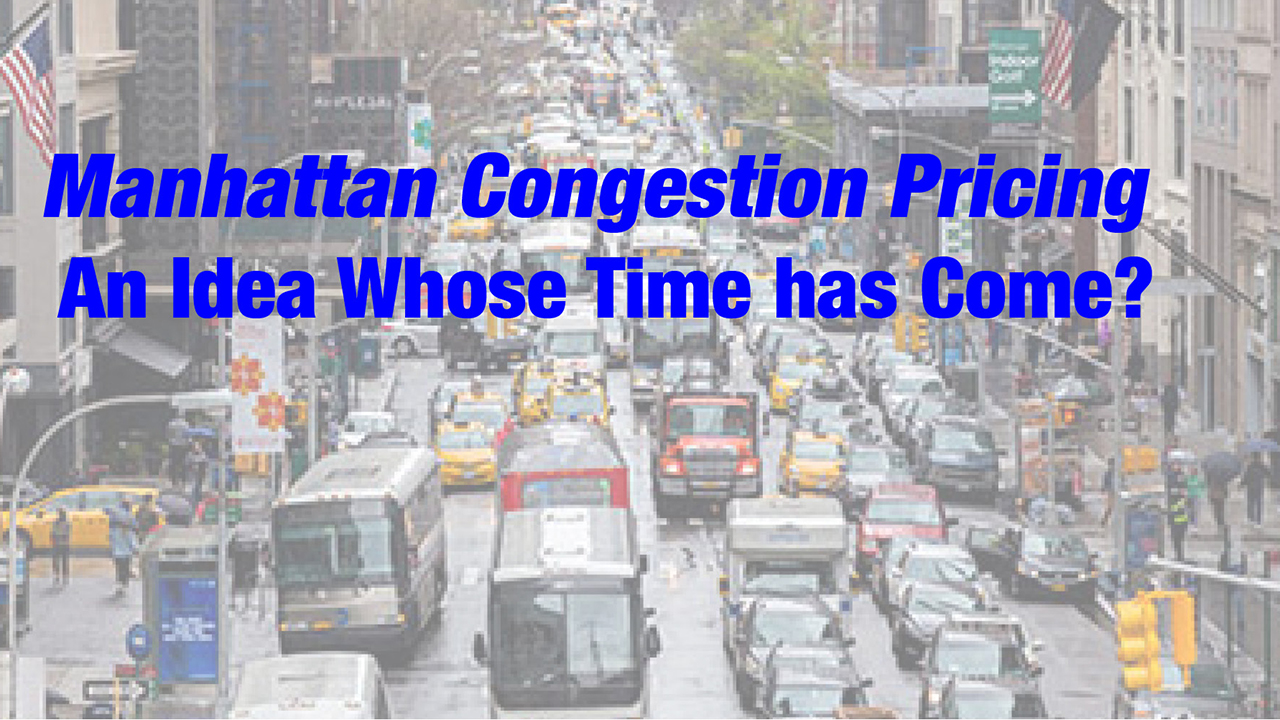
The idea of charging motorists and truckers for the space that their vehicles occupy on city streets has been discussed for some time, but it could be implemented in New York City soon. That would make Manhattan the first place in the United States to carry out such a plan.
Many city leaders in the United States and elsewhere around the world have complained about the crowded condition of the streets in their cities, a result of the sheer number of vehicles that use them. There have been attempts to ration entry by means other than charging motorists and truckers a fee, and these have been used in Mexico City, San José (Costa Rica), Santiago (Chile) and São Paulo (Brazil). Two cities in Europe and one in Asia charge tolls to mitigate congestion: London, Stockholm, and Singapore. In this article, we will look at how well those measures are doing toward achieving the goal of mitigating traffic congestion.
Road Space Rationing
An alternative to charging a toll is road space rationing, which involves a restriction that keeps certain vehicles out of the urban core on certain days. These programs are generally implemented by allowing vehicles with certain license-plate numbers (usually the last digit is the one that counts) into the city on matching dates of the month. The only time it was tried in the United States was in 1973, when gasoline was scarce due to an export embargo by the Organization of Petroleum Exporting Countries (OPEC). It was unpopular among motorists, while ones who had complimentary license plates on two different vehicles managed to avoid the hassle almost entirely. Less-wealthy drivers had to live with it.
Some places have imposed temporary restrictions, like Beijing during the 2008 Olympics. Only a few cities have instituted them on a long-term basis. A program in Mexico City did not do well, as a 2008 study from the University of Michigan showed that there was little effect on the air in the city, while another showed that many residents bought “second cars” that were older, and gave off more pollution, so the net result was negative. San José did better, reducing the number of vehicles downtown by 14% to 16%. We have not found numbers that show specific benefits for Santiago or São Paulo, but Bogatá, Colombia enforced the regulation against transit vehicles at one time, a policy that appears to defeat its intended purpose. Other cities claimed an intended benefit of reducing air pollution, and Sáo Paulo also claimed that its program reduced congestion. Road space rationing using license plate numbers for Manhattan was considered in 2007, but the entire congestion pricing plan died, so the idea was moot.
Congestion Pricing
It seems to go without saying that the benefits of congestion pricing would include both a reduction in the number of vehicles entering the urban core, and a consequent improvement in air quality that would result from it. The latter benefit might become less pronounced as more vehicles powered by electric motors rather than internal combustion engines make their appearance (ignoring the ill effects that are moved from vehicle operation to production of battery-powered vehicles).
The theory behind congestion pricing is that bringing a vehicle into the urban core also brings negative economic externalities, like air pollution, heavy traffic, more noise, and other undesirable effects on streets crowded with vehicles. Charging a fee to bring a vehicle onto those streets within the cordon area is supposed to reduce demand, thereby reducing crowding and the other drawbacks that come with it. Congestion pricing is a strategy for managing demand and does not affect the supply side. For example, making the supply curve for road use steeper by raising prices at certain times of the day moves the equilibrium point to the left along the demand curve, which shifts the new equilibrium point to a lower quantity at the new, higher price. This is similar to electric utilities charging higher pieces when demand is high and lower rates for power at “off-peak hours” when demand is lower, or transit providers offering lower fares outside peak-commuting hours than at commuting times, a practice that Metro-North and the Long Island Rail Road follow. In New York, there is the additional goal of raising money to keep the transit system and the local railroads going, with the understanding that transit is important, even vital, in a place as densely-populated and transit-rich as New York City.
A paper from the Federal Highway Administration (FHWA) on the early experiences with congestion pricing in cities where it is practiced, Lessons Learned from International Experience in Congestion Pricing (download below), was issued in 2008, and summarizes the experiences of Singapore, London, and Stockholm. The paper also contains a review of the literature, and general conclusions and lessons learned about congestion pricing from those cases. Some of our conclusions come from that paper, while others come from more-recent sources, but the FHWA has a number or reports on its website, www.fhwa.dot.gov.
Singapore
Congestion pricing was implemented in Singapore as early as 1975 and upgraded to embrace new collection and monitoring technology in 1998. Other upgrades to technology over the years allowed implementation of variable pricing, with the toll at any given time set to depend on traffic conditions. Singapore charges separately for each trip into the cordon area, and the the total is not capped to produce a maximum fee for the day. According to Singapore’s Land Transportation Authority, the system is fair (charges are based on actual usage), convenient (Americans would call it “pay as you go”), and reliable (because it’s automated). For motorists who go through a collection gantry without having enough credit to pay the toll, they are charged the toll plus an “administrative fee,” or they can pay using a cell phone, also with a transaction fee added. Tolls are collected through a transponder and money is deducted from a stored-value card, and motorists without a transponder can be fined.
According to the FHWA, “Congestion on the RZ [Restricted Zone] was virtually eliminated” while speeds increased as vehicle flow improved. The paper also reported that the benefits of the program were eleven times the costs, that air quality had improved, and so had pedestrian safety. Transit riders benefited from improved service, while riders in “HOV4+” vehicles (four or more persons riding together), cyclists, and pedestrians benefited, too. It was reported that 52% of the population came out ahead with the program, compared to before. Equity impacts were reported as favorable, as mobility improved for non-motorists and other lower-income people. Business was not impacted negatively, while it was reported that World Bank economists reported a 15% rate of return, or better, in 1978. The report on Singapore concluded: “Generally, people in Singapore reflected favorably to the pricing and accompanying package of improvements. Early skepticism has been addressed effectively via information and on-ground experience. It seems the public has come to accept and respect bold policy initiatives like pricing and have largely trusted the authorities as purveyors of effective public service.”
London
London first considered congestion pricing in 1965 but did not have the authority to implement it until 1999, when the Greater London Authority was allowed to introduce road user charges. The program went into effect in February 2003. It originally covered eight square miles in Central London’s business district but was extended to the west in 2005. The fee started at £5 and was increased to £8 in 2005. Motorists entering the area during daytime had to pay the toll, but residents of the area received a 90% discount, and there were numerous exemptions. Charges are made by cameras, and immediate payment is required. Late fees add an additional £10 (currently worth about $12.70 US) if paid the next day, £40 the day after that, and £120 after four weeks. The FHWA report said: “London Congestion Charging has accomplished its stated objectives.” In 2007, the system brought in £89 million, which had to be spent on transportation in London, although the 2005 increase only yielded a small increase in revenue. Traffic in the cordon zone declined by 18% when the toll was introduced in 2003. Traffic delays went down, speed went up, bus reliability improved, and ridership increased 40%. Air quality improved, as did the quality of bus service. The benefit to cost ratio was 1.4 after the program started.
The FHWA report stated: “There are two main reasons for this rather high level of acceptability before as well as after the introduction. First, traffic levels in London had reached unacceptable levels and Londoners felt some radical measure was needed … Second, in London, the concentration of power in the hands of the Mayor meant that ‘local’ political concerns were less important, and thus resources could be concentrated on key projects, such as the implementation of congestion charging.” Ken Livingstone was Mayor at the time, and he considered the congestion pricing program as high priority.
Today the charge applies between 7:00 AM and 6:00 PM on weekdays, and between 12:00 noon and 6:00 PM on weekends. The charge is £15 (about $19 US), and the penalties for nonpayment range from £65 to £195. There is some variability for discounts or surcharges, depending on emissions from the vehicle. The western extension of the zone was removed in 2011 and it is now reported to have about 136,000 residents, out of the roughly 9 million population of Greater London.
Stockholm
Stockholm approved a congestion pricing plan in 2004. It started as a six-month trial in 2006 and won a referendum and became permanent in 2007. Its features included a charging cordon, expanded transit, and new park-and-ride stations. Entering the cordon cost the Swedish equivalent of $1.33, $2.00, or $2.67 in 2006, with a maximum of the equivalent of $8.00 US for the day. About 30% of vehicles were exempted, as were those passing through the zone without stopping. As with the other systems, charges were imposed by overhead gantries, and fines were the equivalent of $10 for the first reminder and $70 for the second. Traffic in the zone slowly increased to 18% at the beginning, and transit use increased by 8% to 9%. The return on investment was reported equivalent to a payback period of four years.
The FHWA report said that public acceptance grew as the program progressed and attributed some of that to the recently implemented London plan. It praised the strong outreach conducted by the authorities and said: “It seems that those people who benefit most from urban road pricing can be convinced if they experience in a trial the positive outcomes.”
There are few examples of congestion pricing in effect, so it is difficult to draw conclusions for New York. Still, the programs in operation appear to be successful, and the public appeared to like them after having an opportunity to get used to them. New York could follow suit, or the result there could be very different. In the meantime, there is a major battle taking place within New York City and across the Hudson. We will take a closer look at the New York proposal in the next article in this series.