
STB Sets 2020-2024 ‘Deflator Factors’
The Surface Transportation Board (STB) has published the annual deflator factor and inflation-adjusted railroad revenue thresholds for 2024.
The Surface Transportation Board (STB) has published the annual deflator factor and inflation-adjusted railroad revenue thresholds for 2024.
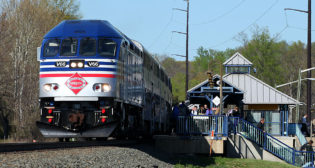
The Virginia Department of Rail and Public Transportation (DRPT) now has a Fiscal Year 2026–2031 Six-Year Improvement Program (SYIP) with investments of $7 billion in public transportation and freight and passenger rail across
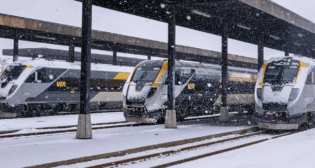
VIA Rail, Canada’s national passenger rail service, reaches tentative agreements with Unifor. Also, Siemens is delivering the second of 10 Charger locomotives for EXO commuter rail, which serves the Greater Montreal area; Connecticut Department of Transportation selects HNTB for major upgrades along Metro-North Railroad’s Waterbury Branch Line; Southeastern Pennsylvania Transportation Authority (SEPTA) extends its advertising partnership agreement; and stepped-up fare enforcement efforts are driving positive change at Metro Vancouver’s TransLink.
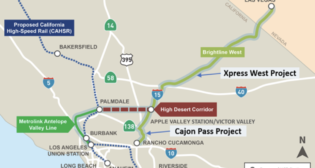
Representatives from the High Desert Corridor Joint Powers Agency (HDC JPA) Board and labor unions signed workforce agreements in summer 2024 for the 54-mile high-speed rail project from Palmdale to Victorville, Calif., that will serve to link the California High-Speed Rail Authority (CHSRA) and Brightline West lines now under development (see map above). Now, the HDC JPA has selected HDR to provide engineering, design, and advisory services for the project.
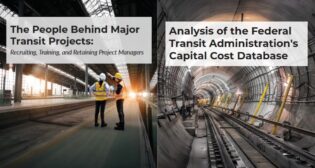
The Eno Center for Transportation (Eno), an independent, non-partisan think-tank, has released two new Federal Transit Administration (FTA)-funded reports to “help agencies more effectively recruit, train, and retain professionals who manage large projects,” as well as assess the FTA’s capital cost database and provide recommendations for improving its usefulness.
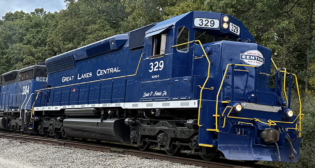
Pittsburg, Kans.-based Watco Railroad Company Holdings, Inc. (Watco) on March 6 reported plans to add Great Lakes Central Railroad (GLC) to its short line portfolio pending approval by the Surface Transportation Board (STB). It has been an equity investor in the GLC since 2013 and now seeks ownership. The STB on May 30 instituted a proceeding.
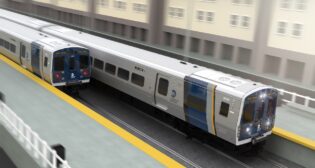
The New York Metropolitan Transportation Authority (MTA) on June 23 announced that its Finance Committee has approved the purchase of 316 M-9A railcars. This includes 160 cars to be allocated to the Long Island Rail Road’s (LIRR) fleet and 156 for Metro-North Railroad (MNR).
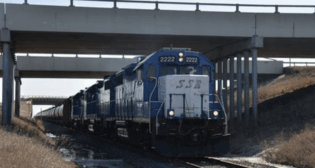
The Saskatchewan Ministry of Highways on June 17 announced the provincial government’s allocations of C$1 million in short line rail infrastructure investments, an increase of C$470,000 or 88% from last year’s budget.
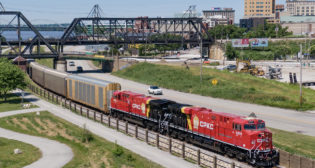
Some better data this week suggests that Canadian Pacific Kansas City’s southern U.S. operating problems related to its May 3 IT systems cutover might be starting to correct, which is good news.
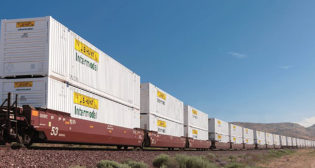
Observations on the TD Cowen/Jason Seidl article, “If All Else Fail, Attempt to Merge.” First, if the railroads lost only 1% of rail traffic between 2014 and 2024 (excluding coal traffic), I
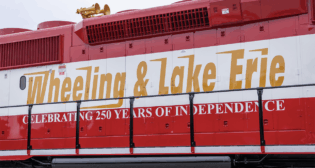
Wheeling & Lake Erie Railway Company (W&LE), a two-time Railway Age Regional Railroad of the Year recipient, unveils “patriotic powerhouse” No. 1776, plus a specially painted hopper car in honor of Breast

Dallas Area Rapid Transit (DART) welcomes Trenise Winters as Executive Vice President and Chief Operations Officer. Also, the Greenbrier Companies (Greenbrier) elects Stevan Bobb and Jeffrey Songer to its Board of Directors.
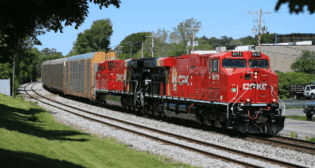
It is eminently logical that if one relocates to a community zoned for heavy industry, they shouldn’t be surprised that a 24/7 distribution hub is constructed near them, bringing with it additional noise and increased highway traffic. It follows that if one relocates to a community with main line railroad track, they shouldn’t be surprised with the arrival of additional train traffic.
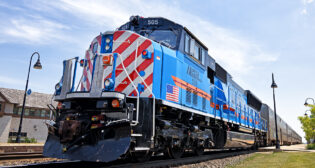
Looking to make its dollar go further, Metra turned to Progress Rail to convert former freight locomotives into passenger power for Chicago. Over the past few years, Sean Cronin, Senior Director of
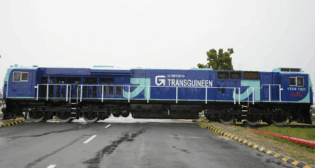
The first Evolution Series ES43ACi locomotive for TransGuinéen Railway was unveiled May 26 by Wabtec Corporation and Rio Tinto SimFer, a joint venture (JV) of the government of the Republic of Guinea in West Africa, Rio Tinto, and Chalco Iron Ore Holdings. On June 20, India Prime Minister Shri. Narendra Modi flagged off the first units for delivery from Wabtec Locomotive Private Limited’s Marhowra plant, an Indian Railways-Wabtec JV.
The Surface Transportation Board (STB) has adopted for third-quarter 2025 the rail cost adjustment factor (RCAF), which is defined as “an index formulated to represent changes in railroad costs incurred by the nation’s largest railroads over a specified period of time.”

CSX subsidiary Total Distribution Services Inc. (TDSI) rolls out an autonomous electric shuttle. Also, CN’s Symington Car team in Winnipeg, Manitoba, Canada, advances its “air buggy”; Norfolk Southern (NS) awards more than 100 scholarships to its railroaders’ children; and the Baltimore and Ohio (B&O) Railroad Museum’s celebration of the 200th anniversary of railroading kicks off with an official website.
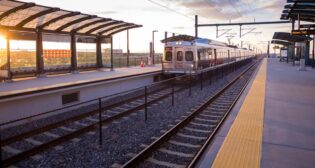
Denver Regional Transportation District (RTD) leads commuter rail ridership recovery nationally from pre-pandemic levels. Also, TransLink launches a transit-themed beer; and Trinity Metro approves a 10-year $324 million contract extension for TEXRail and Trinity Railway Express (TRE).

The American Short Line and Regional Railroad Association (ASLRRA) and the Association of American Railroads (AAR) on June 16 submitted joint comments in response to the Federal Communications Commission’s (FCC) notice of

U.S. Sens. Tammy Baldwin (D-Wis.) and Roger Marshall (R-Kans.) on June 18 reintroduced the Reliable Rail Service Act to clarify the railroads’ common carrier obligation and to establish specific criteria for the Surface Transportation Board (STB) to consider when evaluating whether that obligation is being met. They said it would “give shippers much-needed certainty that is currently lacking.” The Association of American Railroads (AAR) weighs in.