


For the Flying Yankee, a New Owner (UPDATED 7/29)
Written by Marybeth Luczak, Executive Editor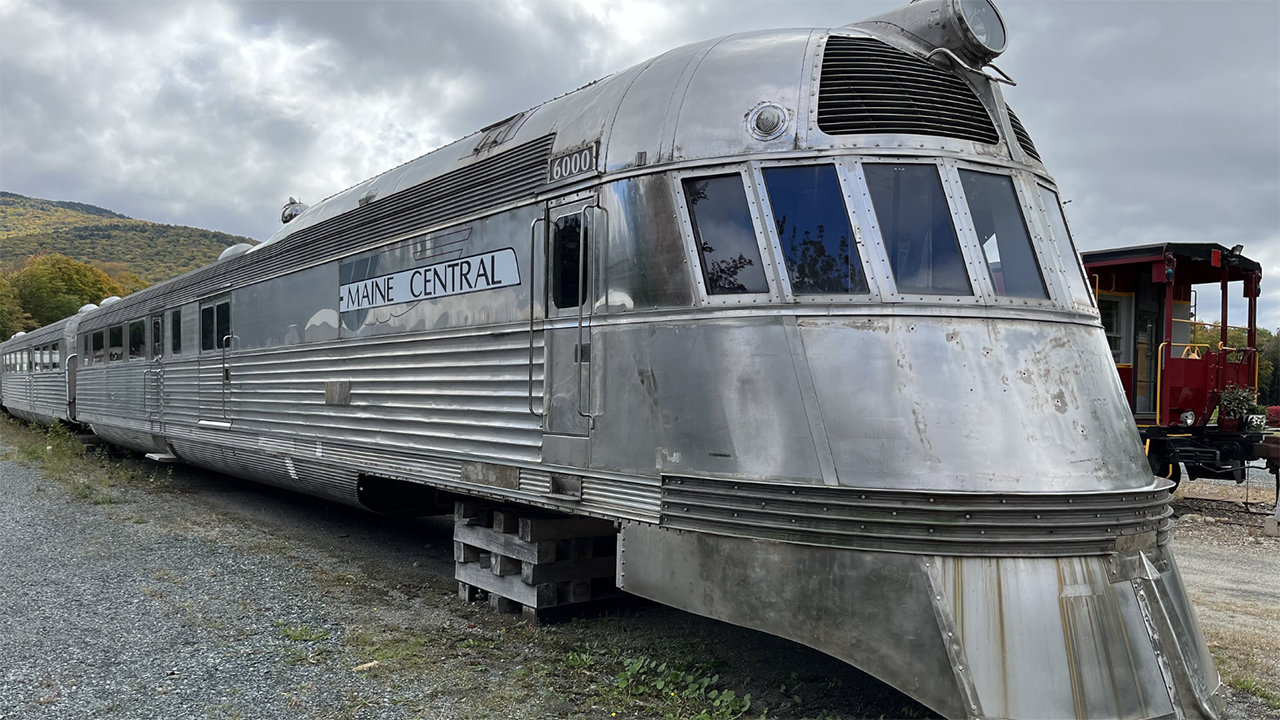
(New Hampshire Preservation Alliance Photograph)
The New Hampshire Department of Transportation (NHDOT) has selected the winning bidder for the Flying Yankee, the diesel-electric streamliner built in late 1934 by the Budd Company for the Boston & Maine, following a Request For Proposal (RFP) process. The streamliner will soon be headed to its new home.
The NHDOT, from November 2023 through Jan. 3, 2024, was accepting proposals for the purchase, relocation and “encouraged” restoration of the three-car articulated Flying Yankee, the contemporary of the Burlington’s Zephyr, later renamed the Pioneer Zephyr. The Flying Yankee, located in Lincoln, N.H., was purchased by the state in 1997.
Nashua, N.H.-based Flying Yankee Association (FYA) on April 6 announced that it had the winning bid, and will take ownership of the Flying Yankee.
“We are both honored and thrilled to be receiving this historic train from the state,” said Brian LaPlant, President of FYA, which was established in 1996 to help the state of New Hampshire with fundraising for and restoration of the B&M #6000. “The Flying Yankee has languished for far too long, and we look forward to preserving, relocating and restoring the train, thanks to the state, as well as our friends, partners, and supporters that will help make this dream become a reality. A beautiful piece of New England history has been saved.”
The Flying Yankee was built for the B&M, thanks to a loan from the Public Works Administration, according to the New Hampshire Preservation Alliance. Replacing a conventional steam-powered train with that same name, the Flying Yankee was a significant departure from trains at the time, according to FYA. “While period-typical passenger cars could weigh 120 tons, the entire three-car trainset weighed only 113 tons and featured the newest technology available at the time,” the association said on its website. “Nearly the entire carbody was constructed from stainless steel, made possible by an innovative construction method called ‘shot welding’ developed by the Budd Company.”
The Flying Yankee carried passengers and freight throughout the Northeast and was maintained at B&M’s South Concord Shops, according to a Feb. 18 Concord Monitor report. Following 22 years of service and running just over 2.7 million miles, it was retired May 7, 1957. The trainset spent years at the Edaville Railroad museum in Carver, Mass., the paper said, before moving to the Plymouth and Lincoln Railroad, which is now the Patriot Rail-owned Hobo Railroad. Much of the Flying Yankee’s route is currently operated by Amtrak’s Downeaster.
According to the Feb. 18 Concord Monitor report, FYA’s goal is to restore the train and run it rather than putting it in a museum. “We’ll try to use the original parts, as we can,” said Jacob Eidsmoe, Marketing Director for the FYA, according to the newspaper. “‘Some we can’t—it will need new windows, new electrical to meet requirements and codes—but many we can,’ he said. For example ‘the chairs, we want to keep them as close to 1935 look and feel as possible.’”
Ownership was officially transferred to the Flying Yankee Association on July 24, according to a Conway Daily Sun report.
“The FYA now intends to move the Flying Yankee from its current location in Lincoln, N.H., at the former Hobo Railroad (now Granite State Scenic Railway) to the Conway Scenic Railroad’s freight yard in Conway Village, across from the Ham Arena, ‘in the near future’ — with FYA officials telling the Sun they are working with the Lincoln-based railroad, the Conway Scenic Railroad and New Hampshire State Police on the relocation process,” the newspaper said. “The plan, according to CSRR President and General Manager/co-owner David Swirk … , [is for] CSRR is to provide temporary track siding for the vintage train until the CSRR can buiid [sic] a restoration museum building to house the train. The FYA will own the train and pay for the restoration with the hopes that it could return some day to the tracks of the CSRR where it once ran on the Boston & Maine. …”


