


Extreme Weather, Extreme Measures
Written by Joanna Marsh, Contributing Editor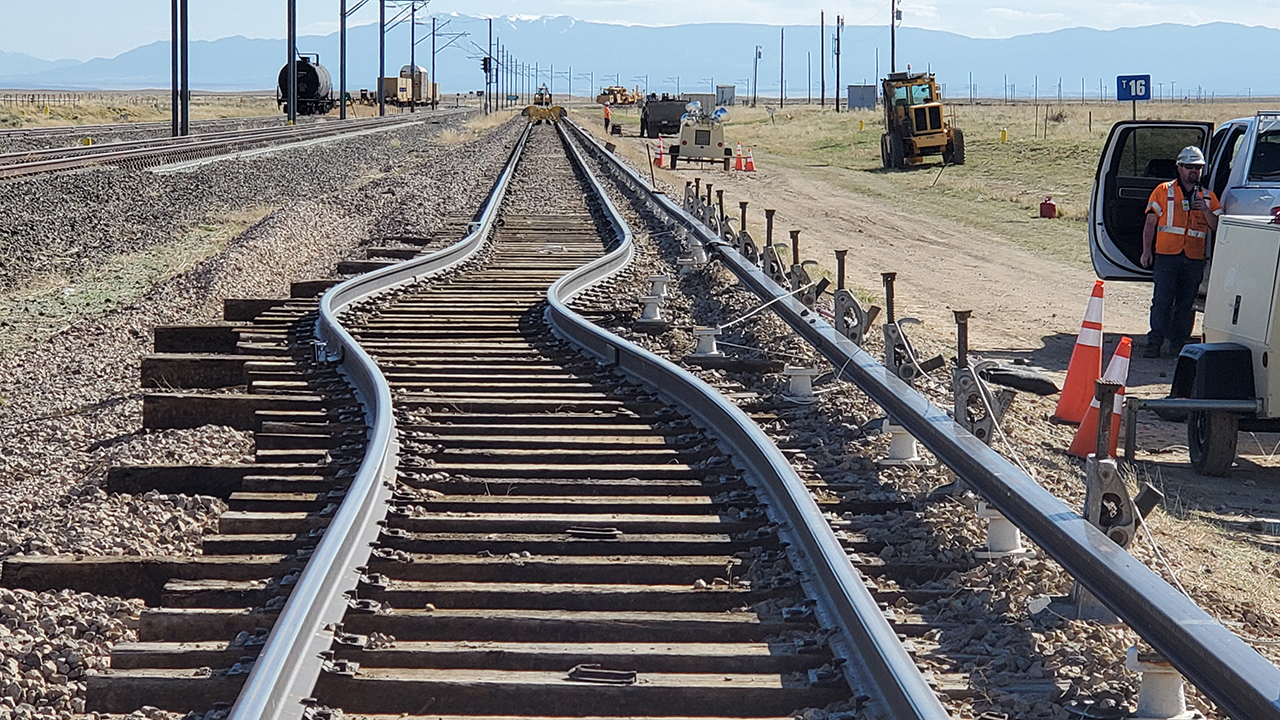
An MxV Rail research team investigates heat-related track buckling. MxV Rail photo.
RAILWAY AGE, MARCH 2024 ISSUE: The rail industry grapples with developing climate-related resiliency plans.
In August 2021, Southern California received its first-ever tropical storm watch, according to the U.S. National Oceanic and Atmospheric Association, when Tropical Storm Hilary was making its way to the Los Angeles Basin and the surrounding area.
The storm pummeled the region, causing Class I Union Pacific to adjust operations on its Yuma Subdivision because debris, water and mud covered the tracks. UP also briefly closed its Mojave Subdivision because of storm impacts.
“Tropical Storm Hilary has moved out of Southern California, but conditions remain tenuous due to heavy mountain runoff, washouts, and mud covering roadways and interstates,” UP said in a customer notification. Train crews with competing Class I railroad BNSF even worked with UP to restore service on the Mojave Subdivision, since both railways use portions of that network.
Southern California’s first-ever warning of an approaching tropical storm is not the only extreme weather event that U.S. railways have experienced in recent years. Record-breaking cold and heavy snowfall in mid-January 2024 created “significant services challenges” in BNSF’s network spanning from Washington to the Powder River Basin and through the Plains and deep into Texas. Texas also experienced a deep freeze in February 2021 where record-breaking cold crippled the power grid, with effects rippling onto freight and passenger rail operations. Heavy rains have also flooded parts of New York City’s subway system.
Under the expectation that extreme weather events like this will only continue, private and public forces are working to ensure that the U.S. freight and passenger rail network can become resilient in responding to current and future extreme weather events. Parties are also hopeful that the rail industry’s response to climate change-related events may spur renewed appreciation of the environmental benefits of the railroads.
Addressing Extreme Weather Events
The work to develop a more resilient rail network delves into the topic of climate resiliency, which Argonne National Laboratory defines as “a way to protect ourselves from the effects of extreme climate events—impacts such as rising sea levels, wildfires, erosion, hurricanes, and extreme heat—that can damage the systems that underpin the economy.”
For the railroads, climate resiliency means “being aware of the potential changes that could affect your infrastructure asset in a negative way, and addressing them appropriately,” said Michael Johnsen, Senior Advisor for Climate and Sustainability for the Federal Railroad Administration (FRA). This definition encompasses not only extreme weather events, but also other situations such as rising sea levels—which could have implications for coastal rail infrastructure—bigger high tides in places such as Miami, New York City and other coastal cities, and increasing events of severe weather because of changing Jet Stream patterns.
The way the rail industry responds to climate resiliency is actually similar to responding to terrorist and cybersecurity threats because “it’s shoring up the network and any vulnerabilities so that operations can continue efficiently and safely,” Johnsen said.
At Association of American Railroads subsidiary MxV Rail, researchers focus on how extreme weather events might affect the rail network. Two areas where MxV Rail has been concentrating on are network resilience related to heavy rainfall, which might bring about inland flooding, landslides, and track or bridge washouts, and extreme heat, which could distort the physical structure of rail.
These two areas are “where there’s most recognition of risk and the most motivation to do what we can to address the risk,” said Scott Cummings, MxV Rail Assistant Vice President for Research and Innovation. Cummings’ primary job duty is to manage MxV Rail’s execution of the AAR-funded research program.
Even though weather events “have been problems for the railroads for more than a hundred years, the risks associated with those are potentially increasing as we’re less able to look at historical norms to predict the future,” Cummings said.
To address heavy rainfall, research at MxV Rail has involved high-tech work, such as using satellite data to look at elevation mapping. The changes in elevations and deformations in the ground structure might give you some advanced warning of where the landslide could occur, or they could point you towards areas where maybe you need to do something to address or help mitigate the risk of an embankment failing or a landslide, Cummings said. MxV Rail is also working with the railroads in researching how railroads can armor their track embankments.
MxV Rail is in literature review mode when it comes to studying heavy rainfall incidents, which means that the group is trying to understand what technologies are available and what things are going to become more available as technologies advance. “We are trying to understand what tools are out there and make sure they are known among the industry,” Cummings said.
The concern with extreme heat is track alignment issues. “With continuously welded rail, the steel rails expand when they get hot, and the track can essentially buckle or displace laterally. Then you can get an alignment problem with your track geometry, and that can result in problems for operating your trains,” Cummings said. “So, one of the key ways that railroads try and mitigate their risk from alignment issues caused by extreme heat is they build and maintain stronger track. This means looking at how lateral track strength is affected when the ballast is disturbed, how the type of cross ties you use affect track strength and how rail anchoring and fasteners improve track buckle resistance.”
MxV Rail is looking at the effects of train speeds across tracks that are prone to buckles, such as how car characteristics and train characteristics might influence optimal train speed on a hot day, and how those characteristics might interact with either the ability for a train to cause a buckle in the track or the ability of a train to stay on the track with a minor buckle, Cummings noted.
In addition to coordinating work with universities and research partners domestically and abroad, MxV Rail works with a technical advisory group comprised of the major North American railways to understand how weather-related incidents affect railroads’ physical network infrastructure.
Other Resiliency Initiatives
Another group working on resiliency-related research is the Mineta Transportation Institute in California. The group, which is affiliated with San Jose State University, received a $4.6 million grant from FRA’s Consolidated Rail Infrastructure and Safety Improvements (CRISI) grant program in June 2022 to coordinate climate resiliency research among five universities.
According to Hilary Nixon, Deputy Executive Director for the Institute, projects range from how to deploy sensors on trains that could detect hazards in real-time, such as flooding/mudflows/debris or wildfires, to developing training for railroad industry personnel on incident response. Research also entails providing tools and resources for the industry to develop plans and policies to mitigate impacts associated with climate change and extreme events.
The universities involved in the Climate Change and Extreme Events Training and Research Program include San Jose State, Michigan State, Oregon State, University of Hawaii and Colorado State University-Pueblo. “All projects have an overarching focus on helping the rail industry to become as climate-resilient as possible,” Nixon said. She expects research deliverables to be ready and available to the public before the grant ends in May 2026. “We are focused on conducting research that will lead to practical, implementable solutions for the industry,” she added.
Besides these research entities, other industry players are becoming involved in developing extreme weather-related resiliency plans.
For instance, in 2022, Amtrak developed a climate resilience strategic plan for the Northeast Corridor. The passenger rail carrier estimates that from 2006 to 2019, it experienced more than 450 service disruptions from floods, wildfires and landslides, among other climate-related events, with the impacts of those events estimated at more than $127 million in lost revenue and lost ridership of 1.3 million customers.
“Amtrak understands that we need to integrate climate change considerations into the current and future planning, design, and construction of our infrastructure and operations. By assessing our risk, understanding our vulnerabilities, and implementing adaptation measures, we will prepare our operations for a sustainable future,” says the report’s executive summary. “Furthermore, by minimizing our contribution to climate change through initiatives that reduce greenhouse gas (GHG) emissions and energy use, we aim to improve operational efficiency while lessening our contribution to climate change. “Finally, we commit to working in partnership with key stakeholders to emphasize the energy efficiency of rail as a transport mode and to demonstrate how improving and expanding passenger rail service can be an essential part of the solution to climate change.”
Creating Holistic Plans
While FRA doesn’t have a regulatory role when it comes to addressing climate change or climate resiliency, the federal agency can pursue climate resiliency through a safety lens.
“We’re concerned with how weather and climate impacts affect the safe and efficient operation of the rail network,” Johnsen said. “This includes everything from the physical structure of the railroad or impacts on signaling and other communication devices, to the people who work in the rail yard or the inspector who must walk along the track. We’re concerned about the workforce out there and the safety of the employees and communities around the rail network, as well as the assets themselves.”
FRA is also funding research into rail resiliency, such as how rising sea levels and storm surges might affect rail infrastructure in areas, such as along the Gulf Coast between New Orleans and Mobile, Ala.
Some of FRA’s grant programs, such as the CRISI grants, address climate resiliency by asking applicants to describe how their projects might address resiliency to ensure sound public investments. This also helps to ensure public-funded projects can pass the environmental process of NEPA (National Environmental Policy Act), which requires the consideration of climate impacts.
One issue in encouraging the rail industry to bolster climate-related rail resiliency plans is to focus on good stewardship of companies’ infrastructure and assets, since the six major Class I railroads and the hundreds of short lines operate as private entities. However, because privately owned freight railroads often oversee their own infrastructure, it can result in local, state and regional entities failing to include the input of the railroads when drafting localized resiliency plans.
But the railroads’ input is key in local and regional emergency planning, especially because of the unique characteristics of rail. Rail could potentially contribute to disaster recovery efforts by helping move people and goods through a region and should be further explored, according to Johnsen. A possible example is having a battery-electric locomotive provide power for essential services, such as a small hospital during a disaster.
“If a county or a city or state is creating a resiliency plan, it should include rail. They should include Amtrak and the short lines and the Class I railroads because those railroads undoubtedly provide goods and services and jobs to somebody in your area. They are an important piece. Even though they’re privately held, you still want to reach out to those entities,” Johnsen said.
Rail can also serve as a backup mode if other passenger transportation modes fail. “FRA’s goal is to provide world-class passenger rail service to the U.S. We want to have an option of passenger rail between city pairs of a certain distance and size, so if the air travel system experiences delays from, say, an ice storm, then you have rail and road as options. If it’s a popular holiday and the roads are congested, then you have air and rail as an option,” Johnsen said. “It’s about creating redundant transportation systems for people to get to where they need to go. Rail can provide another solid intercity transportation alternative, and rail produces fewer air emissions than most air or road trips.”
Indeed, the Rail Passengers Association estimates that rail-based mass transit is 23% more energy efficient per passenger mile than cars and 31% more energy efficient than light trucks. The group also estimates that rail-based public transit saves 4.2 billion gallons of gasoline every year, and it can reduce carbon emissions by as much as 37 million metric tons every year in the U.S.
All industry stakeholders—from the railroads to regional and federal public entities to research organizations—should have a role in developing climate resiliency plans for rail, according to Jim Matthews, President and CEO of the Rail Passengers Association.
“In the U.S., it will be the responsibility of hundreds of different agencies across the country, with different levels of expertise, different levels of funding, operating in different political environments. You know the old saying, right: If it’s everyone’s responsibility, then it’s nobody’s responsibility,” Matthews said. “There’s a risk that in the present system, we won’t get a comprehensive, resilient design standard that will keep systems safe and operating and legitimate alternatives as the climate continues to deteriorate.”


