


Commentary
The Clock is Ticking: Railroads and the Net-Zero 2050 Goal
Written by Jason Kuehn, Vice President, Oliver Wyman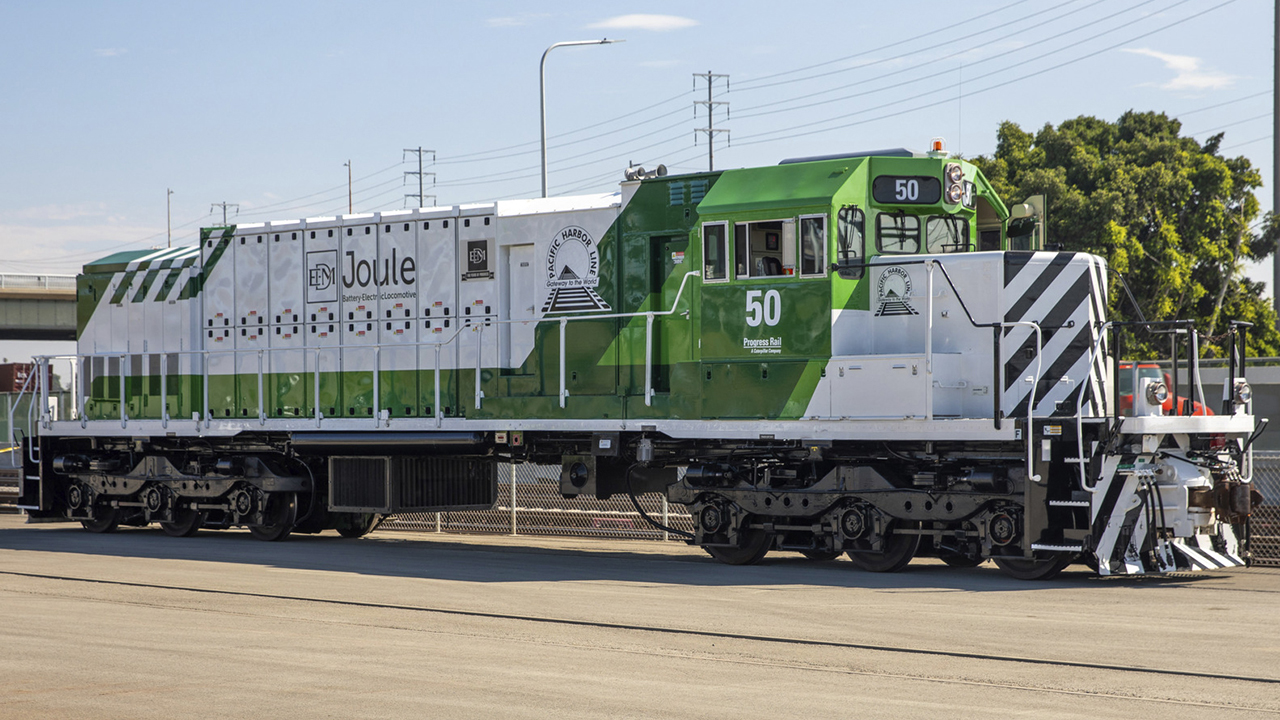
Pacific Harbor Line EMD® Joule SD40JR battery-electric locomotive from Progress Rail. Pacific Harbor Line photo.
The Class I railroads set ambitious goals to reduce greenhouse gas (GHG) emissions in the past 5-10 years, but a review of recent data shows mixed progress at best. Two of these railroads set goals based on reducing overall fuel consumption, which thus far has been helped along by a decline in carloadings (Exhibit 1). The others set goals based on carbon intensity (carbon emissions per million gross ton-miles) and appear to be at risk of not meeting these goals (Exhibit 2).
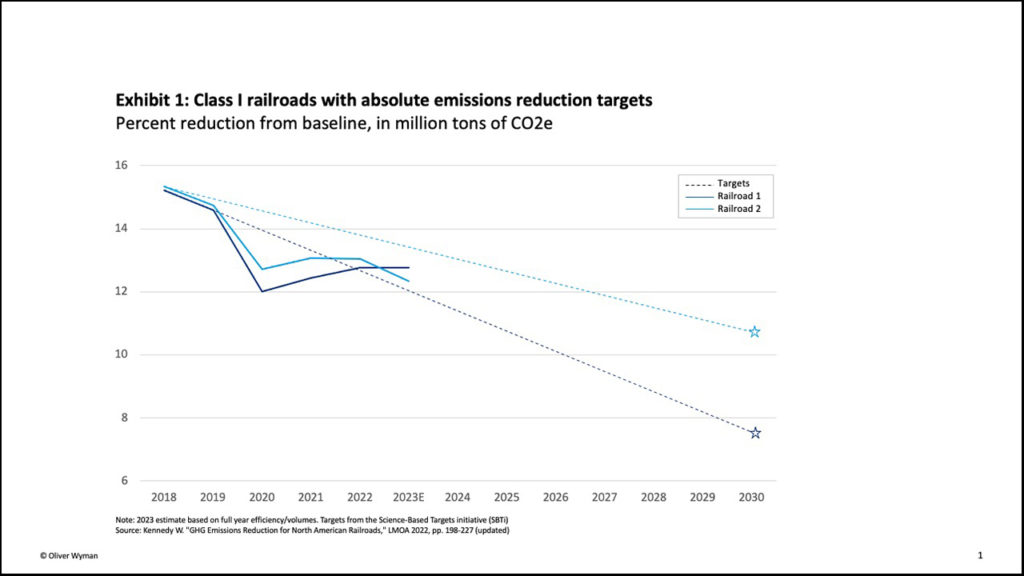
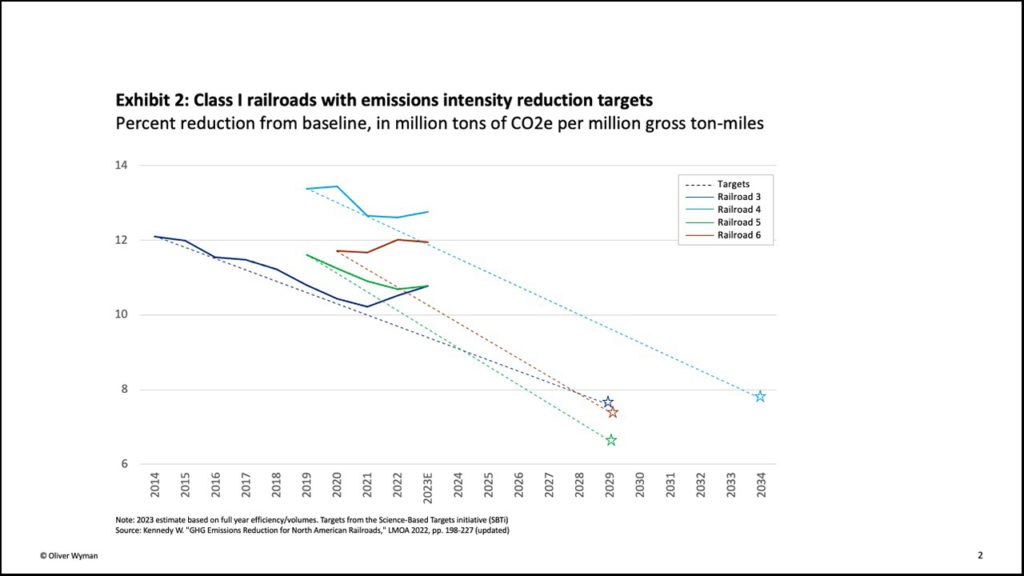
Two assumptions likely fueled the railroads’ original targets: that fuel efficiency would continue to improve by 1% a year, as it had historically, and that bio-based diesel fuels would become conveniently available to replace standard low-sulfur diesel fuel. Unfortunately, these assumptions have not panned out.
More critically, a lack of progress on near-term emissions creates doubt about how the railroads are going to achieve the larger goal of net-zero emissions by 2050. Given that the railroads will likely need 15 years or more to fully transition to interoperable net-zero locomotives (including supporting infrastructure and facilities), they are running out of time to test alternatives, agree on a transition plan and put that plan into action.
Inertia (or the perception of it) from here on out raises the specter of increased regulation. The much shorter replacement cycle for trucks (3-5 years for major truck fleets vs. 20-25 years for locomotives) is locking in real gains quickly. Trucks have already fully achieved locomotive Tier 4 emission standards, and with a push from regulators, are likely to achieve zero emissions well before rail. Trucks also are narrowing the critical gap with rail on fuel efficiency.
The 2030s Conundrum
Historical gains in fuel efficiency were mostly the product of three things: replacing old locomotives with newer, more fuel-efficient ones; locomotive energy management systems; and the conversion from DC to AC traction. The latter two items have been largely maxed out, and the latest Tier 4 locomotives do not provide the fuel efficiency gains of past models. Railroads are choosing to rebuild locomotives rather than buy new—only 137 new road locomotives were built in the past five years—2.5% of the number built in the prior decade.
In addition, railroads face stiff competition for renewable biofuels. Demand from the aviation industry, which has few choices to reduce emissions, far outstrips supply. Plus major airlines likely can outbid railroads for what supply there is. The trucking industry also plans to make use of biofuels, along with electrification, to reduce emissions.
The lack of measurable improvement in locomotive fuel efficiency, coupled with the high cost and limited availability of biofuels, calls into doubt whether railroads can meet their near-term 2030-era goals. And it raises a larger question—should the railroads be focusing instead on the longer and more difficult transition to get to net zero by 2050?
Transitioning to 2050
The Association of American Railroads (AAR) has voiced a preference for hydrogen as the alternative locomotive fuel of choice to meet net-zero 2050 goals. But let us consider what has to happen between now and 2050 in the rail industry to make any alternative fuel the de facto standard—by looking at two of the biggest locomotive technology changes to date: Positive Train Control (PTC) and the switch from coal-powered steam to diesel-electric locomotives.
PTC was the largest undertaking by the railroads in at least five decades. A crucial factor in its success was the use of collaborative AAR industry committees to ensure interoperability across the entire U.S. rail network. There was no substitute for their role.
Initially, in the early 2000s, federally mandated PTC implementation was going nowhere fast until railroad CEO leadership got involved and built consensus; then things started to happen, including jumpstarting AAR committee formation, while teams on the individual railroads simultaneously got to work. From there, chief operating officers began to manage for deadline compliance. We believe something similar must happen with hydrogen, or any other alternative fuel choice, for the industry to meet a net-zero 2050 goal.
The AAR Alternative Fuel Tender Technical Advisory Group and various AAR locomotive subcommittees have begun to look at current issues around alternative fuels and emissions. But it is not too early for AAR committees to start determining what the net-zero 2050 end game for railroads will be, and then develop implementation plans and timelines. Hurdles specific to the rail industry must be identified and subcommittees need to begin working on how these challenges will be resolved, such as lower fuel energy density, technical and safety protocols, and refueling infrastructure.
A key area for example is supporting infrastructure. While the Bipartisan Infrastructure Law includes $7 billion in funding for the development of 6-10 hydrogen production and storage hubs, how will this hydrogen be distributed? Pipeline transport faces big hurdles—existing pipes limit potential volume and hydrogen embrittles conventional steel. The likely best option—at least for a transitional period—could be rail tank cars. Even something as small as a fuel nozzle can be a stumbling block: 50 years ago, Amtrak had to order new locomotives with three types of fuel nozzles on each side of the fuel tank to achieve interoperability.
The list goes on. Shops will need appropriate ventilation systems. Servicing facilities must be designed. How will hydrogen be stored and in what form? Will large servicing facilities include hydrogen production plants? Will the industry approve direct truck to locomotive (DTL) hydrogen refueling? What training will the FRA require for train crews? The industry needs to be tackling such issues now.
PTC planning and design provides two important lessons: By working together, the railroads engineered an interoperable solution that ensured PTC locomotives could operate anywhere in the United States. Second, with a clear plan in place, the railroads were able to work with regulators to establish a workable implementation timeline.
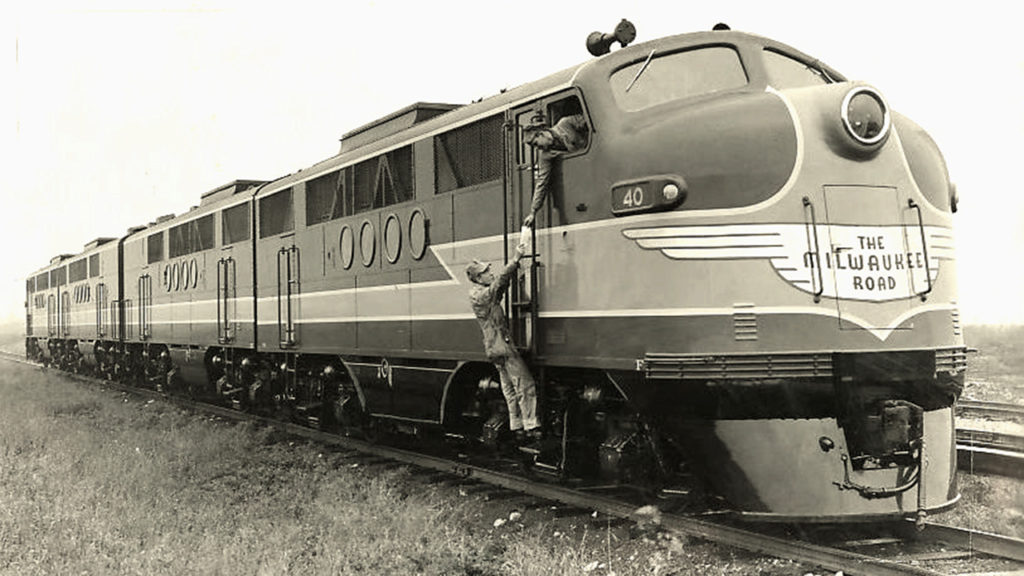
Coal to diesel: Beginning in the 1930s, Electro-Motive Division (EMD) of General Motors designed a new diesel engine, refined the control system, and launched a small demonstration fleet. Although locomotive progress was put on hold by the War Production Board during World War II, EMD (now Electro-Motive Diesel, part of Progress Rail, itself owned by Caterpillar) did advance production of its new 567 engine for the U.S. Navy. The freight rail industry transition from coal-fired steam to diesel-electric locomotives then took hold between 1945 and 1960.
As will be the case for the next-generation locomotive fuel, the railroads had to transform their entire operations to use diesel fuel oil instead of coal, including shop redesign and fueling infrastructure—and this took time. They also had to take the lead in fuel distribution, using tank cars to move diesel during the buildout of today’s pipeline network.
A critical factor that is relevant to the next leap forward in fuel technology is that the railroads used a gradual approach to the transition, starting by proving the technology in yard and local service. This avoided transitioning the entire network to a new fuel supply chain all at once and allowed the economics to be focused where they were most compelling, on those places farthest from coal fields or where water was not abundant or required more extensive treatment.
After WWII, the economics of diesel-electric locomotives were compelling: Reduced fuel costs, reduced locomotive and track maintenance, easier starting of heavy trains, longer crew districts, and even less air pollution. Unfortunately, for the next leap forward, the economics are not yet as convincing. Even in the best-case scenario, alternative fuels are going to cost more in the early years of the next transition.
Skip Ahead or Step-by-Step?
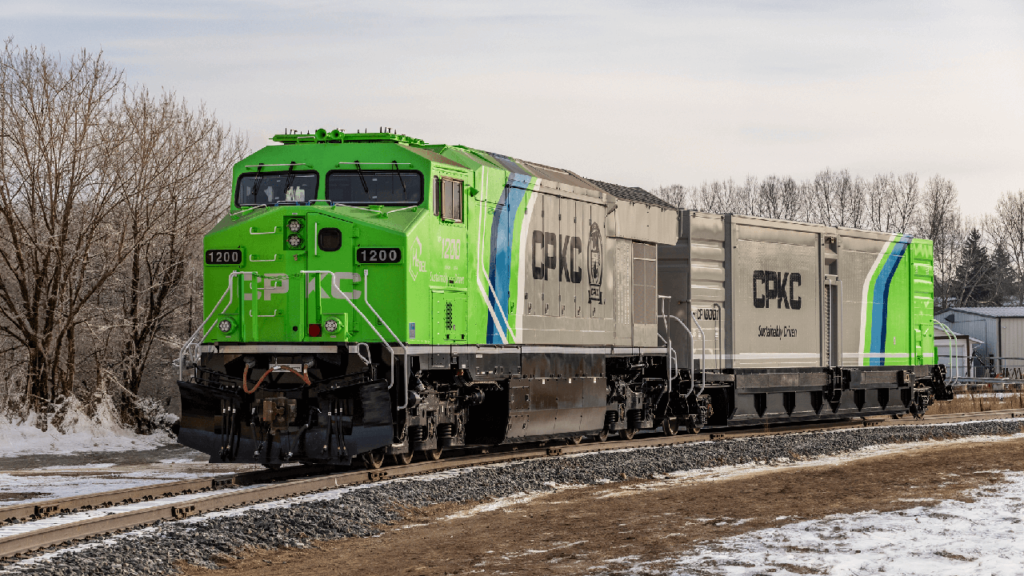
Some railroads want to transition directly to using hydrogen fuel cells (HFC). Appealing as this may be, the number of technological changes required for success is daunting. There is an argument to be made for starting out with an intermediate step: continuing to use internal combustion engines (ICE)—but fueled by hydrogen. EMD’s 710 and 1010J and Wabtec’s (formerly GE Transportation) Evolution Series engines all can be made to burn hydrogen. Using hydrogen this way would allow for dual-fuel systems in the early years—time the railroads could use to gain experience in working with hydrogen while building out the required infrastructure. And tenders built to supply hydrogen ICE locomotives would be transferable to HFC locomotives.
Retrofitting an existing fleet with dual-fuel technology (like the Florida East Coast Railway has done using liquefied natural gas) reduces the risk of stranded investment. And this type of intermediate step could leverage renewable biofuels—to the extent that railroads could secure supplies—as well as hydrogen. This is not likely to be an acceptable end solution for regulators, since hydrogen ICE engines still produce air pollution (in the form of nitrogen oxides or NOx). But it could be an acceptable transition option that significantly reduces GHG emissions while a new fuel supply chain is being built.
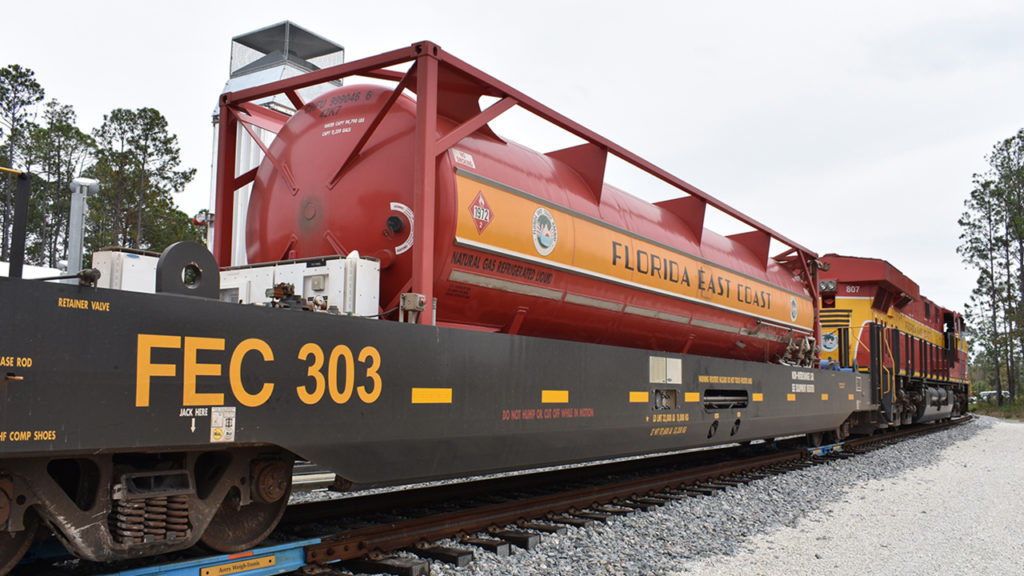
None of this will be useful, however, if the industry as a whole cannot agree on what the end state will be before transition steps begin. There has been enough academic research on batteries, hydrogen as a fuel, electrification and other technologies that the industry, through the AAR and MxV Rail, and with expert assistance, should be able to problem solve with economic modeling to reach a best-solution consensus.
A Moon Shot for Rail
NASA’s first Apollo moon landing in 1969 was not a one-shot deal—early Mercury and Gemini space missions incrementally built up the technical expertise and the confidence required for success. Similarly, the rail industry is facing a challenging, complex, multi-year technology project—which needs a definitive goal and a series of agreed upon and well-planned steps. So with the hard stop of 2050 in view, we believe the industry must quickly align on the following:
- Review current GHG emissions targets and model potential scenarios for economy-wide biofuel availability, demand and cost, to clearly delineate a path to achieving goals in the 2030s and beyond.
- Gather and deploy resources to define and agree on what the 2050 net-zero end game will look like, with a focus on road locomotive interoperability. (This sector also consumes the most fuel and generates the highest emissions.)
- Define the future role batteries will play, for road locomotives, yards, and local service. Battery-electric and battery-hybrid locomotives currently are being developed and tested for yard and local service. Recapturing and reusing braking energy could reduce fuel consumption by at least 10-15%. Maximizing energy efficiency will be important to help minimize the cost of energy transition, since renewable biofuels and hydrogen are all expected to cost more than petroleum-based diesel fuel.
- Develop a well-documented transition plan and timetable, targeting initial deployment in yard and local service and on captive routes with high-density unit trains for road locomotives. Since such unit trains operationally cycle the fastest and undergo rigorous usage over fixed, repetitive routes, this would quickly uncover any issues in road service, while minimizing the need to develop new supply chains for alternative fuels during testing.
- With an end goal and transition plan in place, the industry will be better positioned to negotiate realistic implementation timelines with regulatory agencies at the federal and state level (if required). As was demonstrated with PTC, regulators are more likely to be open to negotiation if they believe their goals have been accepted and that the industry has developed a detailed, fact-based path to achieving these goals.
Tick-tock! The net-zero clock is running for railroads. And the shorter the transition period gets, the greater the chance of stranded investment, loss of competitiveness and increased regulatory intervention. The rest of the world, and most important, the North American trucking industry, is on the move to reduce emissions. With flat rail traffic volumes and dwindling coal demand, there has been little demand for new locomotives for 5-plus years. This offers a rare window for the industry to tackle the net-zero challenge wholeheartedly, collaboratively, and with a lower risk of stranded investment, while continuing to be an economical and environmentally friendly mode of transportation in North America.


