


Wheel-Rail Creep Curve Development Using RCFS
Written by Yuqing Zeng, Principal Investigator, MxV Rail
William C. Vantuono
MxV RAIL R&D, RAILWAY AGE SEPTEMBER 2024 ISSUE: MxV Rail’s rolling contact fatigue simulator (RCFS) is a full-scale test rig consisting of a railroad wheelset and two 56-inch-long rails attached to a “track” table. The precisely controlled test rig uses wheel rolling and rail reciprocating movements to simulate various wheel/rail (W/R) contact conditions without scale factor implications. The RCFS can create pure longitudinal, pure lateral and combined creepage through changing lateral shift and angle of attack (AOA) between track and wheelset.
The creep curves and saturation value (friction coefficient) of W/R contact are important factors that can affect vehicle/track dynamic performance, derailment safety and W/R surface damage. Previously, the W/R creep curves were measured using either small-scale twin disks or roller rigs, and the creep forces were generated by adjusting longitudinal creepage, with no lateral creepage/force involved. The W/R longitudinal and lateral creepages act on the two wheels at the same time and can have a significant effect on axle steering, risk of flange climb and W/R interface damage. Therefore, full-scale W/R contact tests, including lateral creepage and/or combined lateral-longitudinal creepage, that are more representative of actual W/R interacting conditions in revenue service are needed to investigate these effects.
Funded by the Federal Railroad Administration (FRA) and Association of American Railroads (AAR), MxV Rail conducted a series of full-scale W/R rolling contact tests using the RCFS to 1) generate W/R contact creep curves and 2) determine the friction coefficient. The tests used wheelsets with new and worn Class C wheels and intermediate strength rail samples to investigate the effect of wheel loads, contact pressures and surface properties on the tribology performance of the W/R interface under dry contact conditions.
To generate the creep curve accurately, the table yaw angle was controlled and varied to create an AOA from 0 to at least 30 mrad (an AOA of 30 mrad is large enough to reach creep saturation). The wheelset’s lateral position was centered to minimize the effect of both longitudinal and spin creepage on the creep force measurements. The vertical, lateral and longitudinal contact forces were measured using two tri-axial load cells and one instrumented rail.
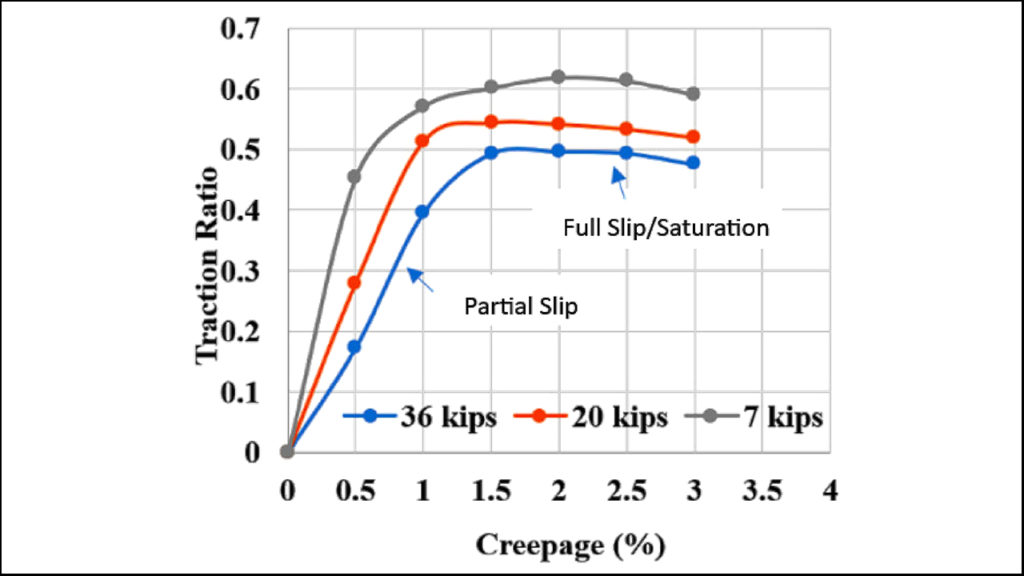
Figure 1 shows the measured creep curves of new Class C wheels and new intermediate strength 136-pound rails using different wheel loads representing cars in a fully-loaded (36 kips), partially-loaded (20 kips) or empty condition (7 kips). For new wheels and rails, W/R contact friction coefficients increase with the decrease of wheel loads (or contact pressure). Additionally, the initial slope of the contact creep curve that defines the partial slip region increased with a decrease in the wheel loads (or contact pressure).
The creep curves shown in Figure 1 are important to the evaluation of flange climb derailment. It has been widely accepted that the maximum friction coefficient under dry W/R contact conditions is approximately 0.5, but test results from the RCFS indicate that the actual value could be larger at low wheel loads that may exist for an empty car or during dynamic wheel unloading. By using a constant friction coefficient less than or equal to 0.5 for the evaluation of cases where the W/R creep forces are near saturation, the flange climb derailment risk may be underestimated in the case of new wheels on new rails.
For the worn W/R combination, the measured W/R contact friction coefficient was less than that of the new W/R combination at full slip/saturation. Although the difference in the maximum friction coefficient was less obvious, when the wheel load changed, the difference in the initial slope still existed. Additional research and tests were carried out to investigate the effect of contact pressure on the W/R contact creep curve under dry and lubricated conditions, including friction conditions under flange contact, effects of wear on surface hardness and roughness, among others.


