


Boxcar Requiem
Written by William C. Vantuono, Editor-in-Chief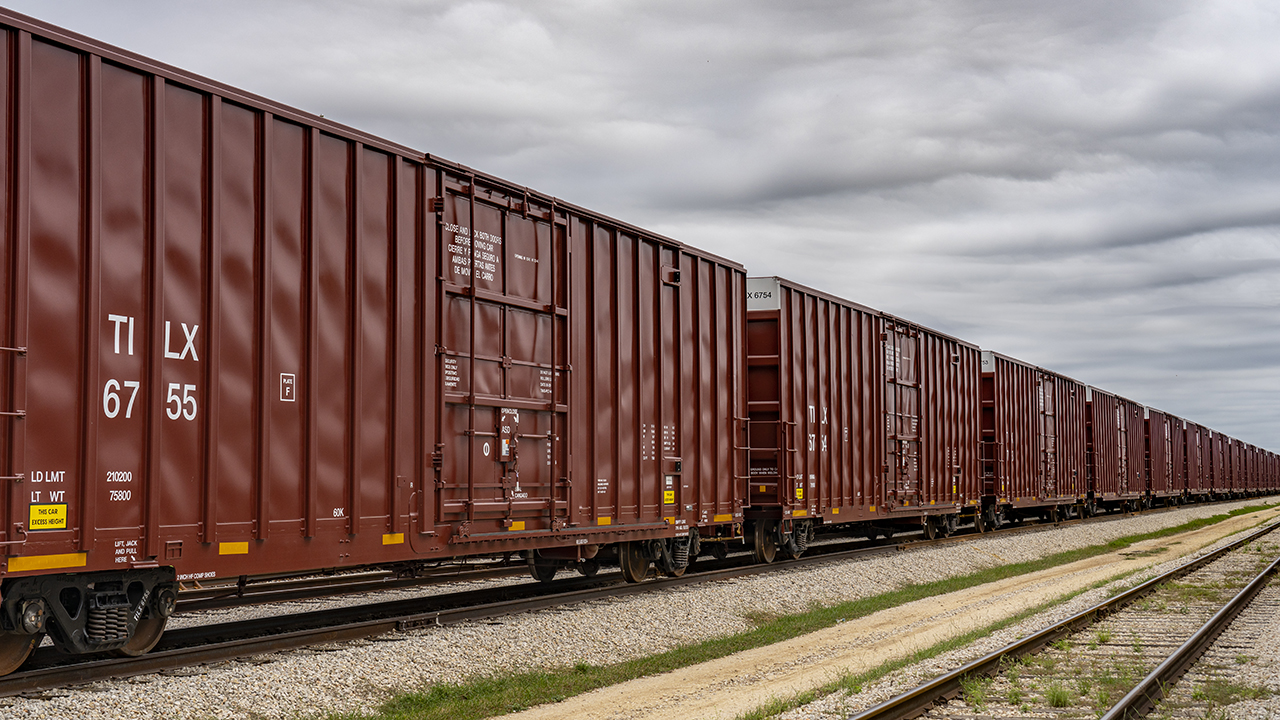
TrinityRail EcoBox™
RAILWAY AGE, SEPTEMBER 2024 ISSUE: Part 1: Can this multi-purpose railcar drive carload growth?
Perhaps the most basic of freight cars, the boxcar has been around almost as long as the railroad industry itself—the mid-19th century. The North American fleet consists of approximately 108,000 units—by far the smallest fleet by car type—with an average age of 28 years—the oldest of all railcar types. Versatile because they can handle many different commodities, they’ve nevertheless been largely replaced by intermodal containers. However, intermodal containers require specialized loading/unloading facilities and handling equipment. Boxcars generally don’t. That may be a key advantage as far as their role in rail freight carload growth is concerned.
Fleet age, initial high manufacturing cost due to complexity (a new 60-foot high-cube plate F is in the neighborhood of $150,000), antiquated car-hire rules, excessive empty back-haul miles (poor utilization), loading infrastructure that’s typically older than the cars themselves, and too many sizes (ranging from 40-foot Plate B to 89-foot hi-cube Plate G) are problems impacting wider boxcar use.
“The North American rail industry is plunging toward a boxcar cliff as many cars are hitting their 50-year expiration date and not being replaced because the Arbitration Rule suppresses boxcar rates far below competitive levels,” according to Railway Supply Institute President Patty Long. This will occur in about five years. Only about 20,000 new boxcars have been built since 2014, not nearly enough to replace the entire fleet.
Boxcar manufacturers include Greenbrier, TrinityRail, FreightCar America and National Steel Car. GATX, with close to 9,000 units, and TTX (RailBox pool service) are the largest boxcar fleet owners. The industry is looking to standardize new-builds on 60- or 50-foot Plate F cars. The questions are, how many, and how soon?

“My view from years in the industry is that you’re not going to find anything closer to truck than a boxcar,” says Norfolk Southern Vice President Business Development and First and Final Markets Stefan Loeb, who has considerable Class II and III experience. “It’s among the most important pieces of equipment in terms of rail growth, but its also right in the crosshairs. It’s probably one of the highest touch car types in railroading when it comes to the level of customer interaction. Boxcars are more critical for flexible freight than anything else because they are the closest thing to the drive-in container that railroads compete against in the carload space. And they’re not like a grain car that only cycles between a port and a grain elevator. Boxcars go everywhere. Even though that’s great flexibility, it creates a harder investment piece for shippers and for short lines.
“It’s very important that we address the challenges, especially aging. To compete with truck, you must have the most efficient car type, which puts it in that 60-foot plate F size. But it’s a very expensive car because it’s made of a lot of steel.
“We need to figure out how to turn the cars faster, whether that’s through pooling or other methods. In terms of winning freight off the highway, nothing is more important than a boxcar. But it’s an older fleet that a lot of folks are finding hard to reinvest in. Those are the things that industry must address, and it has to be a multi-party solution. The customers have to be willing to look at their loading docks. The railroads have to try and get as efficient as possible and not have all these car types running around, which in general we have. But again, it also needs what I’ll call an acceptable investment thesis with the folks who are going to own the cars. Then you layer on the complexity of a third-party, not railroad-owned, entity.
“And because boxcars have to be flexible on what they can carry, that almost hurts them in how fleets get built for the future. That’s where a multi-faceted group needs to come together to address some of these issues to clear the runway for more boxcars to be built.”
Carbuilders view boxcars as important to their business and having a role in rail freight volume growth, but acknowledge that they’re dealing with similar issues as railroads and shippers.
“We see continued demand for new boxcars,” TrinityRail tells Railway Age. “Despite some shift to truck and intermodal in the past, a steady outlook for boxcar shipments and a population of aging assets are likely to drive new boxcar production demand in the coming years. Insulated and refrigerated units have been trending recently.”
One example is the EcoBox™. With a 60-foot, 3-inch interior length, the lighter weight, high-capacity Insulated EcoBox™, designed for the beverage, food and packaged goods industries, features fiberglass-reinforced panels and spray foam insulation applied to the underframe, providing protection from extreme temperature fluctuation.
Versatility and flexibility, TrinityRail notes, are necessary for a robust boxcar market, along with high manufacturing quality. “The market cannot support a single-use car,” the company says. “As an industry, we need to build and manage the fleet in the most efficient manner possible and improve car utilization. Telematics, like our Trinsight® Logistics Platform and RailPulse, of which we’re a member, will go a long way toward boosting efficiency. The battle for modal shift from truck to rail is very real to us.”
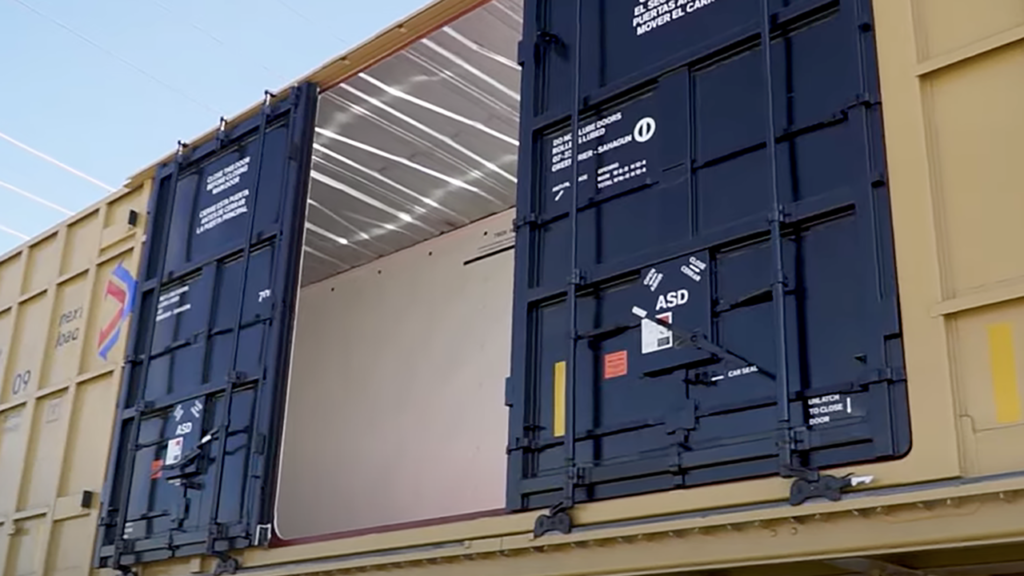
Boxcars are subject to extreme physical stresses that can easily damage a critical, complex component—doors. Forklift strikes are the most common. Greenbrier is addressing this problem with its Titan Series Doors™, which feature the company’s standard door mechanism, with all associated parts: replacement hasps, anti-spin/anti-drift devices and patented worm drive.
“These doors use an advanced high-strength Grade 100 weathering steel that provides twice the yield strength of a traditional boxcar door, sliding or plug,” Greenbrier notes. “This is based on Industry Standard AAR Test S-213, the maximum impact of force before permanent steel deformation occurs, making a door difficult or even impossible to open, or to close and lock. Average plug door lifetime repair-related costs are 55% lower than traditional steel plug doors, based on a 2024 internal standard boxcar door repair model derived from interviews with boxcar repair experts.
“With the Titan Series, reducing weight is secondary, even though this design does reduce weight somewhat. Our goal is to strengthen the door and prevent damage from incidents like forklift strikes, and we’re able to use advanced high-strength steel for that purpose. We can take this technology and implement it on any size door that we’ve done in the past, in any size the customer needs.” Ten car sets, five with Norfolk Southern and five with TTX, have been in service for about a year.
Part 2 of this series will be covered in the October issue by Financial Editor David Nahass in the Railroad Financial Desk Book.


