Force Control
Written by William C. Vantuono, Editor-in-Chief
MxV Rail
RAILWAY AGE, FEBRUARY 2024 ISSUE: Nearly 140 years after the first patent was issued, draft gears and cushioning devices remain as fundamental to railroading as steel wheels rolling on steel rails.
Few other freight railcar components need to withstand as much in-train force as draft gears and cushioning devices. Safety and ride quality rely on these components performing seamlessly with wheelsets, braking systems, roller bearings, side bearings, truck assemblies, and, most important, couplers. The design and engineering that goes into these heavy-duty devices is complex and continues to evolve and improve. Principal suppliers of these components are Amsted Rail, A. Stucki, Miner, Strato and Wabtec.
First, some history: A U.S. patent was issued to William H. Miner, founder of the company that is today’s Miner Enterprises, on Oct. 20, 1891, for a “true tandem spring draft gear.” This set the stage for a 30-year product run. W.H. Miner spring draft gears “filled a special need during the railroads’ transition from wooden frames and the standardization of draft gear pockets, automatic couplers and braking systems from approximately 1885 to 1919,” the company notes. “The key patents involved in this evolutionary period of our draft gear business is covered in The Amazing Story of the Miner Spring Draft Rigging,” downloadable:
“The object of my invention,” William H. Miner said, “is to provide a draft-rigging of a simple, strong, and efficient construction, embodying great buffing and pulling resistance, and providing for a gradual or cushioned absorption and transmission of strains and shocks to the body of the car. To this end, my invention consists of a drawbar having springs arranged tandem between the draw-timbers and through which the strains and shocks, either pulling or buffing, are gradually absorbed and transmitted to the draft-timbers. In this matter of conserving railway revenue, it is essential that the draft gear should be a scientific mechanical appliance with the same degree of care represented in its design, material and construction as should be embodied in a high duty machine tool.”
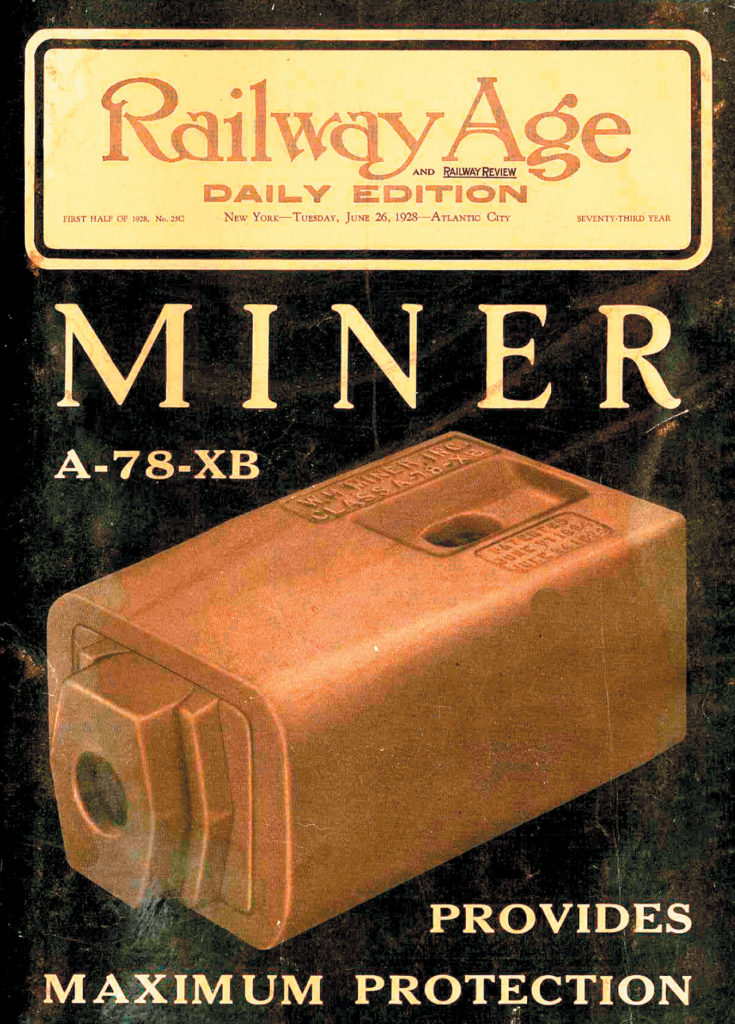
Back in the day, when the cover of Railway Age (then a weekly and sometimes a daily during industry trade shows) was available to advertisers, Miner’s products were often showcased. The June 26, 1928, cover featuring the company’s A-78-XB draft gear is just one example:
Fast-forward 95 years to the Association of American Railroads End-of-Car Energy Management Task Force, a committee consisting of representatives from railroads and suppliers and including TTX Company, and MxV Rail researchers. At the June 26-28, 2023, AAR Research Review in Pueblo, Colo., MxV Rail Principal Investigator II-VTI Adam Klopp presented a summary of the Task Force’s ongoing draft systems research.
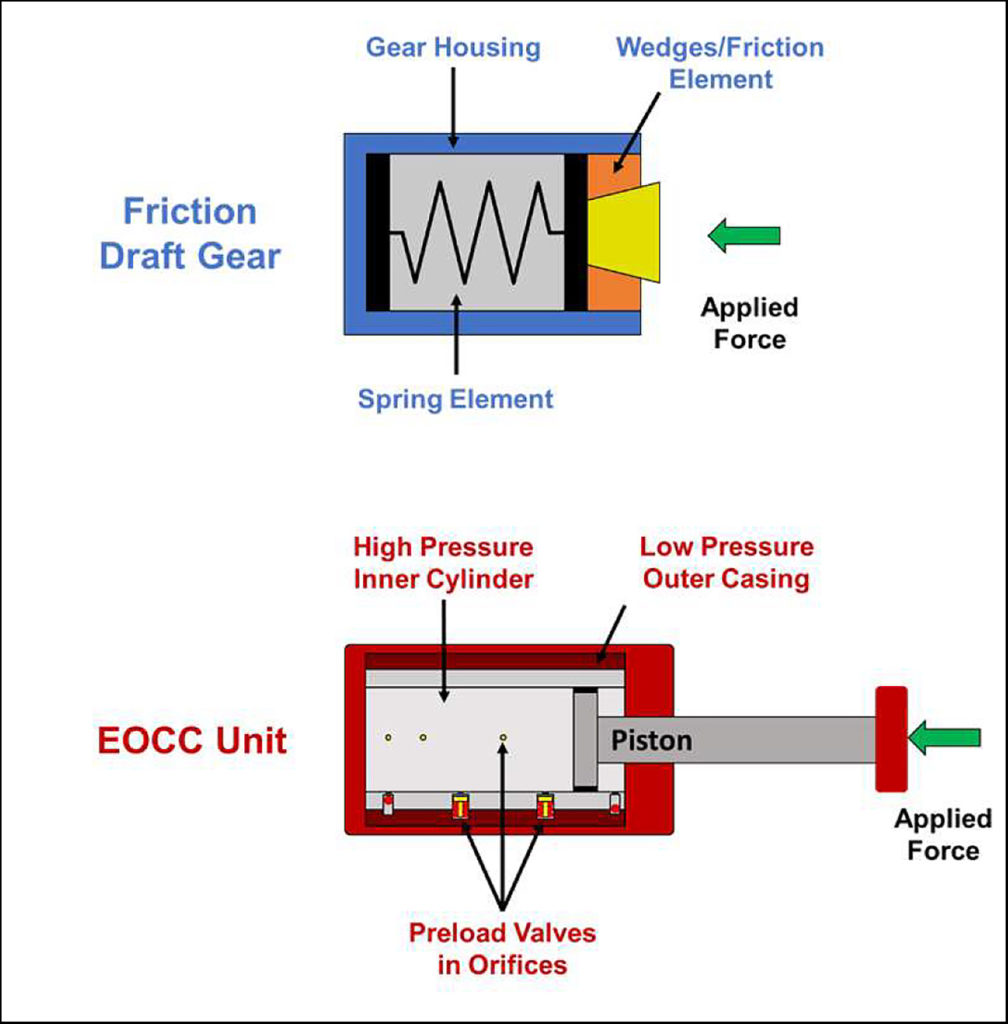
The End-of-Car Energy Management Task Force’s objectives, Klopp noted, “are assisting the industry in reducing service disruptions from component failures, broken coupler knuckles and train separations. Improved draft system performance provides better impact protection and control of in-train forces, limiting train slack action. Draft systems protect railcars and lading from coupler forces in a train by limiting relative motion, absorbing impact energy.” The most common draft systems are friction draft gears (DG), which have a short-displacement stroke and provide “good control of train slack action,” and end-of-car cushioning (EOCC) units, which have long-displacement stroke and provide “good energy absorption in yard impacts.”
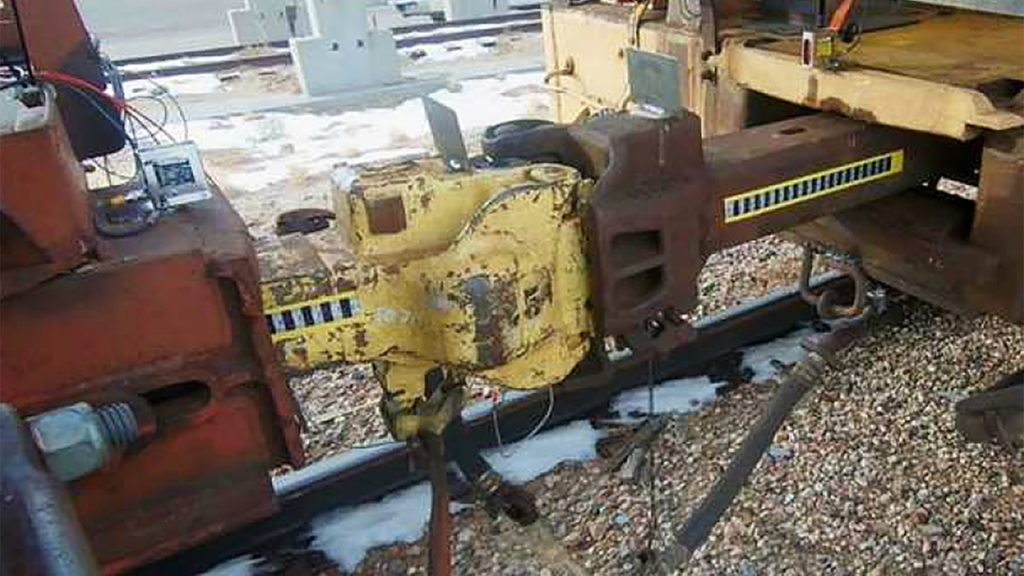
Draft system evaluations “historically have been done in North America through car-to-car impact testing or drop hammer tests from the AAR Manual of Standards and Recommended Practices,” Klopp pointed out. “They’re good for evaluating impact protection and energy absorption, but they aren’t good indicators of in-train performance and slack control.”
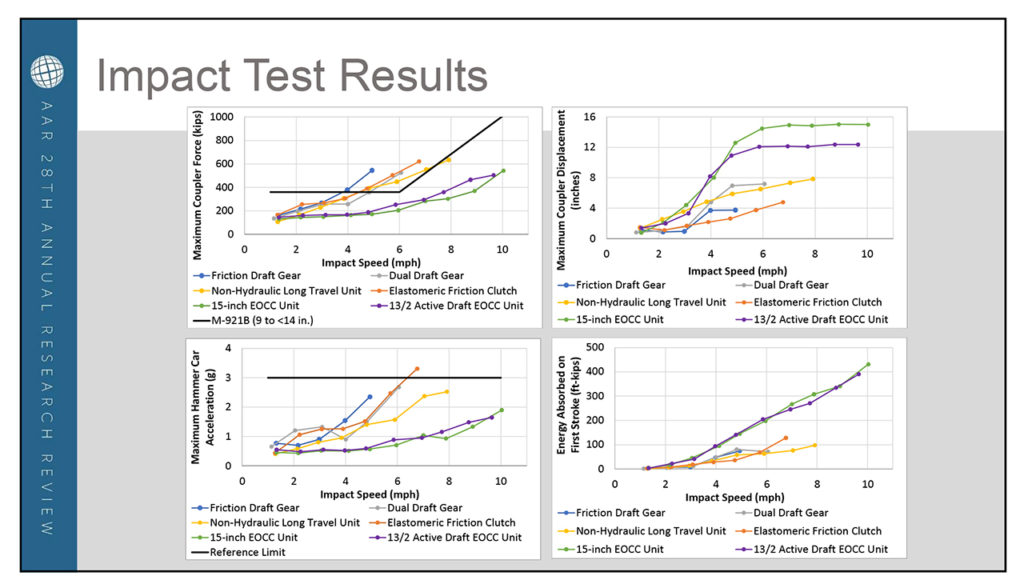
MxV Rail and the End-of-Car Energy Management Task Force are currently developing a combined testing and simulation methodology to evaluate impact and in-train performance. Draft system impact testing has been conducted for six systems:
- Friction draft gear.
- Dual draft gear.
- Elastomeric friction clutch draft gear.
- Non-hydraulic long-travel unit.
- Standard 15-inch EOCC unit.
- 13/2 active-draft EOCC unit (13 inches of buff, 2 inches of draft; other combinations are available, but the Task Force focused its efforts on the 13/2 configuration).
The impact tests were conducted “to evaluate impact protection provided by these systems, and the dynamic forces,” Klopp noted. “We also wanted to characterize these systems for use in modeling.”
“Drift Simulations” were conducted with a block of 286,000-pound GRL (gross rail load) cars equipped with a single draft system type, and no locomotives or brakes. The block of cars was allowed to “drift” through grade transitions intended to create slack action and evaluate in-train performance.
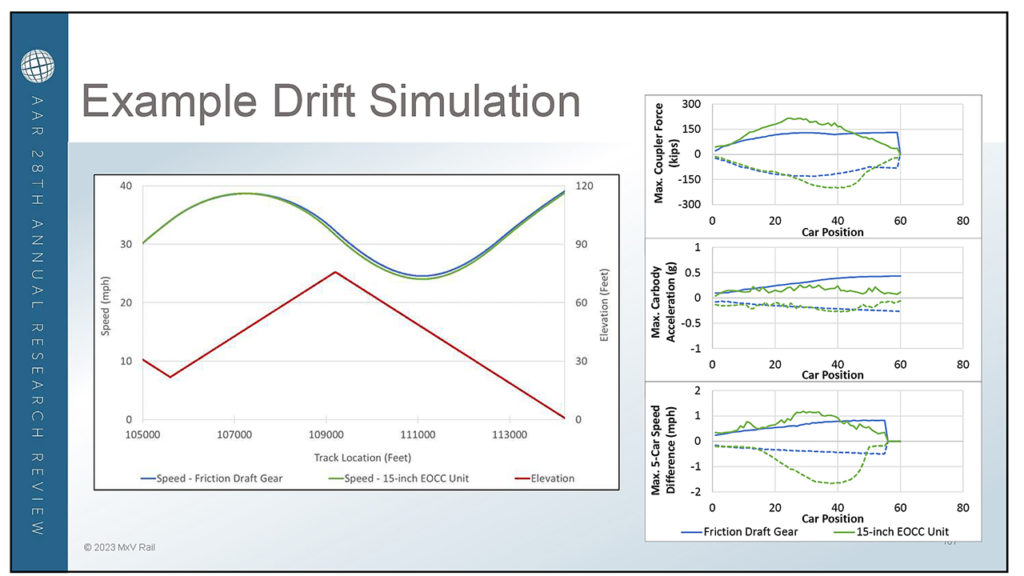
“The results show that EOCC units generally provided less train action control,” Klopp reported. “Higher speed differences and forces develop. Friction draft gears and alternative units generally provided better train action control, with limited relative motion and forces. Impact tests showed EOCC units provided the most impact protection, while standard DGs provided the least. Standard DGs provided the most slack control, while EOCC units provided the least. Alternative draft systems provided better impact performance than DGs but with a smaller displacement than EOCC units.”
MxV Rail and the Task Force are now developing a draft system evaluation Recommended Practice, supplementing current impact tests with train action modeling, and updating draft system evaluations “for the modern railroad environment.”
See also: MxV Rail R&D: Railcar Draft System Modeling

One long-time (2008-2023) End-of-Car Energy Management Task Force member is Amsted Rail Vice President Engineering Jay Monaco, who gave this writer his first “lesson” in active-draft EOCCs some 30 years ago. It was time for a “low-impact refresher course” (pun intended), and he spent some time late last month bringing me up to speed:
RAILWAY AGE: I find it interesting that the research is ongoing after so many years. There are continuous improvements to be made?
MONACO: Initially, the idea of active draft came about a long time ago. There were hydraulic cushioning devices that had a mechanical spring coil, spring positioning mechanisms to give them some attenuation in the draft direction. Some cost reductions and simplifications occurred at the railroads, so we ended up with cushioning devices that did a great job for yard impacts, but went through complete slack and no shock absorbing at all in the draft direction, metal to metal. It was especially bad in the older days before we created the hydraulic lock preload devices that prevent the unit from running in very easily against the force that was generated by internal gas pressure. It was on the order of 6,000-8,000 pounds, which is inconsequential in a train, and then it would come all back out as slack. So these blocks of units that were cushion-equipped, like autoracks, really were feeling the pain. The advent of preload, and particularly hydraulic lock preload, really helped a lot. That was proven in testing autorack unit trains, but it took care of only one part of the problem. We still had the issue of not really having any cushioning in draft. We tried installing a plain orifice—not a valve—staged an inch and a half or so inward so that it could run in easily up to that point. In the event it would receive a draft shock in the train, it would have some degree of cushioning in that short amount of travel. But that didn’t go anywhere, either. There are expired supplier patents on this internal stuff. We sold a few, but the railroads weren’t sure if it was going to cost more, and there was constant churning over the specifications, M921E for autoracks and M921F for standard railcars.
RAILWAY AGE: You left the industry for a few years and returned in 2005. Had any progress been made?
MONACO: It finally turned into a research initiative, but started really slow. The railroads said, “Well, we’ll try one.” Our committee said, “No, you can’t just put one in there and expect that car to get slammed and say it’s performing better.” You have to equip the entire train. You need to avoid that buildup of velocities when you don’t have any attenuation in the draft direction, especially if you’re going down a grade and you have slack run-in, a buildup, and then you start going up a grade and those connections come out and you have high draft shocks that result in fatigue damage to the coupling system and even broken knuckles and train separations. In any case, testing occurred with only one unit. And sure enough, it didn’t do a whole lot. It helped a little bit. Today, there are pockets of adoption, but it hasn’t gone wholesale.
RAILWAY AGE: What if active draft became the standard? It seems to me that, all things considered, it would be cost-effective. If there’s a good case to be made that the industry abolish prior specifications and go to active draft only, make it the standard. Would there be any issues in terms of retrofitting draft gear pockets in existing cars?
MONACO: Not really. We’ve been able to get creative with the guts of the hydraulic unit, and I’m sure other suppliers have as well. A 10-inch travel unit in its pocket can be 9/1. A 15-inch travel unit can be a 14/1 or even a 13/2. In Adam Klopp’s test data, you can see that 13/2 isn’t really that much worse than the 15-inch when it comes to impact performance. So you’re not giving up very much. We’ve accomplished that by putting elastomeric pads inside the cushioning unit on the front side of the piston and the inside of the front head. A couple of donuts in there to do all the work. Looking again at the Task Force research results, there is a dramatic difference between hydraulic cushioning devices and draft gears. That’s all pretty well understood. Again, the cushioning unit values are really very close to what’s happening with the draft gears, if you look at the magnitude of the values. What you’re sacrificing in train action forces is minimal compared to the damage that can occur in a higher-speed impact in coupling events.
RAILWAY AGE: What has the advent of longer trains with PSR, these 10,000-foot and 15,000-foot trains, done? And what about dynamic braking, where the locomotives, not the air brakes on the cars, are providing much of the braking force? It has been suggested that dynamic braking, while it has its benefits, especially when applied with distributed power, doesn’t do much to mitigate in-train forces. It could actually make them worse. There will be higher incidents of in-train draft and buff events.
MONACO: I tend to agree with that. Obviously, the in-train dynamic forces are going to be higher. One thing is certain: Railroaders are going to have differing opinions.
Bottom line: As long the industry’s stakeholders work together, safe, productive and profitable railroading will be the result.