Intermodal Briefs: BNSF, Port of LA
Written by Marybeth Luczak, Executive Editor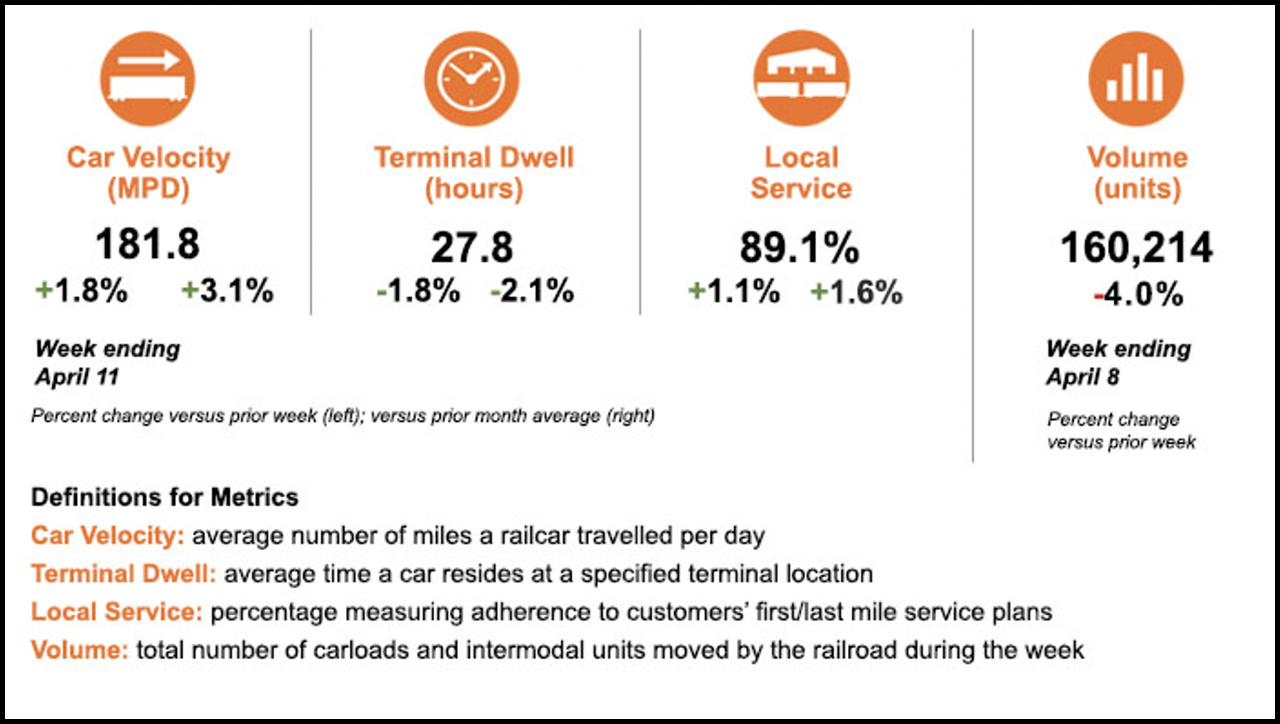
BNSF on April 14 provided the metrics chart above as part of an online customer notification.
BNSF provides customers an intermodal update, citing “some improved service performance” while its teams address network-wide weather-related challenges. Also, the Port of Los Angeles closes a “soft” first-quarter 2023, down 32% from the prior-year period.
BNSF on April 14 reported to customers that it is focusing on alleviating traffic backlog stemming from weather-related challenges. In the North Region, the “Twin Cities has had snow on the ground for 111 consecutive days, and Minneapolis-St. Paul airport has logged five straight months of double-digit snowfall for the first time in history, dating back to 1884,” according to the Class I railroad. “Further west, a record 37.4 inches of snow fell over Casper, Wyo., last week, breaking the city’s all-time two-day record for snowfall. High winds, up to 70 mph, in the Southwest and Midwest also caused some service interruptions on the Southern Transcon, our primary route between Chicago and Los Angeles.”
BNSF said it has temporarily relocated employees to the impacted areas—specifically to locations in and around the Twin Cities and across the Southwest—to “expedite recovery across our network.” Additionally, the railroad’s mechanical teams are “working overtime to repair locomotives and railcars faster and return them to service.” Some traffic has been rerouted and railcars added to alleviate switching demands in the Twin Cities area and to support freight volumes, respectively.
According to BNSF’s April 14 report, flooding from rapid snow melt caused multiple track washouts during the week; one near Foxboro, Wis., approximately 130 miles northeast of Saint Paul, Minn., and another near Watertown, about 50 miles west of Saint Paul. “Both incidents impacted the main track, but service was restored in less than 36 hours as crews worked quickly to repair the affected track as the waters receded,” according to the railroad.
BNSF also reported metrics (see chart, top): Average car velocity for the week ending April 11 improved slightly for the versus the prior week, up more than 3% from the level for March; terminal dwell is below the average level for the preceding week and month; and local service compliance, “which reflects our timeliness in handling carload freight,” increased slightly versus the prior week and month.
For the upcoming week, flood watches and warnings are currently in effect for parts of northern Montana, North Dakota, Minnesota and Wisconsin, “as warmer temperatures combined with a surplus of snow have caused water levels to rise,” BNSF said April 14, noting that its operations teams will “continue monitoring water levels in flood-prone areas and taking preventative measures to minimize customer impacts.” The railroad added most areas of its network will experience “favorable operating conditions,” with “no significant weather events” expected.
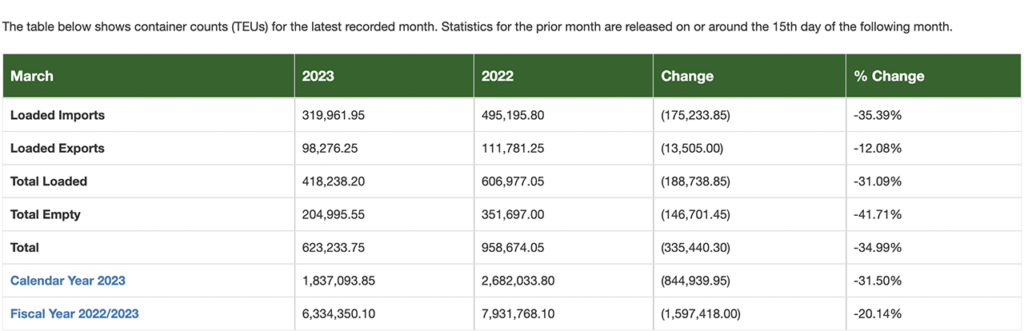
The Port of Los Angeles on April 12 reported handling 1,837,094 TEUs (twenty-foot equivalent units) for the first three months of 2023, falling 32% from the same period last year, which it said was the best first quarter in the Port’s history.
It processed 623,234 TEUs in March. Loaded imports reached 319,962 TEUs, down 35% from March 2022, and loaded exports came in at 98,276 TEUs, a 12% drop from last year. Empty containers landed at 204,996 TEUs, a 42% year-over-year decline.
“Economic conditions slowed global trade considerably in the first quarter; however, we are beginning to see some signs of improvement, including nine consecutive months of inflation declines,” Port of Los Angeles Executive Director Gene Seroka said. “While March cargo volume was lower than last year at this time, early data and monthly growth indicates a moderate increase in the third quarter.”