


Commentary
The NS Showdown: An Old Economist’s Thinking
Written by Mark Burton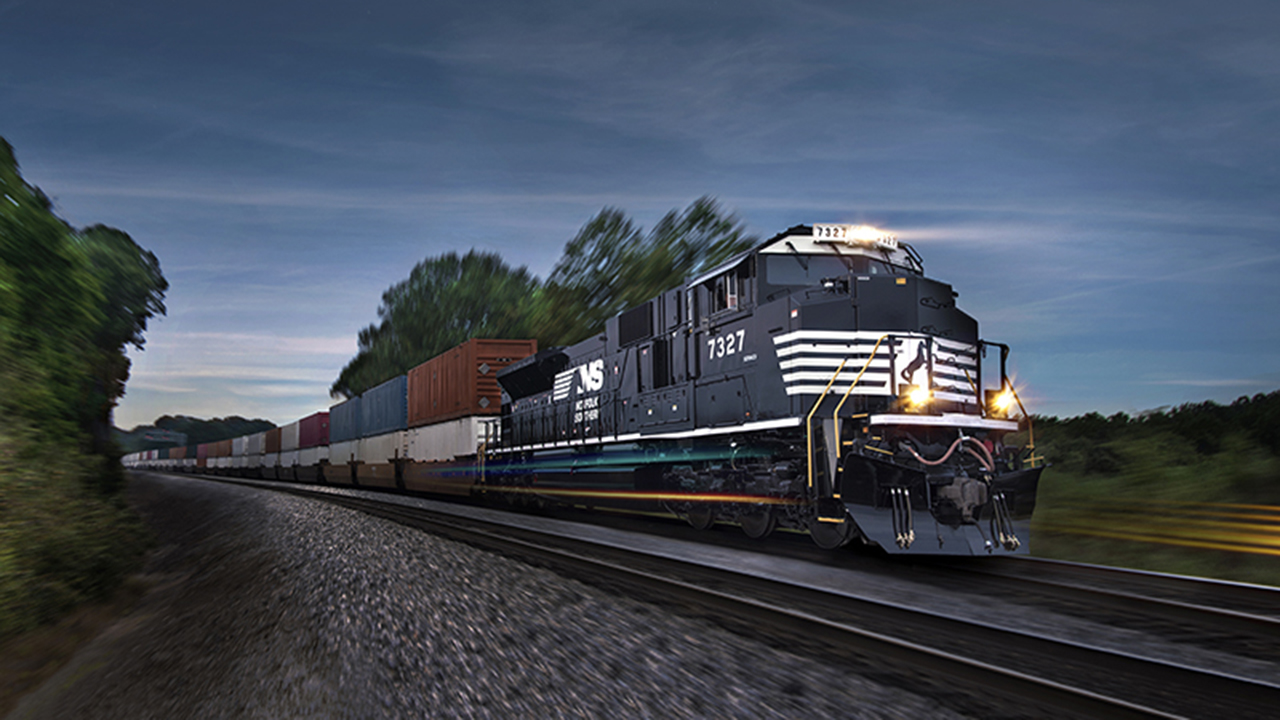
Norfolk Southern photo.
I am a market economist and I’d sooner eat a bucket of ballast than have it said that I prefer any other market structure over competition or that government intervention is a natural and happy thing. When we’re in a textbook setting, nothing works better than competition, and we don’t have to lay a hand on it.
Furthermore—and this is important—profit seeking is an essential element in the competitive process. Through this simple lens, what’s happening with Norfolk Southern, its shareholders and the railroad’s would-be rescuers may seem perfectly okay. It is not—not at least, without the apt consideration of some thorny issues that usually don’t appear in principles of economics textbooks.
Again, economic profits (as economists define them) are critical to market mechanics. Positive (bigger than normal) profits lead to investment, business entry and market expansion. Smaller than normal (perhaps, even negative) profits prompt disinvestment, business exit and market contraction. In a competitive equilibrium, robust producers earn revenues that are just sufficient to cover efficiently incurred costs (including investment costs) and weaker firms that do not meet this standard die ugly but often colorful deaths.
Within this light, Norfolk Southern’s would-be new managers seem to be saying, “If you let us run things, we’ll at least get this poor performer’s profits up to normal where they should be so that NS has a secure future.” And if competition is as portrayed, shouldn’t this be a matter for shareholders to decide without our input or interference? Quite probably, this ruckus will spell the end of the line for Alan Shaw and other senior NS managers, but if the new team is to be believed, everyone else could walk away happier, or at least, the overall economy will be made more efficient and stable despite some collateral injuries.
This dime-store view misses two points. First, aggressive investors, like those pursuing NS, have notoriously short time horizons. The outside group, with their new board in place, will quickly impose today’s iteration of “Precision Scheduled Railroading” (a euphemism for draconian cost cutting). These cuts will quickly bolster market metrics. Profits can be nabbed, and the new cast can disappear before sundown. In some industries, this form of hit-and-run market discipline is fine, even entertaining—but not in an industry where asset lives are routinely measured in decades. True stability and growth insist that long-lived assets be tended by leaders with a more grownup view of the future. Otherwise, important investments with somewhat delayed payoffs will never be forthcoming. To understand this point, contrast the proposed revamp of NS with Berkshire’s handling of BNSF. This short-sightedness is reason enough for apprehension, but there’s more.
Even setting aside the issues of dynamic inefficiency that may be tied to an all-too-short time horizon, the broader community still has standing in the discussion of Norfolk Southern’s future. The argument here is less rigorous but potentially far more meaningful.
When America’s privately held railroads first sought public approval for their enterprise, they struck a fundamental bargain with the rest of us. We give up the right-of-way and let their noisy trains run through our backyards if the railroads will play as nice as they can and provide us with safe, reliable and affordable services. The specific terms of this bargain shift somewhat with changing commerce and emerging technologies. But these terms go well beyond a common-carrier obligation to subsume several other important topics, like labor well-being, shipper prosperity, and regional stability. Our (sometimes grumpy) adherence to this bargain should buy us more than a rote reliance on the forces of unfettered competition. The public is supposed to be a partner and therefore deserves a voice.
So yes, left alone, freely functioning markets will address the collateral damage that an NS takeover may inflict on the broader public. And quite surely, this will happen without anybody’s say-so or regulatory input. Displaced labor, while maybe a little beat up, will be absorbed elsewhere. Disenfranchised shippers can perhaps write off misplaced investments and move. And abandoned communities will very naturally give way to places where transportation alternatives are more abundant and dependable. Markets work just fine, and they will accomplish these things with little or no public sector guidance. But damn it, we bargained for better than this.

Dr. Mark Burton is a semi-retired transportation economist with a long-standing interest in freight transportation. An Economics faculty member at the University of Tennessee assigned to UT’s Center for Transportation Research, his professional career has included both academic and consulting research in transportation economics. In addition to authoring a number of articles and monographs, Dr. Burton has provided testimony in proceedings before the Surface Transportation Board, a variety of state agencies, and the U.S. Senate. In August 2004, Dr. Burton was named as Director of Transportation Economics at the University of Tennessee’s Center for Transportation Research. In addition to his academic work, Dr. Burton has three years of practical experience, serving in Burlington Northern’s Law Department between 1982 and 1985. The opinions expressed here are his own. He has no professional affiliation with Norfolk Southern or Ancora Holdings Group LLC.


