Commentary
Crew Size is About More Than Safety
Written by Bruce E. Kelly, Contributing Editor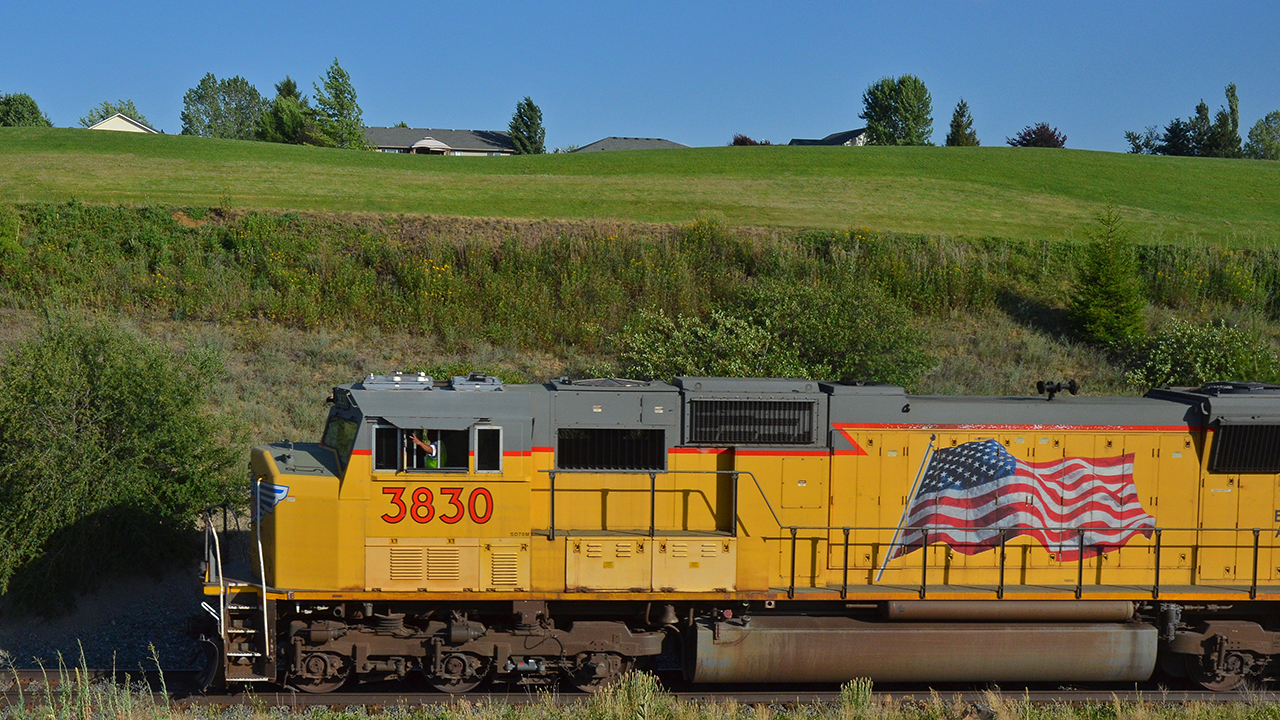
The conductor waves from a Union Pacific train passing behind the author’s home in northern Idaho. Bruce Kelly photo.
In his commentary posted on May 1 and published in the May issue, Editor-in-Chief William C. Vantuono said what few others have been willing to say regarding the subject of how many bodies to assign to the locomotive cab. And he summed it up brilliantly with just two words: “It Depends.”
Most of the controversy over crew size, especially when argued among those within the D.C Beltway and in certain state capitals, has centered around safety, the question being whether a second person in the cab helps reduce the likelihood of any sort of accident. While that debate rages on, I’m here to suggest that crew size should depend on more than just safety. It should depend also on operational and territorial factors.
What could I possibly mean by that? Look no further than Union Pacific’s Ayer Subdivision between Spokane, Wash., and Hinkle, Ore. Roughly 120 of its 180 miles of mostly single-track main line exists where there is no road access whatsoever—not even a crudely maintained service road or jeep trail along the right-of-way.
Why does that matter? Because to implement one-person crews on many—if not all—of their routes, railroads would use what they refer to as a ground-based conductor, or roving conductor, or mobile conductor, or as UP coined it, an “Expeditor.” In March 2023, following the disastrous Norfolk Southern derailment in East Palestine, Ohio, UP said it was suspending its campaign for one-person train operation. But then, just four months later, UP announced it was renewing the effort, with plans to test engineer-only operations on select lines in Nebraska, Colorado and Wyoming.
UP released a video to demonstrate how an Expeditor can efficiently prep trains for terminal departure, and still respond in an efficient, time-saving manner to malfunctions experienced enroute. Take note of this worker’s ability to drive right up to the broken knuckle and perform the needed repair, with far greater ease than if he’d been riding in the cab and had to walk back with new knuckle and tools in hand. Have a look:
Expeditors – Ground-Based Conductors – YouTube
However, not every stretch of main line railway enjoys such proximity to easy road access, which takes us back to UP’s Ayer Sub in eastern Washington, where more than 100 miles of track lie beyond the reach of any roads. Nowhere is this more acute than in the Palouse River Canyon, the remoteness of which was captured in a drone video posted just days before Vantuono expressed his points on the question of crew size. See here:
MOST RUGGED Northwest Railroad! (4K) | Palouse Canyon Short Segment | March 30, 2024 – YouTube
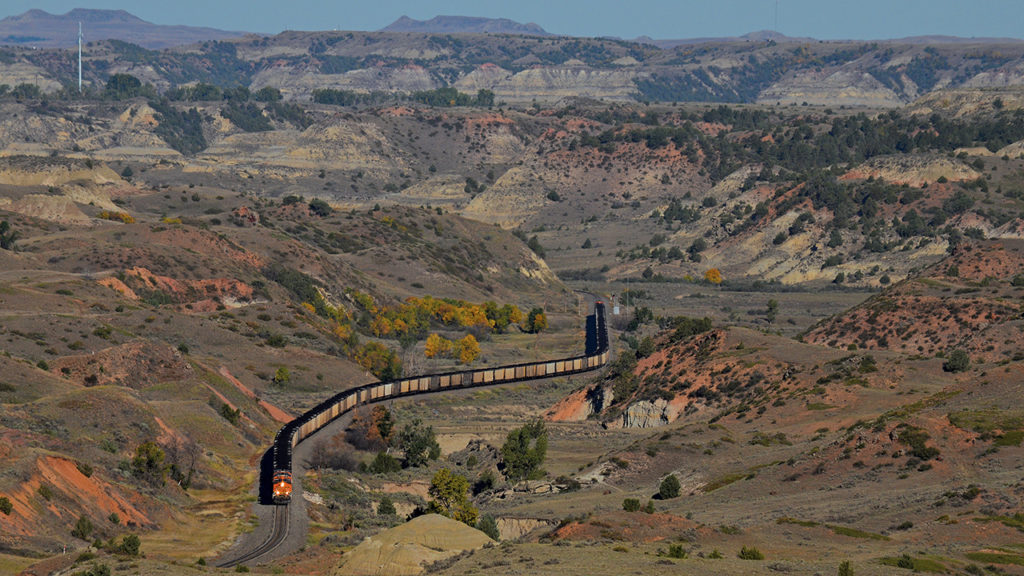
For nearly eight miles, UP’s track through most of this canyon is without road access, except for one leading to a state park and another providing private entry to a remote ranch. Both roads cross UP via overpasses that span deep rock cuts; there’s no way to drive to or park at track level. If a train with only an engineer in the cab were to suffer an air hose separation or broken knuckle in a place like this, it would take hours for a roving conductor to drive from the nearest terminal and hike miles to the problem—probably more miles than a conductor in the cab would have to walk.
UP’s Ayer Sub carries some of the longest trains in the U.S., including 188-car potash trains bound for Pacific export. The word is out that these trains may soon expand to as many as 220 cars, and despite their specialized cars being fewer than 50 feet in length, total train length would be more than two and a half miles. Double-length grain trains are also being considered for UP’s Ayer Sub. They’re already the norm—along with double-length trains for other commodity types—on BNSF.
Throughout the U.S. Class I and regional railway network, there are thousands of track miles that no rubber-tired road vehicle could possibly reach, including places more remote and isolated than UP’s Palouse River Canyon, places where the so-called roving conductor would never go, short of being delivered via horseback or helicopter, if at all, and places where having a conductor in the cab makes all the business sense in the world.
This is a comparatively small price to pay in labor if it enables a much quicker solution to mechanical or operational problems in hard-to-reach locations. The sooner a disabled train gets moving again, the less likely that other trains ahead of it and behind it will become idled themselves due to crews exhausting their hours of service, and relief crews having to be brought to those trains. Which illustrates how—at least in some situations—the quest to reduce operating costs by reducing crew size can become the proverbial picture of tripping over dollars to pick up dimes.
On subdivisions or crew districts where highway and local road access to railroad property is sufficient, and where access roads on railroad property are adequately maintained, the scenario of a one-person train crew and traveling conductor holds feasibility, at least from an operational standpoint—but not in every instance. It works reasonably well on many short lines, where track conditions often confine running speed to 25mph or less. While the train on such a route advances slowly to the next town or industrial complex where work is to be performed, the conductor can drive ahead to identify which cars will be picked up or re-spotted, discuss business with the customer, and pre-line any switches that will aid in the first moves to be made.
Implementation of one-person crews in freight service on Class I main lines has been blocked for the time being by FRA rule. But that didn’t stop another form of crew reduction from going into effect on a Class I carrier last year, which eliminated brakeman positions in at least three Western service areas under what that railroad described as “a collective bargaining agreement” with SMART-TD. As a result, yard jobs and locals on portions of that railroad now operate with only an engineer and conductor. Instead of having two people on the ground lining switches and coupling or uncoupling cars at both ends of a train or cut of cars, there’s only one person, who must walk back and forth from one end of the cars to the other between various moves.
It’s unknown whether the accumulated figures for car delay due to this practice get factored into the record keeping of terminal dwell. As long as “productivity” looks better to Wall Street because fewer bodies are being paid to perform the same work, few seem to care whether or not that work is delivering carloads to customers in the same time that it used to, or if new customers are signing on (let alone being allowed to) to replace those who have become discouraged and switched to another rail carrier, or to trucks—to say nothing of the growing human toll on employees.
On example is the conductor I spoke with, whose phone app has logged him walking as many as 25 miles on some workdays since the brakemen in his territory were eliminated. And that’s no leisurely stroll in the park, especially when much of that distance is walked on ballast, ties and uneven ground. It’s probably too soon to calculate the coming wave of filings for workplace injuries to feet, knees and backs.
Determining crew size is clearly not a one-size-fits-all process. It depends, as Vantuono suggested, but he stopped short of outlining a laundry list of what all the criteria might be. I won’t put words in Bill’s mouth. It’s merely my opinion, one possibly shared by a few others in and outside the rail industry, that the kind of landscape and infrastructure where trains operate, and the enormous length of some of the trains being run today, are important considerations that risk being ignored by those who will have the final say in whether freight trains can go from two people in the cab down to one. Or none.
Editor’s Note. My laundry list of criteria for one-person crews would include fully integrated, AI-driven technology, much of which is available or in development, that communicates in real time across all platforms:
- PTC, preferably “PTC 2.0” where the available bandwidth can accommodate all systems deployed on board, on the wayside, or in the central office.
- Real-time locomotive health monitoring.
- Outward and inward facing locomotive cab cameras.
- A full array of railcar telematics (real-time tracking and tracing, sensors to detect anomalies like shifted loads, excessive in-train forces, etc.).
- Railcar inspection portals equipped with high-speed, high-resolution cameras and machine learning.
- Wayside fault detectors (HBDs, especially acoustic HBDs; WILD, dragging equipment detectors, etc.; that communicate in real time and perform trending analysis).
- Remote health monitoring of all wayside systems (interlocking controllers, switch position indicators, grade crossing warning systems, switch heaters, lubricators/friction modifiers, etc.).
- Fully automated, self-powered railcars moving in revenue trains at revenue speeds equipped with track inspection and rail flaw detection technology (i.e. CN’s ATIP cars).
All of this (and by no means is my list complete) would involve up-to-date FRA inspection rules that replace manual inspections, allowing railroads to concentrate the work performed by track inspectors, track workers, signal maintainers, car inspectors, etc. on quickly addressing problems before they lead to catastrophic failures (derailments, for example). The result would be a safer railroad with fewer service disruptions, fewer employee injuries, improved service, improved employee quality of life, and—I usually avoid saying this over-used and abused term—greater shareholder value. – William C. Vantuono.