


Class I Briefs: CN, UP
Written by Marybeth Luczak, Executive Editor
CN in November 2021 formally committed to a 2050 net-zero target for carbon emissions by joining the Business Ambition for 1.5°C and the United Nations’ Race To Zero campaigns.
CN has joined Environment and Climate Change Canada’s Net-Zero Challenge. Also, Union Pacific (UP) and representatives from the city of Houston, Harris County and Bayou City Initiative in Texas have begun rail yard remediation discussions.
CN has signed on as a founding participant of Environment and Climate Change Canada’s Net-Zero Challenge, a national voluntary initiative launched Aug. 26 for businesses operating in Canada.
Among the other 11 founding participants are BASF Canada, Cement Association of Canada, General Motors of Canada Company, Greater Toronto Airports Authority, and Shell Canada Limited.
Businesses joining the challenge “commit to developing and implementing credible and effective plans to transition their facilities and operations to net-zero emissions by 2050,” according to the government office, which noted that the challenge is complementary to and aligned with other international initiatives such as the United Nation’s Race to Zero Campaign.
Any Canadian company may join. To remain in the program, a company must “meet minimum requirements, submit annual progress reports, and produce five-year updates of their net-zero plans,” according to Environment and Climate Change Canada.
“CN’s pledge to net-zero carbon emissions by 2050 aligns with the government of Canada’s commitment,” CN Vice President, Financial Planning and Sustainability Janet Drysdale reported in an Aug. 26 CN Twitter post. “We will continue to decarbonize our operations and, in turn, will enable our customers to reduce their transportation supply chain emissions and support their and our growth in sustainable products and markets.”
UP on Aug. 26 reported that railroad officials have met with representatives from the city of Houston, Harris County and Bayou City Initiative in Texas, concerning the site of former Houston Wood Preserving Works (HWPW), which closed in 1984. Discussions have started “in an effort to reach agreement on measures needed to remediate a former wood-tie preserving site,” according to UP, which inherited the site in 1997 after its merger with Southern Pacific Transportation Company (Southern Pacific Railroad).
UP said it notified the Texas Commission on Environmental Quality (TCEQ) about the discussions, and that the other three parties have joined the Class I railroad in asking for a “temporary pause in the agency’s processing of the HWPW RCRA permit, allowing the local parties to discuss adjustments that are designed to enhance and speed up remediation. This pause in processing the permit is not intended to circumvent the administrative process and does not impact private litigation.”
“Union Pacific believes this is a positive step forward and appreciates the opportunity to work together with the city of Houston, Harris County and Bayou City Initiative,” said Clint Schelbitzki, Assistant Vice President–Public Affairs, Southern Region. “The well-being of all Houstonians—including our important neighbors in the Fifth Ward and those nearby—are at the heart of all our steps, rooted in compassion, collaboration and most importantly action.”
Since its merger with Southern Pacific, UP reported it has conducted investigative and cleanup work under the oversight and approval of the TCEQ to address the “historic groundwater and soil contamination and to prevent exposure pathways including:
- “More than 11,000 tons or 25 million pounds of creosote-impacted soil was consolidated onsite and an engineered cap was built to prevent exposure.
- “Capping additional areas of creosote-impacted soils with an engineered barrier consisting of concrete, asphalt, and other materials to prevent exposure to the creosote-impacted soil.
- “Conducted significant and widespread sampling of over 120 groundwater monitoring wells within the site and outside the property beneath the Greater Fifth Ward and the Kashmere Gardens area.
- “Implemented a removal program to pump creosote from monitoring wells where it is encountered.”
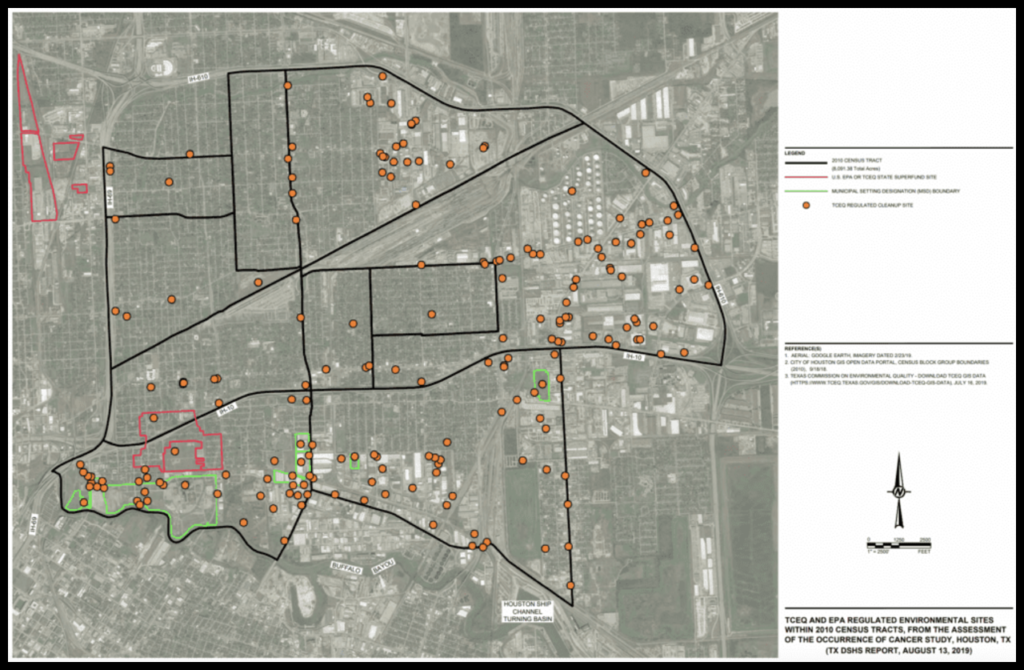
In 2019, the Texas State Department of Health Service conducted a study and identified a cancer cluster in a census tract covering more than 8,000 acres, which includes the Fifth Ward neighborhood, that included the site, according to UP. The former HWPW site, it noted, represents 33 acres, or less than 0.4%, of the total 8,000-area region included in the study.


