


BNSF 3Q23: Net Income, Volumes Down
Written by Marybeth Luczak, Executive Editor
BNSF on Nov. 6 released third-quarter 2023 financial results, including net income of $1.221 billion, a 15% decline from the prior-year period’s $1.442 billion, and total volumes (in thousands) of 2,296, down 5% from 2022’s 2,411.
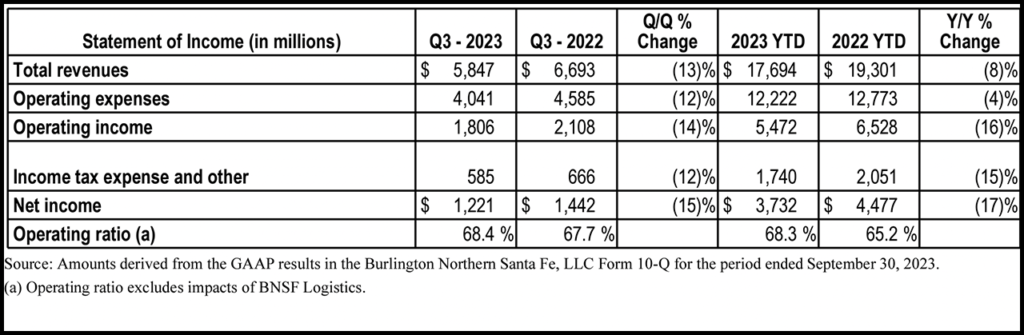
BNSF posted operating income for the third quarter and first nine months of 2023 of $1.8 billion—falling 14% or $302 million—and $5.5 billion—dropping 16% or $1.1 billion—respectively, compared with the same periods in 2022. Operating ratio (OR) came in at 68.4% for the third quarter, a 0.7% increase compared with 2022’s 67.7%; for the first nine months of 2023, it was 68.3%, up 3.1% from the same point last year.
Total revenues for the third quarter and first nine months of 2023 decreased 13% and 8%, respectively, compared with the same periods in 2022, which BNSF said reflected lower volumes of 5% in the third quarter and 9% in the first nine months of 2023. Average revenue per car/unit declined 7% in the third quarter “due to decreased rates per car/unit and lower fuel surcharge revenue, partially offset by positive business mix, while average revenue per car/unit increased 2% in the first nine months of 2023 resulting from higher yield,” according to the Class I.
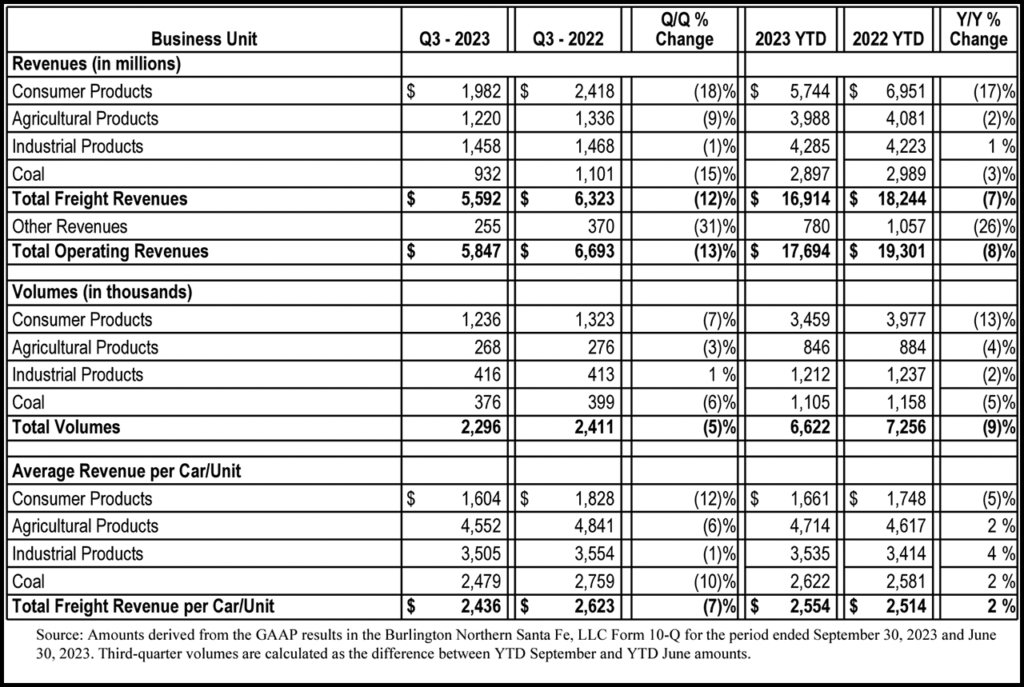
BNSF reported that revenue changes also resulted from the following:
- Consumer Products volumes dropped 7% and 13%, respectively, in the third quarter and first nine months of 2023 compared with the same periods last year “primarily due to lower West Coast imports, the loss of an intermodal customer, and competition from lower spot rates in the trucking market, which has impacted domestic intermodal demand, partially offset by an increase in automotive volume from higher vehicle production.”
- Agricultural Products volumes decreased 3% and 4%, respectively, in the third quarter and first nine months of 2023 vs. the 2022 periods, which BNSF primarily attributed to “lower grain exports, partially offset by higher volumes of domestic grains, renewable diesel, feedstocks, and oilseeds and meals.”
- Industrial Products volumes rose 1% and fell 2%, respectively, in the third quarter and first nine months of 2023 vs. 2022. BNSF said the third quarter’s increase was “primarily due to increased demand for construction products from infrastructure demand, partially offset by lower demand for plastics, chemicals and sand,” while the decline in the first nine months of the year was “primarily due to lower demand for plastics, chemicals and lumber, partially offset by gains in construction from infrastructure demand.”
- Coal volumes declined 6% and 5%, respectively, in the third quarter and first nine months of 2023 vs. 2022. BNSF primarily attributed this to “moderating demand as a result of lower natural gas prices and weather-related impacts.”
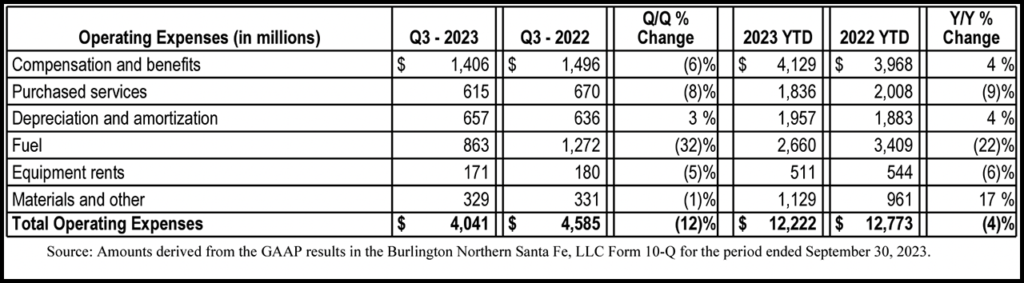
BNSF’s operating expenses for third-quarter 2023 and the first nine months of 2023 came in at $4.041 billion—down 12% from the prior-year period’s $4,585 billion—and $12.222 billion—down 4% from 2022’s $12.773 billion—respectively. The railroad attributed a “significant portion” of the decline to: fuel expense decreasing 32% and 22% in the third quarter and first nine months of 2023, respectively, compared with the same periods in 2022, “primarily due to lower average fuel prices, lower volumes and improved efficiency,” and locomotive fuel price per gallon falling 29% and 17% in the third quarter and first nine months of 2023, respectively; compensation and benefits expense dipping 6% and rising 4% in the third quarter and first nine months of 2023, respectively, with the third quarter’s decline “primarily due to the impact of the ratified union labor agreements in the prior year” and the changes for both periods reflecting “increased headcount, wage inflation, and lower productivity in 2023”; materials and other expense decreasing 1% and increasing 17% in the third quarter and first nine months of 2023, respectively, with the increase in the first nine months of 2023 “primarily due to general inflation, increased casualty and litigation costs, higher property and other miscellaneous taxes, as well as lower gains from land and easement sales”; and purchased services expense dropping 8% and 9% in the third quarter and first nine months of 2023, respectively, “primarily due to lower purchased transportation by our logistics services business and a reduction in drayage costs, partially offset by general inflation.” According to BNSF, there were no significant changes in depreciation and amortization or equipment rents.


