


Commentary
REF 2024: Tight Market Feeds Mixed Temperament
Written by David Nahass, Financial Editor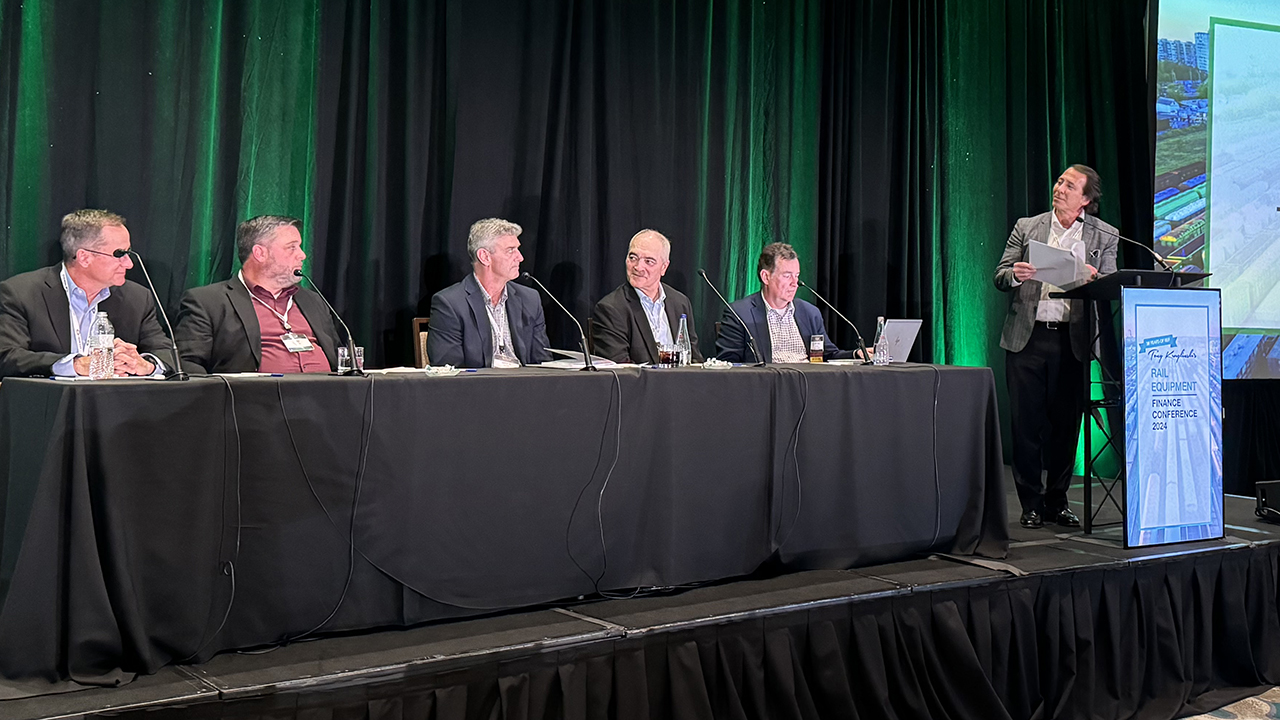
On the railcar appraisal panel led by Pat Mazzanti (Railroad Appraisal Associates), Ed Biggs (Biggs Appraisal), Greg Schmid (RESIDCO) and Bryan Vaughn (Modern Rail Capital), FMV values were higher across most car classes except for older grain and coal cars. There were some mixed opinions on older tank values. Small-cube hopper values increased. Biggest market gainers? Boxcars, plastic pellet hoppers and PD covered hoppers. All photos by William C. Vantuono.
FINANCIAL EDGE, RAILWAY AGE APRIL 2024 ISSUE: At the Rail Equipment Finance Conference (REF) in March 2024, a tight rental market combined with lower new car build levels and listlessness in merchandise, grain and coal loadings to create a mixed temperament. Here’s a rundown of the key presentation takeaways.
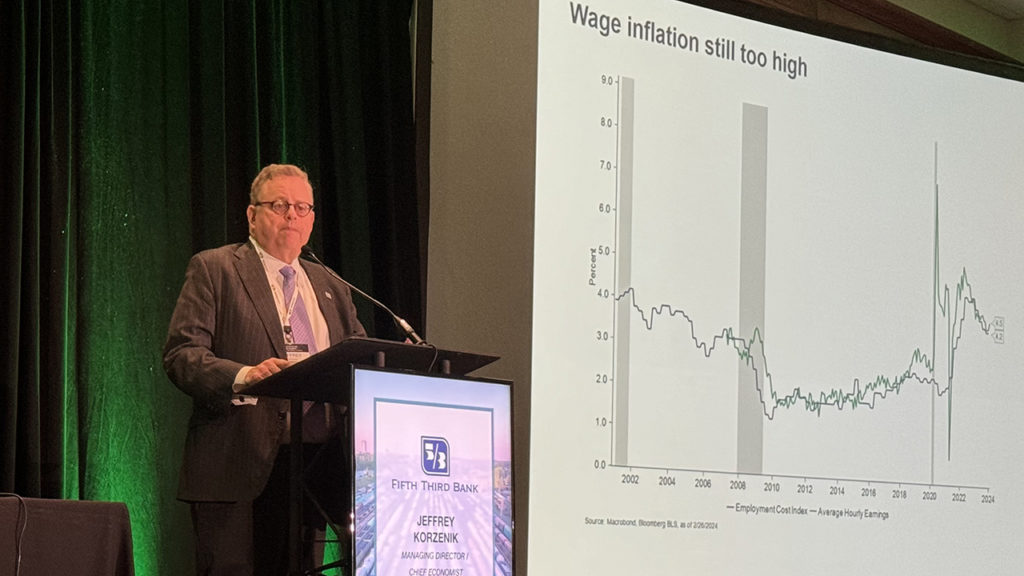
Day 1 keynote Jeffrey Korzenik (Chief Economist from Fifth Third Bank) discussed the possibility of the economy’s soft landing (continuing cautious optimism with ongoing risks) then pivoted engagingly to discussing the U.S. workforce’s labor challenges and the opportunity for companies to hire second-chance employees (primarily those with minor felony convictions). Korzenik covers the topic in his book Untapped Talent. Key takeaway: The birth rate in the U.S. sits at 1.6% and needs to be at 2.1% to maintain the population (due to infant mortality).
David Humphrey (Railinc), REF’s “railcar guru,” updated statistics on the North American railcar fleet and its YOY changes (see p. 49). Key takeaways: The national fleet increased to 1.637 million; there are 52,883 covered hoppers and 32,523 boxcars reaching full interchange life over the next 11 years, beginning in 2025.
Robert Pickel (National Steel Car Ltd.) discussed factors stressing the new car market. Inquiries and orders remain reasonable, while labor and supply chain challenges persist. Pickel follows prevailing 2024 production forecasts of new car production in the mid 40,000s.
Eric Starks (FTR Transportation Intelligence) noted a somewhat stagnant economy. Starks reported an early 2024 strengthening of imported container activity. Key takeaways: Starks does not currently see data supporting Red Sea and Panama Canal-driven increases in West Coast port traffic; and current data indicates softness in railcar demand right now.
Graham Brisben (PLG Consulting) discussed the energy and chemical landscape for rail. Key takeaways: EIA estimates that globally renewable energy will out-generate coal by 2025; demand for biodiesel has made the U.S. a net soybean oil importer; polyethene’s “second wave” is complete with a third wave softly under way; and U.S.-based rare mineral mining is a potential rail growth story.
Jarrett Bilous and Geoff Wilson (Standard and Poor’s) updated the domestic economic picture. Key takeaways: S&P sees low recession risk; an improvement in freight indexes is an economic positive while other contradictory factors (ISM New Orders Index) are showing weakness; and per-carload railroad revenue continues to increase post pandemic.
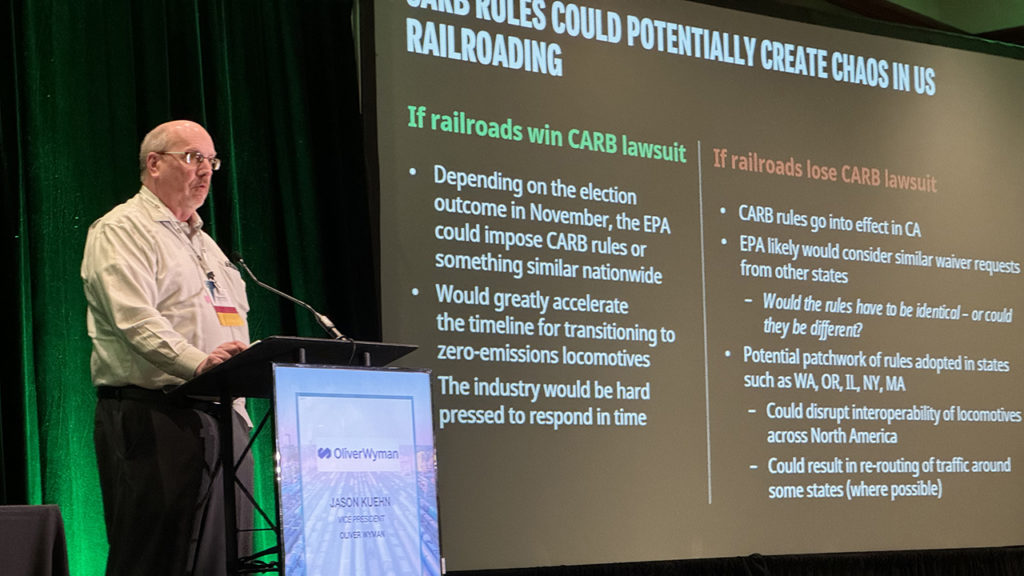
Jason Kuehn (Oliver Wyman) noted rail maintains efficiency in freight moved per ton-mile but generates half the freight revenue per diesel gallon. Key takeaways: A gallon of renewable diesel costs $8.05 to produce—it is being offset by $4.52 of government incentives. Right now, rail does not have a solution to address the North American road locomotive fleet, more than 50% of which will need upgrades before 2040.
Ron Sucik (RSE Consulting) tackled the intermodal market. Sucik noted early 2024 intermodal traffic increases are the fifth month of YOY West Coast traffic improvements. 2024 traffic is expected to exceed 2022 levels. Key takeaways: Nearshoring will continue to be an impact factor even as manufacturing moves to a just-in-time delivery focus.
John Ward (National Coal Transportation Association) updated the coal market. Key takeaways: Coal’s energy generation share is expected at 15% (from 17% in 2023) in 2024 and 13% in 2025. Coal-fired generation capacity of 2.3 GW will retire in 2024 with more capacity retired in 2025. Even with small declines in rail loadings, Coal shippers remain concerned about railroad service.
Clint Pella (Union Pacific) discussed the national fleet’s changing demographics and decreasing railcar specialization. Car type variety has decreased rapidly since 2010 while total fleet size has been increasing. Key takeaway: Pella sees standardization creating customer, railcar owner and railcar operator supply chain certainty. Standardization offers opportunity for asset optimization and service consistency.
Daniel Anderson (TrinityRail) discussed the tank railcar market and reaffirmed tanks as the national fleet’s second-largest car group and the largest lessor-owned segment. Tanks are the youngest major car group resulting from decreases in the average retirement age. Key takeaways: Tank traffic has been volatile; tank car compliance (think HM-216 and HM-246) will impact car supply/availability. Bio and refined fuels and chemical growth are market positives.
Johanna Biggs (Biggs Appraisal) identified that fleets for covered hoppers (>5,000 cf), 117J tanks and boxcars grew most in 2023. On the appraisal panel led by Pat Mazzanti (Railroad Appraisal Associates), Ed Biggs (Biggs Appraisal), Greg Schmid (RESIDCO) and Bryan Vaughn (Modern Rail Capital), FMV values were higher across most car classes except for older grain and coal cars. There were some mixed opinions on older tank values. Small-cube hopper values increased. Biggest market gainers? Boxcars, plastic pellet hoppers and PD covered hoppers.
Paul Titterton (GATX) kicked off Day 2 at REF. Titterton discussed what the railcar industry may have learned from collective history and that the current railcar and leasing cycle is different from those in the past. Key takeaways: Titterton illustrated how lease pricing has diverged from both railcar demand and the railcar fleet replacement rate. He sees less volatility in the future with consistency in current fundamentals.
Independent analyst Tony Hatch addressed whether Norfolk Southern will survive the Ancora onslaught and all other things railroad. Key takeaways: Even with lackluster loads and earnings, railroads continue to pivot to growth unable to shake ongoing influence of the “Cult of OR”; short line railroad growth continues as a positive story; rail could add $61 billion in revenue with limited capex spending; and technological innovation continues with implementation rapidity expected to increase.
Doug Driscoll (Genesee & Wyoming), David Horowitz (GATX), Anthony Petrillo (Packaging Corporation of America) and David Sellers (Greenbrier) talked boxcars. Key takeaways: Shippers, railroads and car owners must collectively convert more boxcar loads from truck to rail. The boxcar market shows lower loadings and some weakness, but a rebound is expected. The car-hire system remains an issue; the national boxcar fleet enhances utilization but challenges remain, as it continues needing investment and rightsizing; technology can impact freight demand.
Patrick Kurtz (AITX) discussed covered hoppers. Kurtz discussed the negative impact of a third bumper crop in Brazil on grain loadings but has some positive effect on milled product loading increases. Kurtz sees some PD fleet replacement needs. Key takeaway: Covered hopper fleet segments show reasonable utilization; food product loadings have been weaker vs. nonfood loadings. Kurtz highlighted discordance between hopper carload growth and fleet growth.
Day 3 at REF is for locomotives. David Humphrey of Railinc led with a locomotive fleet discussion. Key takeaways: Without significant new builds or fleet growth, the national locomotive fleet ages every year; even thinking optimistically about locomotive unit longevity, more than 7,000 (from a total fleet of 37,600) locomotives may need replacement by 2030. (Details in the May issue.)
Don Grabb (Triangle Brothers) discussed how, overall, Class I railroads do not have a cohesive strategy to replace diesel as the primary fuel for locomotives. Key takeaways: Timing for a systemic change in how locomotives would be fueled could require more than a decade of time to address 25% of the fleet. Furthermore, Class I executives concerned with other problems connected to railroad operations do not have concerns about the future of diesel fuel as a priority.
Pedro Santos (HGmotive) discussed HGmotive’s efforts to lead the transition to hydrogen as a locomotive fuel. This will utilize HGmotive’s hydrogen tender for linehaul rail service. Key takeaways: Undeveloped hydrogen in Canada and renewable energy in the Southeastern U.S. have the capacity to offer zero-carbon hydrogen-based fueling solutions. Santos is watching geological hydrogen as the potential game changer for the future of low carbon fueling.
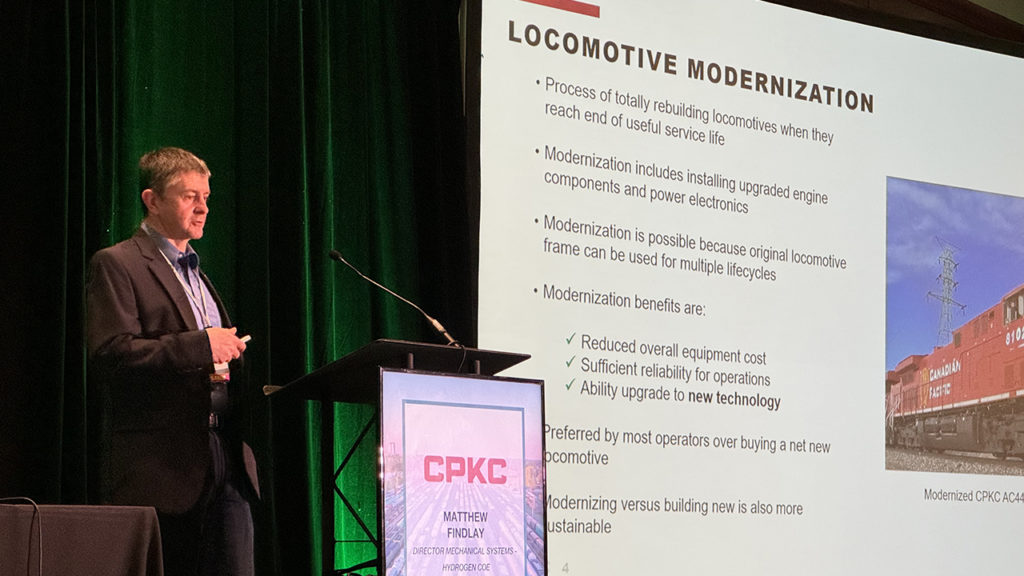
Matthew Findlay (CPKC) discussed the railroad’s hydrogen locomotive program. Findlay said that diesel accounts for 92% of CPKC’s carbon emissions. He noted that zero-emission locomotive modification was the next phase in locomotive rebuilding. CPKC has determined that hydrogen fueling can be completed in a reasonable timeframe and at a reasonable cost if the supply of hydrogen is available for the use. Key takeaways: With validated technology, CPKC will continue to move along the road of carbon neutrality, adding electrolyzers and a larger fleet of fuel cell locomotives and tenders. CPKC sees a pathway to reduce carbon emissions on this pathway.
Glen Rees (Cummins Inc.) updated Cummins’ work using a variety of strategies to engage in carbon emissions reductions for motive power. Cummins sees a need to be flexible pursuing alternate fuel strategies while maintaining flexibility to use renewable or biodiesel, renewable or bio natural gas and hydrogen, with a focus on promoting a fuel-agnostic engine. Key takeaways: Rees reminded the audience that “getting to zero [emissions] is not a light switch”; and Cummins sees available grant money to assist in the switch to a carbon-neutral fuel platform for railroads, including short lines.
Robert Brenner and Peter Thomas (Wabtec) updated Wabtec’s new products and alternative fuel strategies. Wabtec recognized the pressure on North American rail to move quickly to change railroad emissions, and sees potential for the CARB locomotive emissions regulation to spread beyond California. Wabtec is ready to address a multitude of replacement fuel and emissions reduction strategies from repowering to batteries to fuel cells. Key takeaway: A future with battery-powered linehaul locomotives was unlikely. Wabtec is preparing for a multi-modal solution of biofuels, battery, hydrogen and emissions reduction.
Andrew Anderson (Progress Rail) discussed his company’s point of view on the path toward carbon reduction and curtailment. Progress Rail is working on a hybrid style locomotive that would convert existing diesel locomotives to the hybrid model with an improvement in tractive effort. Key takeaway: Progress sees that all biodiesel types can be used in existing combustion engines and is evaluating the long-term maintenance expense impact.
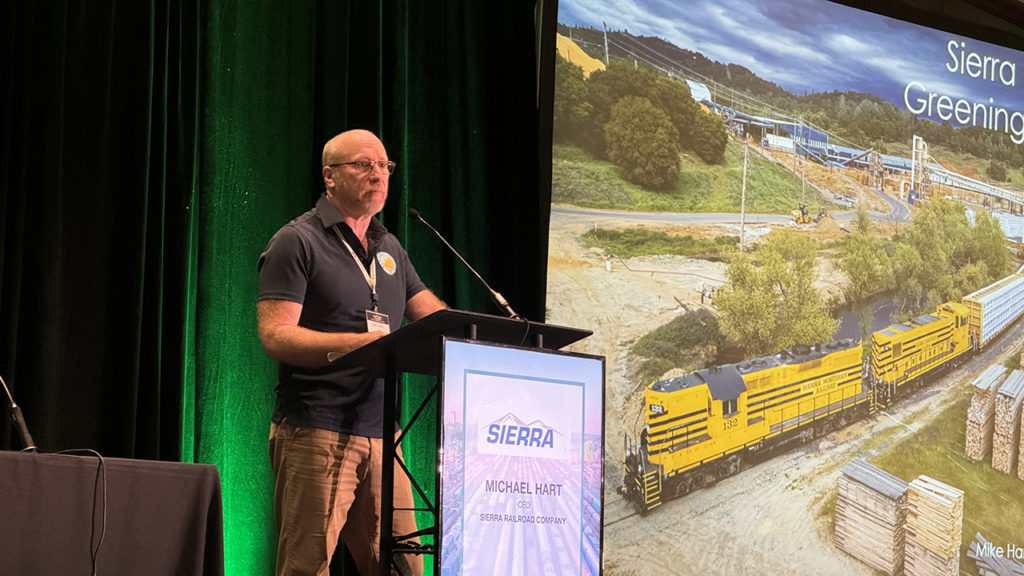
Michael Hart (Sierra Northern Railroad) discussed his short line’s use of, and successes with HFC (hydrogen fuel cell) locomotives in California. Hart detailed sister company Sierra Energy’s FastOx® system, which creates green hydrogen through the high-temperature waste burning. He sees the turnkey opportunity to place FastOx® wherever biomass feedstock can generate hydrogen. Key takeaway: Hart sees an abundance of locations for FastOx® that could benefit short line railroads looking to make a conversion to hydrogen.
Jason Kuehn returned to discuss the timing and process for the necessary fuel transition for North America. Kuehn notes that with the U.S. planning carbon-free by 2050, any new Tier 4 locomotive has a 26-year maximum useful life. North American rail is challenged by the time and money for any plan requiring transition in a limited timeframe. Kuehn prioritizes fleet modification over new-product transition. This conserves time and cost. Key takeaway: While noting how little the industry has changed in five years, Kuehn sees hydrogen in the lead for replacing linehaul locomotives, while battery hybrids have a larger share in switching.
Stuart Biggs (Biggs Appraisal) noted that locomotive rebuilds added significant increases to the number of AC4400 locomotives YOY. Key takeaway: There are approximately 4,000 Wabtec locomotives potentially available as remanufacturing candidates.
In the final panel of the day, Pat Mazzanti and Greg Schmid returned to the stage along with Rick Ortyl (MetroEast Industries) to discuss locomotive values. In the first half, the panel discussed locomotives built in the 1960s and 1970s. The market perspective remains strong as use in industrial service remains cost-effective. On the newer six-axle fleet, valuations were higher YOY for all AC traction locomotives that are capable of being rebuilt or that were 2004-built or younger. Key takeaway: Contrary to recent years, the audience felt that Class I railroads with a fixed price purchase option on newer locomotives (2008 or younger) would purchase those units since they are likely Tier III-compliant and within the CARB rules age threshold.
REF 2025 is March 2-5, 2025 (www.railequipmentfinance.com). See you in La Quinta!


