
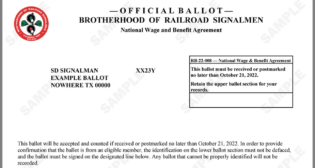
Threat of Rail Work Stoppage Growing
The Brotherhood of Railroad Signalmen (BRS) on Oct. 26 became the second of 12 rail unions to reject a tentative agreement amending wages, benefits and work rules on most Class I railroads
The Brotherhood of Railroad Signalmen (BRS) on Oct. 26 became the second of 12 rail unions to reject a tentative agreement amending wages, benefits and work rules on most Class I railroads

If the name of Britain’s new Prime Minister, Rishi Sunak, seems familiar, it’s not because most recently he was the comical BoJo’s (Boris Johnson) treasury chief (they call it Chancellor of the Exchequer across the pond, where lately the ruling Conservative Party has been changing out Prime Ministers with the frequency of replacing furnace filters).
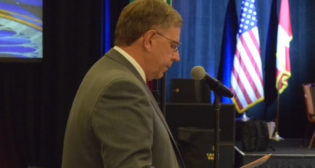
Members of the Mechanical Division of the International Association of Sheet Metal, Air, Rail and Transportation Workers (SMART-MD) and of the National Conference of Firemen & Oilers (NCFO) have voted to ratify
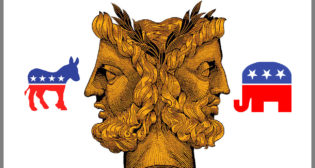
WATCHING WASHINGTON, RAILWAY AGE OCTOBER 2022 ISSUE: Surface Transportation Board (STB) Chairperson Martin J. Oberman remains as difficult to categorize today as when he arrived in January 2019. In many respects, he brings to mind mythical Roman god Janus, who, in seeing forward and backward, symbolizes change and transition.
One might as well ask who threw the overalls in Mrs. Murphy’s chowder as to enquire what more the Surface Transportation Board (STB) might learn from additional public hearings on the question of whether railroads Canadian Pacific and Kansas City Southern should be permitted to merge, and under what conditions.
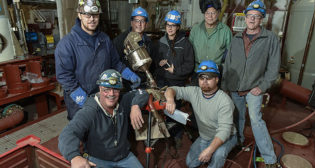
The National Carriers Conference Committee (NCCC), representing most Class I railroads and many smaller ones, has reached a second tentative agreement with the International Association of Machinists and Aerospace Workers (Machinists). The
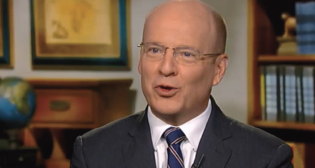
If tentative wages, benefits and work rules agreements reached between rail labor unions and most Class I railroads (and many smaller ones) fail to be ratified by union members in coming weeks, might leadership of those unions override a majority “no” vote and unilaterally impose the tentative agreement or, alternatively, submit it to binding arbitration rather than pursue further collective bargaining or authorize a strike?
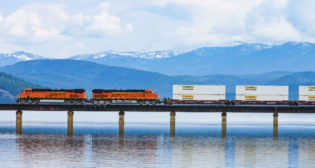
WATCHING WASHINGTON, RAILWAY AGE SEPTEMBER 2022 ISSUE: As Atchison, Topeka & Santa Fe Railway (Santa Fe, now part of BNSF) intermodal train No. 198 sprinted from Chicago toward Kansas City one November day in 1989, a special guest was aboard an attached business car.
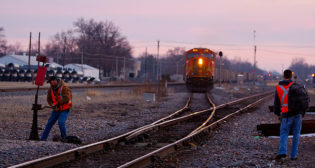
It took an all-night bargaining session in the Washington, D.C., offices of Labor Secretary Marty Walsh, but as dawn approached Thursday, Sept. 15, three rail unions, representing almost 60% of unionized rail workers and which had been holding out for a better deal than was reached by nine others, came to terms with the National Carriers Conference Committee (NCCC) that represents most of the nation’s Class I railroads and many smaller ones.
Increasingly likely on Sept. 16, or shortly thereafter, is a rail labor strike or management lockout creating a nationwide rail shutdown that almost certainly will elicit from Congress back-to-work legislation and third-party determination of wage, benefits and work rules amendments to end this almost 33-month-old round of collective bargaining.