In September 2021, VIA Rail Canada took delivery of the first of 32 new Siemens trainsets, and on Nov. 30, revealed it to the public; testing started in December. (Photograph Courtesy of VIA Rail Canada)

Canada Commits to Passenger Rail Revival With HFR Certainty

Canada’s public passenger railway VIA Rail has been pulled back from pandemic-induced oblivion by a federal government now framing the scheme for a dedicated, electrified right-of-way linking Quebec City and Toronto as a certainty for the first time since the project was first revealed in 2015.
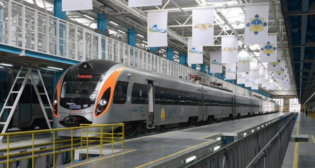
“Ukrainian National Railways is ready to provide trains for the evacuation of civilians if the Red Cross negotiates safe passage and humanitarian corridor,” the railway reported on March 3.

Ukrainian National Railways Appeals for Red Cross Protection

Ukrainian National Railways appealed to the International Red Cross March 3 to demand that invading Russia guarantee the safety of evacuation trains for civilians trapped in cities under siege. Most urgent is the city of Volnovakha in the Russian-occupied Donbass region at the eastern edge of the country.

Commentary

For VIA Rail, an Existential Crisis

Battered by COVID-19 lockdowns, fatigued rolling stock, fierce competition for station slots and the ubiquitous adoption of alternatives to physical travel, Canada’s publicly owned intercity passenger system is mired in an existential crisis over which it has little or no control. That is the depressing message in VIA Rail’s 2021-2025 Corporate Plan, dated Nov. 5 2021 but never officially announced by way of news release. It resides in an obscure page of the company’s website.

Commentary

Mountain Railways: Ground Zero for Canadian Climate Change (Updated—CP Building Back Fast!)

If there are no atheists in foxholes, then there should now be no climate skeptics left among Canadian railroaders, as they move rapidly on what they do best: rebuild to keep the trains running.

Disastrous Flooding Cuts Vancouver Off From Rail, Road Service

Food and toilet paper have been stripped from grocery store shelves across British Columbia as panic buying follows the realization Wednesday, Nov. 17 that the previous day’s Biblical flooding means road and rail connections with Vancouver and southwestern British Columbia could be disrupted for months.

Commentary

VIA HFR: How Viable? How Close?

A glimpse of actual progress teased the passenger rail industry July 6 when the Canadian government unveiled previously obscure details of its long-running High Frequency Rail (HFR) program.

The ‘H’ Factor

RAILWAY AGE, FEBRUARY 2021 ISSUE: First steam. Then Electric. Then diesel. Then batteries. Next: Hydrogen fuel cells?

Hydrogen Strategy for Canada’s Railways

Canada wants to bring back steam to its railways, but don’t expect the return of glorious white plumes of condensation, drifting over deep-frozen prairies. This time, the steam would be the invisible exhaust of high-efficiency locomotives and self-propelled passenger units, powered by the on-board conversion of hydrogen into electricity and hot water vapor. Canada hopes to build upon its advantage as builder of the world’s first HFC (hydrogen fuel cell) prime-mover.

Commentary

Alberta’s CBR Fiasco: NDP Clowns to the Left, UCP Jokers to the Right

In a desperately irrational move at the end of its term in the winter of 2019, Alberta’s former NDP (New Democratic Party) government tried to defy Economics 101 by dramatically increasing crude-by-rail capacity in order to raise prices. Nobody outside former Premier Rachel Notley’s statist brain trust thought that was a good idea. Especially not the railways: CN and Canadian Pacific both insisted that the government commit to paying the $C3.7 billion contract price, whether or not the trains were needed. In the event, “or not” turned out to be a very wise condition for the railways.

Brake Defects Plague Canada’s Aging Grain Cars

Hard-to-detect braking system defects have rendered Canada’s aging fleet of grain hoppers a safety hazard, says a former director of derailment investigations for the country’s Transportation Safety Board (TSB), the Canadian equivalent of the U.S. NTSB. Ian Naish, who retired from the TSB in 2009, in a CBC interview posted May 15, declared, “The grain car fleet overall is quite defective.”

LOAD MORE