Battery Locomotives: Debate Continues
This commentary is in response to the article “Point-of-Use ZE an Incomplete Picture,” by Nicholas Little, Railway Age, Nov. 20, 2024, which was in response to my Jan. 3, 2024 article, “ZE
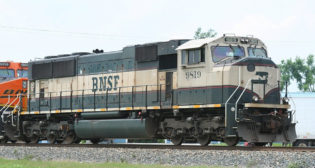
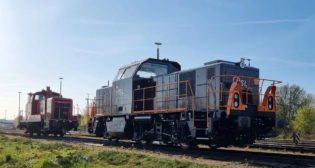
The first locomotive to successfully use an AC (alternating current) three-phase asynchronous traction motor drive system was the German DE2500 diesel-electric in 1971, built by Henschel-BBC. DB (Deutsche Bundesbahn) Class 202, an
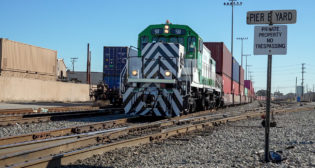
Since the second half of the 20th century, four-axle diesel-electric switcher locomotives have been used extensively on short lines. The most common are the EMD SW1500 (1,500 hp/1,119 kW), GP9 (1,750 hp/1,305
First, let’s look at the release of harmful substances by locomotives with onboard energy sources. The most prominent is the diesel-electric locomotive. Its electric traction motors are environmentally friendly, but its diesel
Hybrid technology combing hydrogen fuel cells (HFC) and batteries may be a viable means to obtain high power ratings for main line North American locomotives, which for a very long time have
U.S. regional/commuter trains traveling relatively short distances are making progress on ZE (zero emission) initiatives. The technology under evaluation comes from numerous global sources. For ZE long-distance trains, battery-electric and HFC (hydrogen
By 2050, in accordance with the Paris Climate Agreement, zero-emission locomotives may have completely replaced conventional diesel-powered equipment on the railways of the world. Current development of zero-emission switcher locomotives, combined with
RAILWAY AGE, AUGUST 2021 ISSUE: The GEVO12-equipped, three-section 3TE25K2M is among the world’s most powerful diesel-electric locomotives.
Based on emerging technologies in batteries, hydrogen fuel cells and renewable natural gas, zero-emission motive power is a possibility.