Commentary
When Politicians Gave Two Toots
Written by Frank N. Wilner, Capitol Hill Contributing Editor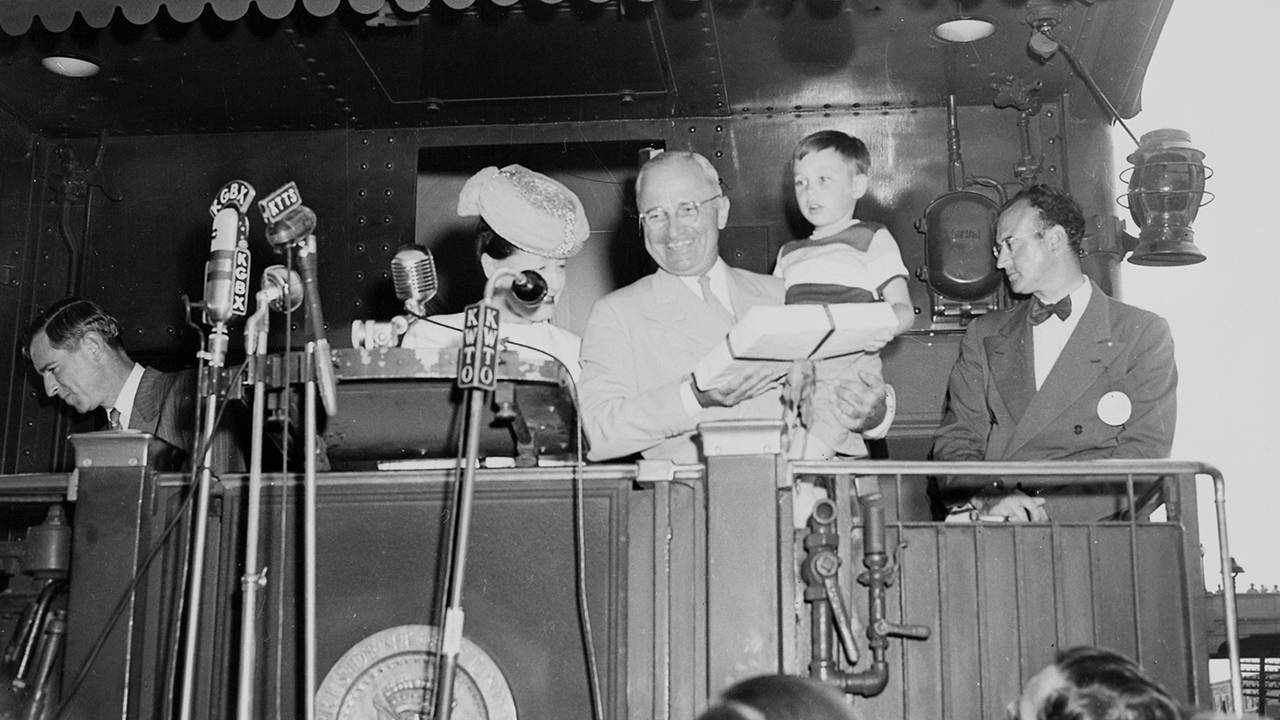
President Harry S. Truman standing on the rear platform of the presidential train, holding a small boy and a present. Probably in Bolivar, Mo., where Truman dedicated a statue of Simon Bolivar. July 4, 1948. Abbie Rowe/Wilimedia Commons. National Archives and Records Administration. Office of Presidential Libraries. Harry S. Truman Library.
WATCHING WASHINGTON, RAILWAY AGE SEPTEMBER 2024 ISSUE: Much of America’s history and progress is traceable to railroads. They bound together the continental United States, made possible settlement of the West, linked farms with markets, aided development of towns and cities and enabled our industrial revolution.
Modernity is less aglow about railroads. There remain few sufficiently long of tooth to recall the heyday of private-sector passenger trains offering specialty fare on signature crockery; onboard secretarial services, stock market quotations, barbers and hairdressers; or actor Ronald Reagan extolling in advertisements the lure of dome cars. What survives is a federally owned, operated and taxpayer subsidized Amtrak.
Notwithstanding their essentiality to America’s economy, freight railroads—other than when they block highway crossings, infrequently wreck or their unions threaten to strike—operate largely in obscurity.
Enquire today of passers-by the names of freight railroads and the answers likely are fallen flags as found on model train sets or as appear on the Monopoly Board.
Another bygone is the political campaign train whose publicized scheduled arrival was announced by two toots of the locomotive whistle—ergo, “Whistle Stops.” To an awaiting crowd, a smiling candidate delivered from the last car’s observation platform a short, punchy, partisan oration. Minutes later, a couple more toots signaled a goodbye wave, the consist chugging on to encore performances and expected favorable next-day local news coverage.
It was a long-ago epoch, observed the Los Angeles Times, “when you could see, hear and even talk to the President of the United States. You could shake his hand, too.”
In a new book, Whistle-Stop Politics, public relations consultant, journalist and one-time congressional aide Edward Segal captures the quintessential lore of this truly American invention.
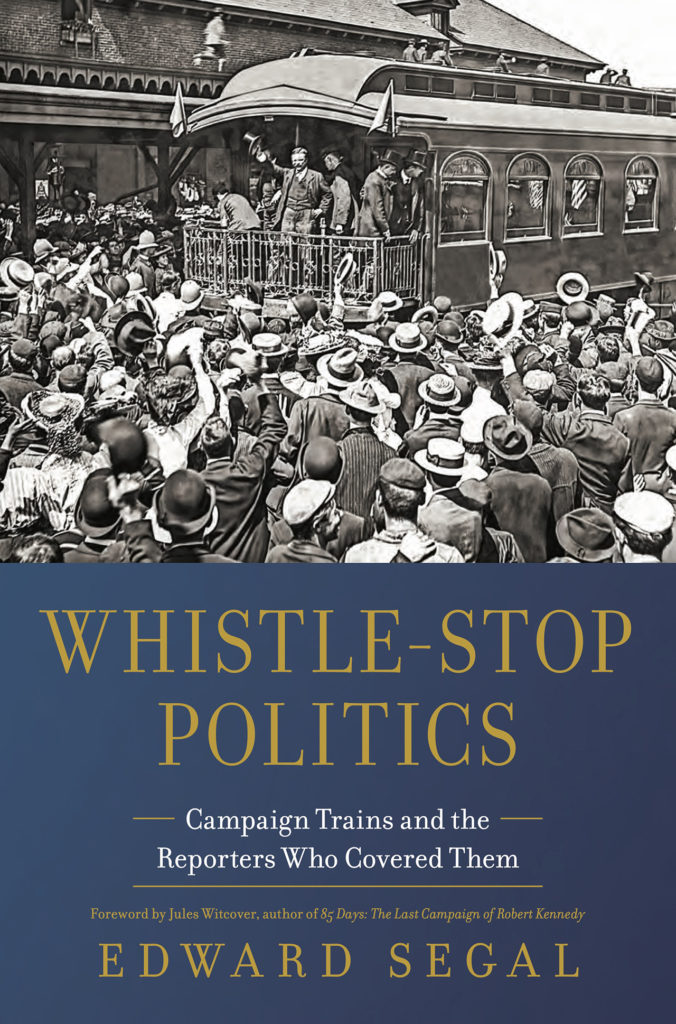
Whistle-Stop Politics. By Edward Segal. Rock Creek Media. Hardcover, 377 pp., $29.95 (Amazon). E-book: $8.99 (Kindle), $7.99 (Barnes & Noble).
While Segal reminds us that Barack Obama (2008 in Pennsylvania) and Joe Biden (2020 in Ohio and Pennsylvania) recreated abbreviated Whistle-Stop tours, truth is that air travel and television advertising long ago effectively eclipsed riding the rails to scavenge for votes.
Segal escorts readers through the detailed planning and occasional gaffes attending political campaign trains whose inhabitants included speech writers, press relations staff, campaign aides, journalists and sometimes a brass band—the activity remindful of a traveling circus.
Dozens of historical photos and abundant endnotes validate Segal’s research, including the pedigree of the book’s cover snapshot—a 1902 South Lawrence, Mass., Whistle-Stop oratory by top-hat waving Teddy Roosevelt. The image, Segal informs, was part of a photo collection traded to satisfy an unpaid bar tab. But he has toppers:
• In his 1858 Senate race against Abraham Lincoln, Stephen A. Douglas mounted on a flatcar of his campaign train a brass cannon that fired deafening blanks to signal his approach.
• When Benjamin Harrison’s mid-term rally train made an unscheduled, late-night stop in rural Arkansas in 1891, locals gathered. The conductor, assuming the President asleep, presented himself as Harrison and gave an impromptu and well-applauded short speech.
• Before President Calvin Coolidge could utter even a word upon a Whistle-Stop arrival near St. Louis in 1924, the train departed. The taciturn Coolidge managed a single, “Goodbye.”
• Franklin D. Roosevelt ordered his 1932 campaign train stopped at a Montana grade crossing so he could greet just four people who were waving.
• Presidential candidate Wendell Wilkie delivered so many rear-platform orations in 1940 that, at Rock Island, Ill., all he could muster was, “The spirit is willing, but the voice is weak.”
• While President Harry Truman’s 1948 campaign train was stopped for the night in Missoula, Mont., a noisy crowd gathered, causing Truman to appear on the observation platform in his pajamas.
• When Presidential candidate Barry Goldwater’s campaign train prematurely departed an Athens, Ohio, Whistle Stop in 1964, a dozen traveling journalists who had disembarked to interview spectators were stranded and left to their own devices to catch up at a later stop.
In contrast to today’s divisive politics of gloves-off, dark art savagery, Segal delivers in Whistle-Stop Politics a welcome respite, returning us to a gentler political era when better manners were more a rule than an exception. This is a fun read.
Wilner’s new book, Railroads & Economic Regulation, is available from Simmons-Boardman Books at https://www.railwayeducationalbureau.com/, 800-228-9670.