Commentary
Ninth of a Series: Will LA Remain a ‘Transit City’?
Written by David Peter Alan, Contributing Editor
At the end of Who Framed Roger Rabbit, one of the characters mentioned how great the transit in Los Angeles was. Of course, the story was set in 1947, when Pacific Electric’s Red Cars and LADOT’s Yellow Cars provided streetcar service to plenty of places, not only in L.A. itself, but also throughout Southern California.
The streetcar network that had been so strong only a few years earlier was gone by the early 1960s. Thirty years later, transit started to make a comeback in the City of Angels, with the start of Metro Rail, operated by the Los Angeles County Metropolitan Transportation Authority (Metro). Metrolink, a network of trains to outlying areas, running mostly during peak commuting hours, followed. Both systems have grown, and both are planning for future growth and service improvements; enough to make some Angelinos feel secure in living an auto-free urban lifestyle that involves doing things in or near the city and taking trains and local transit for most or all mobility.
While this is a recent development that has brought an amazing comeback to the downtown area, we will know soon if this trend will continue. Like other transit providers, Metro and Metrolink are vulnerable to the coming fiscal cliff that will have a negative effect on essentially the entire transit industry in the United States. While service is becoming stronger on Metrolink, it still runs “commuter trains” for most of its schedule, and “off-peak” service, both on weekdays and on weekends, is weak. Metro Rail is strong and growing, with six lines in operation (two subway and four light rail). All of them run full-service schedules.
Metro Moves Toward the Cliff
As early as April 7, 2023, Transit Center warned: “LA Metro expects to be short $400 million in FY2025, ballooning to a $1 billion gap by FY2026. Planned projects, including opening and operating new train lines and electrifying its bus fleet, will add considerable expense to LA Metro’s bottom line over this period. The estimated shortfalls are 20%-45% of FY 2023’s operations expenditures of $2.2 billion.”
The Transit Center post also noted that Metro’s farebox recovery is low, and that much of its funding comes from local sales taxes. This funding method can be risky, especially when the economy is slow.
Less than two months later, on May 26, Joe Linton commented on the recent MTA 2023-24 budget in LA Streetsblog. That budget includes more than just Metro transit and Metrolink; it also includes money for highways and other roads that pass through the county, which includes the city. As the first of three positives, Linton said: “There is no fiscal cliff here right now. Since the pandemic, transit ridership is down. Metro finances transit almost entirely via sales tax revenues, which aren’t dependent on ridership. Many agencies more dependent on fare revenue—BART, Caltrain, etc.—are seeking state funding to stave off problematic service cuts and/or fare increases.”
Linton’s second positive was that Metro Rail planned to increase service from the 84% of the 2019 level in effect at that time to 96%. The third was that bus service would stay essentially the same. But Linton complained that Metro increased its annual highway construction budget while decreasing its transit construction budget, and that it “perpetuates a problematic transit policing status quo.”
On June 26, Dan Brekke of KQED, San Francisco’s NPR station, reported the $1.1 billion in state funding that we mentioned in our previous report on the situation in the Bay Area. That amount will be used for aid on a statewide basis and would come from cap-and-trade funds, but Brekke reported: “That amount represents just a fraction of the more than $5 billion that local transit agencies have been seeking over the next five years to avoid what’s come to be known as their fiscal cliff. That would be enough funding over a long enough period to allow operators to develop new sources of revenue to finance their day-to-day operations, agencies say.” Brekke mentioned Los Angeles only once in his report, saying: “It’s also unclear exactly how the new funding will be shared among operators, whose deficit projections vary dramatically. The Los Angeles County Metropolitan Transportation Authority, the state’s biggest transit district, for instance, is facing even bigger deficits than its Bay Area peers in coming years.”
As the fiscal year wore on, Metro’s financial picture turned more ominous. Steve Scauzillo reported in the Los Angeles Daily News on Jan. 10 that Metro had to close the budget gap between revenue and operating costs by May, when this fiscal year’s budget would be enacted. He began his report by saying: “Despite steady ridership growth, LA Metro faces budget challenges in the next few months as managers seek ways to tackle escalating operating costs and revenue shortages to make up for Metro’s loss of federal pandemic bailout dollars that helped them balance the last three budgets.” He also reported that Metro CEO Stephanie Wiggins acknowledged: “We are facing a fiscal cliff, too. We are trying to keep it manageable.”
Scauzillo’s report went into detail about certain areas where costs are rising, and he summarized the increases this way: “In a report on the upcoming 2025 fiscal year budget, Metro laid out seven areas where spending is projected to outpace sales tax revenues by more than 2-to-1 in the next five years, from 2024 to 2029.” The report concluded that overall, “The operating cost growth (6.5%) is increasing faster than sales tax and operating revenues (2.6%).” He reported that ridership remained strong, at about 83% of pre-pandemic level. With Metro’s low farebox recovery (estimates have ranged from 5% to 15%), and heavy dependence on sales tax revenue, higher ridership contributes little toward the bills.
On May 15, www.mynewsla.com reported the 2024-25 budget, shortly before final approval: “The proposed $8.9 billion budget for the 2024-25 fiscal year is 4.3% lower, or a reduction of some $400 million, compared to the $9.3 billion for the 2023-24 fiscal year,” and that “Wiggins attributed the reduction to a $198 million decrease in revenues and a decrease in grant funding coming to the agency. Additionally, bond proceeds and carryover funds are expected to drop in the coming fiscal year.” While infrastructure spending would be reduced by 21% from the previous year, the budget included $2.7 billion for transit operations for all modes, an 11.4% increase from the previous year.
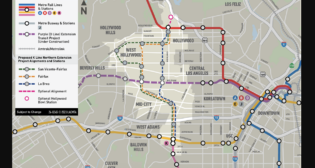
The Metro Rail system is expected to expand during the next year or two, with the opening of the Metro Connector in the fall, which would connect the C (Green) and K (Crenshaw) Lines), Phase I of the D (Purple) Line subway under Wilshire Boulevard, and the Foothill (Gold) Line Extension from Azusa to Pomona. These new extensions will increase the utility of the system overall and bring new riders, but they will also increase operating costs.
Metrolink: Different Structure, Similar Situation
Metrolink runs trains throughout the Southern California region: as far north as Ventura, as far south as Oceanside, and as far east as Redlands; the latter reached through San Bernardino on the new Arrow service. Metrolink is a far-flung multi-line system, but most of its service runs during peak-commuting hours, although there are plans to increase “off-peak” service on weekdays and weekends in the near future. That has already been done on the Antelope Valley Line running northeast of the city, toward Via Princesa and Palmdale on part of the historic Southern Pacific San Joaquin Line. All lines except one originate and terminate at Los Angeles Union Station. The sole exception is the Inland Empire—Orange County Line, which runs limited service between San Bernardino and Oceanside.
While L.A. Metro is a standalone transit agency, Metrolink is governed by Metro and other such agencies in the region. Meredith Yeoman, Metrolink’s Public Relations Manager, explained to me: “Metrolink is funded through a joint powers authority governed by five county transportation agencies: Los Angeles County Metropolitan Transportation Authority (LA Metro), Orange County Transportation Authority (OCTA), Riverside County Transportation Commission (RCTC), San Bernardino County Transportation Authority (SBCTA), and Ventura County Transportation Commission (VCTC). As such, Metrolink did not receive COVID relief funding directly. Rather, funds were allocated to our member agencies, which then distributed these lifeline funds to Metrolink.”
Yeoman also told me: “As COVID relief funding was exhausted, we actively advocated for California state lawmakers to pass SB 125 last year. This bill forestalls the transit fiscal cliff by providing transit agencies with an additional $5.1 billion to be distributed over the next three years, ensuring that this critical but temporary funding will be available through FY25-26. Similar to the federal COVID aid, SB 125 funding is provided to Metrolink by our member agencies, which are also responsible for supporting other modes of transportation in their respective counties, such as buses, light rail, and active transportation.”
Currently, Metro is the only agency that provides rail transit. The authority in San Bernardo County owns the Arrow line to Redlands, but Metrolink operates it. OCTA’s Orange County Streetcar is under construction in Santa Ana and Garden Grove. At this writing, it is expected to begin revenue service in August 2025.
An overview of SB 125 says that “SB 125 (Chapter 54, Statutes of 2023) guides the distribution of $4 billion in the General Fund through the Transit and Intercity Rail Capital Program on a population-based formula to regional transportation planning agencies, which will have the flexibility to use the money to fund transit operations or capital improvements.” The statute also authorizes $1.1 billion toward reaching zero-emissions and establishes a Transit Transformation Task Force to recommend policies that would improve the region’s transit. The list of stakeholders on the task force does not include advocates for transit riders.
SB 125 will help keep transit going in the region, but Yeoman is aware that it delivers only a reprieve, and not a permanent solution. She told me: “While our funding structure and the decisive action of California lawmakers have, for the time being, insulated Metrolink from the fiscal cliff that is directly impacting many of our counterparts across the country, we are mindful of the fiscal challenges that we could face in the coming years. Right now, we are focused on building the best service possible for the communities we serve, growing our ridership base and accelerating farebox recovery following the pandemic.”
While it is expected that the reprieve for California’s trains and transit generally will last through the middle of 2026, an announcement on from Gov. Gavin Newsom’s office dated July 8 indicated that the funds authorized in SB 125 might last two years longer than that, saying: “The remaining SB 125 funds will be approved annually through fiscal year 2027-28.”
Metrolink furnished us with the following information, which came from the California Transit Association, about the schedule for disbursing these grants. The $1.1 billion for the Zero Emission Transit Capital Program is being distributed in amounts of $190 million in FY2023-24, $220 million in FY2024-25, $230 million in FY2026-27, and $460 million in FY27-28. The larger grants totaling $4 billion under the Transit and Intercity Rail Capital Program (TIRCP), also from the Budget Act of 2023, will be distributed by mid-2026. The timeline is $2 billion in FY2023-24, and $1 billion in both FY2024-25 and FY2025-26. These are formula-based grants, so it remains to be seen how much these amounts can be “flexed” to provide money for operations throughout the duration of the programs.
Looking Toward the Future
The prospect of the fiscal cliff does not seem to be keeping either Metro or Metrolink from making ambitious plans. Metro is making big plans for the 2028 Olympics, which transit managers say will be a “car-free” Olympics. Metrolink’s plans are not so ambitious yet, but the agency plans to increase service on weekends and on weekdays outside peak commuting hours. Metrolink recently increased service on the Antelope Valley Line north of the city, almost doubling service to Via Princesa in the middle of the line, where multiple daily round trips were added as short turns. Plans call for increasing service similarly on other lines and rescheduling trains for better connections at L.A. Union Station to other Metrolink lines. These service enhancements are scheduled to go into effect this fall.
Still, there is a difference between funding for capital projects and for operations. The COVID-era legislation, which allowed one-shot funds that transit providers can use for operations, was designed to provide temporary relief. In contrast, the billions of dollars authorized by the Infrastructure Improvement and Jobs Act (IIJA), also known as the Bipartisan Infrastructure Law (BIL), called for building infrastructure that, by its nature, is designed to last at least for decades (or longer). New infrastructure will require maintenance, while transit always costs money to operate. Will the states step up to the plate to keep the transit within their borders going? Time will tell, and California appears to be doing so, at least for the next few years.
As a transit manager, Yeoman is aware of this. At the conclusion of her statement, she said: “We believe the fiscal cliff may merely be delayed and in preparation we will continue to explore, in concert with our member agencies, longer-term sustainable sources of funding that can be dedicated to commuter rail capital and operating costs.” Time will tell how long the state funds will last.
Before we conclude this series with some comments about future transit funding, we will return to the Northeast to report on the MBTA in Boston and its regional rail system. That agency has instituted some innovative policies, and we will report on how it is doing in the next article in this series.

David Peter Alan is one of North America’s most experienced transit users and advocates, having ridden every rail transit line in the U.S., and most Canadian systems. He has also ridden the entire Amtrak and VIA Rail network. His advocacy on the national scene focuses on the Rail Users’ Network (RUN), where he has been a Board member since 2005. Locally in New Jersey, he served as Chair of the Lackawanna Coalition for 21 years and remains a member. He is also a member of NJ Transit’s Senior Citizens and Disabled Residents Transportation Advisory Committee (SCDRTAC). When not writing or traveling, he practices law in the fields of Intellectual Property (Patents, Trademarks and Copyright) and business law. Opinions expressed here are his own.