


Commentary
Summer Sojourn to MARS
Written by Ron Sucik, Contributing Editor and Principal, RSE Consulting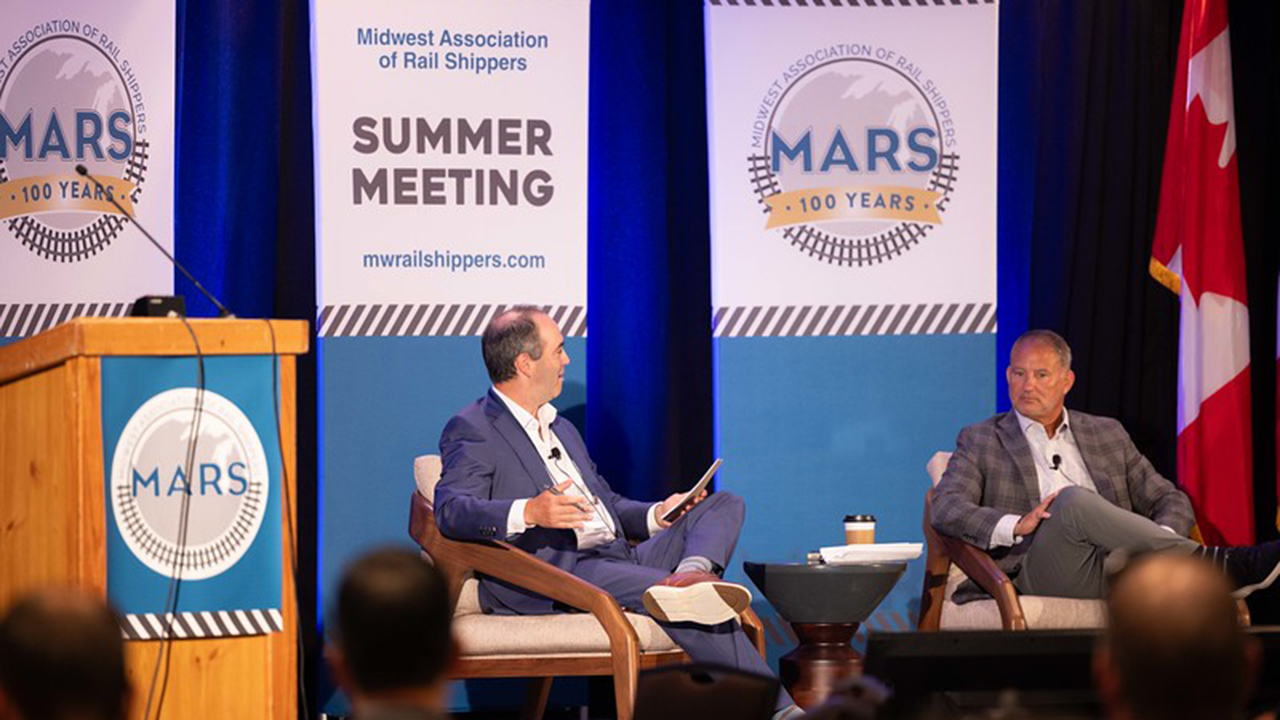
The conference opened with remarks from Chuck Baker, President, American Short Line and Regional Railroad Association (left), and Mike Miller, CEO North America, Genesee & Wyoming. MARS photo.
On July 9, MARS (Midwest Association of Rail Shippers) celebrated its 100th anniversary with its Annual Summer Meeting at the Grand Geneva Resort in Lake Geneva, Wisc. The conference opened with remarks from Chuck Baker, President, American Short Line and Regional Railroad Association, and Mike Miller, CEO North America, Genesee & Wyoming, which coincidentally was celebrating its 125th anniversary. Miller commented that G&W had recently held a celebration at its very first customer 125 years ago.
Miller’s comments to Baker were that G&W priorities are safety and providing service “that exceeds customer expectations.” Miller has strong respect for the workforce and pointed out that G&W did not furlough during COVID, and expanded control, communication and service capabilities, benefiting employees and customers. He spends time with new employees to help them understand the importance of their railroad job and its importance to the whole country.
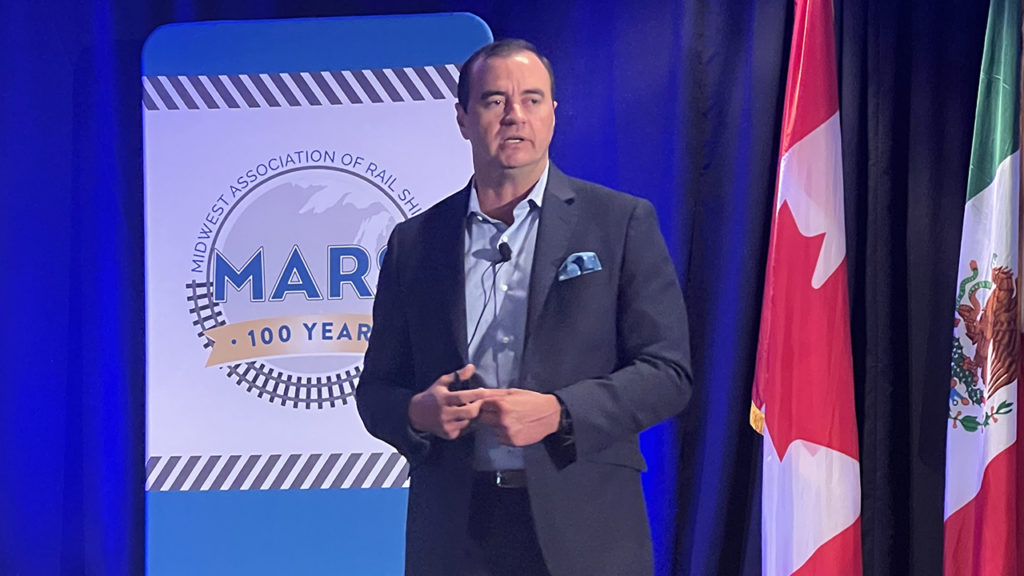
Jon Gabriel, Vice President Network Strategy, Design & Innovation at BNSF (above), gave a spirited discussion of how AI is being embraced and implemented to improve rail operation efficiencies while reducing injuries. An example given was hostling operations at large intermodal terminals where equipment accidents are possible. AI, he said, has the potential to provide employees involvement in more-productive planning and operations within the terminal.
Gabriel pointed out that switching a large classification yard involves selecting from hundreds of different movement combinations, but handled by AI, the time and effort to figure out moves and switches can be reduced, leaving the human element to complete other productive tasks. As well, taking previous data records and expediting new data will improve ETA accuracy and the supply chain management.
AI and camera and sensing technology have become so sophisticated that they can determine the difference between a spec of debris and a hairline fracture in equipment moving at 70 mph, Gabriel noted. OCR (Optical Character Recognition) and camera technology and drone use will continue to improve service.
An Innovation Panel consisting of Matt Findlay, Director Mechanical Systems, Canadian Pacific Kansas City; Peter Jones, Senior Vice President International Engineering, Product Development & Automation, The Greenbrier Companies; and Brad Myers, Executive Vice President, CEO Amsted Digital Solutions, covered several key technological developments.
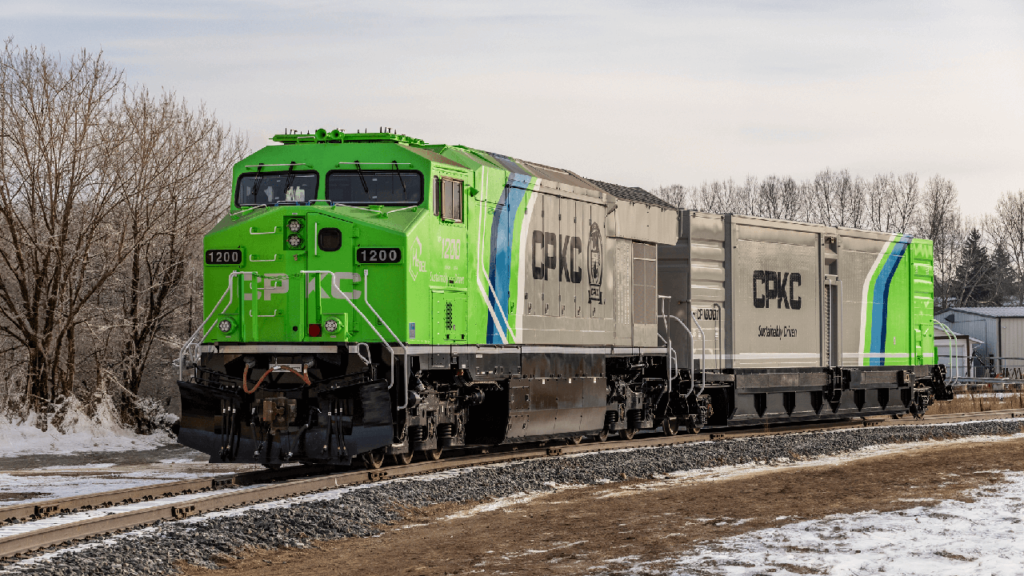
Findlay gave an excellent presentation on the progress of CPKC’s Hydrogen Locomotive Program. One slide titled “Zero Emission-Locomotive Modernization” pointed out that batteries, fuel cells and storage are all modular components that can be integrated into pre-assemblies known as skids. The process enables rapid modernization and conversion of existing traditional (diesel-electric) locomotives through integration.
Peter Jones presented on Greenbrier’s Ultra-High-Strength Steel Gondola™, designed as part of a joint initiative with Norfolk Southern. It uses an innovative formula for ultra-high-strength, wear- and abrasion-resistant steel with a yield strength close to 175 KSI, which allows the tare (unloaded) weight to be reduced by up to 15,000 pounds. A unique tub design reduces product (such as slabs of manufactured steel) hangup during loading/unloading. Also, Greenbrier’s new-design hatch covers eliminate the need for personnel to walk along the tops of hopper cars.
Greenbrier’s Multi-Max Plus™ motor vehicle carrier (video below), designed with input from railroads and car manufacturers, has been re-engineered to safely transport high-profile trucks and vans with a 20-foot, 2-inch hinging deck that can configurable as a bi-level or low bi-level easily, enabling adjustments to be completed on-site at loading locations. Fully compatible with existing bi-level fleets, it comes equipped with Greenbrier’s patented door design that reduces theft and vandalism by restricting access to the rack interior and roof.
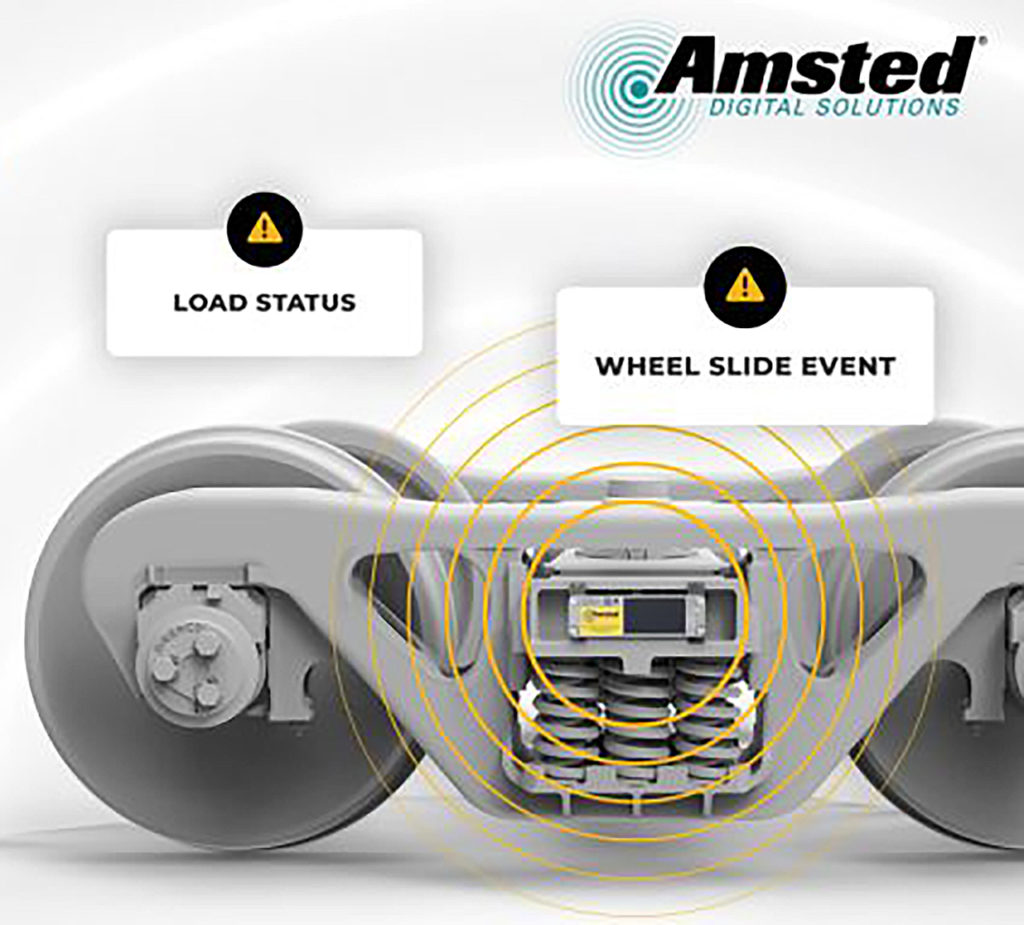
Myers gave a presentation on the newest innovations in telematics: applied sensor devices that can determine all aspects of railcar movement and condition. Most interesting was a slide showing that the cost of installing the new onboard technology has been reduced 62.6% since 2016.
The luncheon speaker was Union Pacific Executive Vice President Operations Eric Gehringer. Safety is UP’s most important consideration, he said, followed by people, service (leveraging technology to improve the customer experience), cost control and asset utilization. Gehringer commented that UP continues to improve and update technology, adding GPS to 47,000 containers, for example, to “improve the driver experience and supply chain fluidity” at UP intermodal terminals. The railroad has developed a new crosstie handling car that simplifies loading and unloading on the right-of-way. Previously, 50,000 ties required 15 days to be unloaded by a crew; it now can be done in 14 hours with this new high-production, autonomous machine (video below). UP, Gehringer said, “leverages technology for a safer, more efficient railroad.”
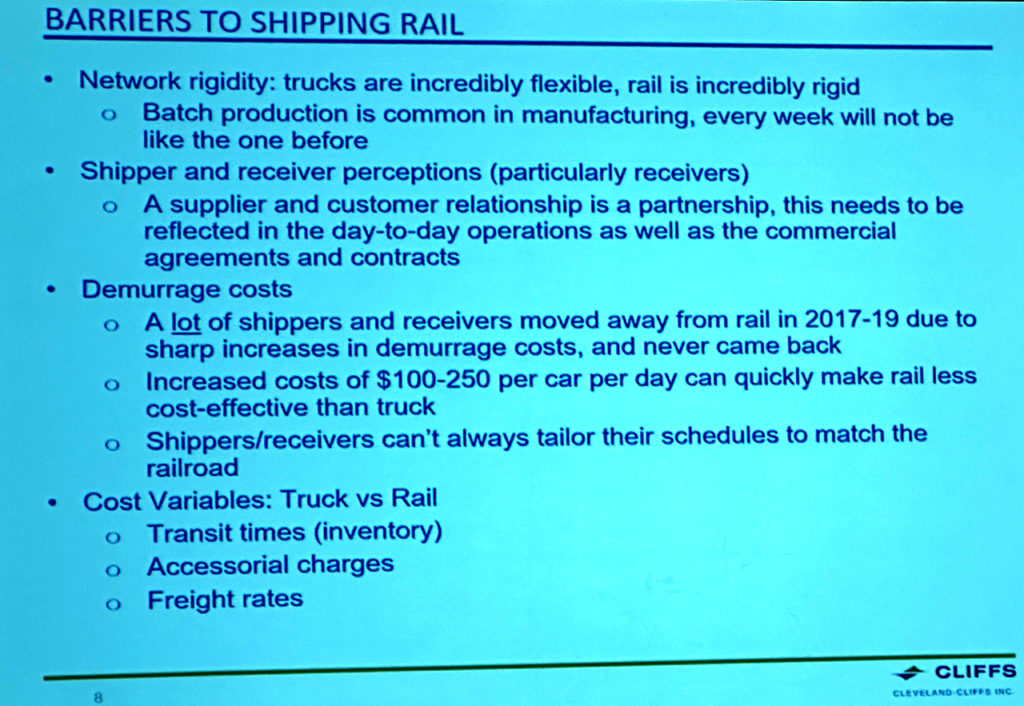
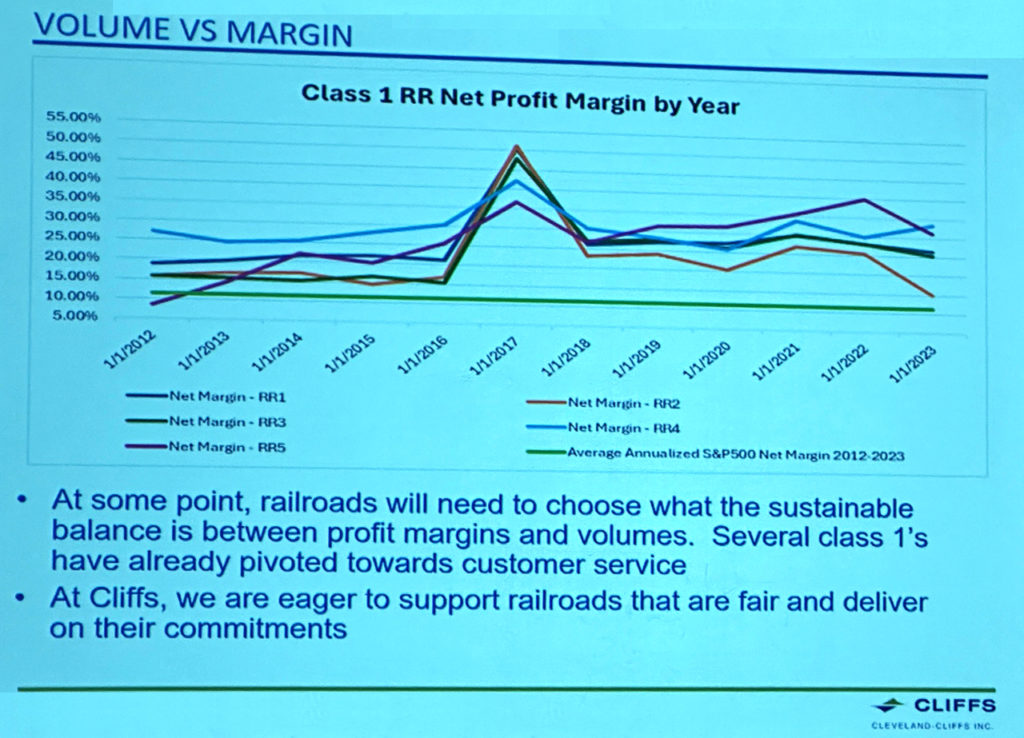
Among Cleveland-Cliffs Inc. Director Rail Logistics Conrad Victor’s observations (and criticisms) of rail were that many shippers and receivers moved away from rail between 2017 and 2019 “due to sharp increases in demurrage costs and never came back … At some point, railroads will need to choose what the sustainable balance is between profit margins and volume.” He added that “several Class I’s have already pivoted toward better customer service.”
JBX Rail Vice President Eric Monger closed out the conference on a positive note. Average train speeds have increased by nearly 5%, trending at four-year highs, he said. Terminal dwell times have decreased by almost three hours, and equipment that has not moved in 48 hours has decreased by 7.7%. “Do not blame the equipment for failures,” Monger said. “We have the technology through telematics to determine failures with enough advance time to prevent the longer-term delays we encounter. We need those onboard equipment devices and telematics transmitting preventative reports on the more-timely 15- to 20-minute basis now available.”


