


Commentary
Labor Beware: Even the Best of Friends Can Be Wrong
Written by Frank N. Wilner, Capitol Hill Contributing Editor
Administrator Amit Bose having said in a July 28, 2022 FRA press release that the agency is “committed to data-driven decision-making,” no supporting data accompanied the new rule’s publication. RRA photo.
WATCHING WASHINGTON, RAILWAY AGE MAY 2024 ISSUE: Among choices faced by political appointees are whether to obey statutes defining their authority or perform as political partisans. The optics of an April announcement by the Department of Transportation (DOT) and Federal Railroad Administration (FRA) of a final rule mandating two crew members in the locomotive cab—with limited exceptions—was an unashamed demonstration of the latter.
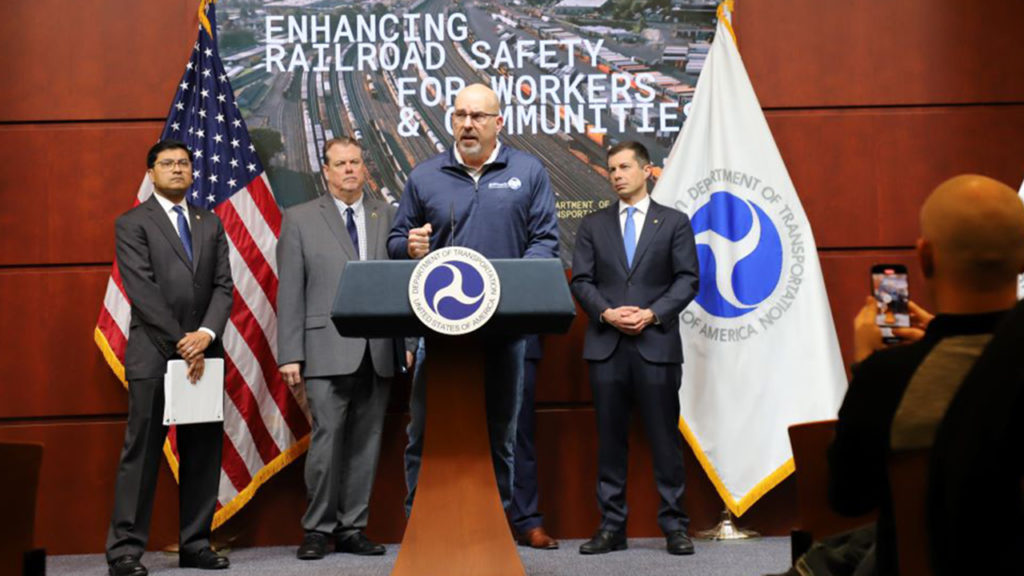
The announcement had adornments of a political rally—some dozen rail labor officials on stage—with DOT Secretary Pete Buttigieg and FRA Administrator Amit Bose delivering on a Biden campaign promise.
Shockingly missing was evidence of how the new rule will enhance rail safety as required by the Administrative Procedure Act (APA), which instructs courts to nullify them as “arbitrary and capricious” when lacking quantitative assessments. There must be, the Supreme Court has said, “a rational connection between the facts found and the choice made.”
Also alleged is a violation of Executive Orders by Presidents Reagan, Clinton and Obama (E.O. 12291, 12866 and 13563) that agencies, before publishing rules, must prove that expected benefits exceed anticipated costs.
A railroad challenge that the FRA rule violates the APA will be decided by the 11th Circuit Court of Appeals in Atlanta—seven of whose 12 judges were nominated by Republican Presidents, with six of the seven nominated by President Trump.
A House Joint Resolution to nullify the FRA rule was introduced April 26 by Rep. Eric Burlison (R-Mo.), but it is unlikely to reach floor votes before a court ruling. Resolutions, with the same effect as legislation, are used to enact temporary legislative objectives or to amend legislation already adopted. If passed by the House and Senate, resolutions also must be signed into law by the President.
Despite Bose having said in a July 28, 2022 FRA press release that the agency is “committed to data-driven decision-making,” no supporting data accompanied the new rule’s publication. Previously, the National Transportation Safety Board said, “There is insufficient data to demonstrate that [rail] accidents are avoided by having a second qualified person in the cab,” and FRA said in 2019 it lacked “reliable or conclusive statistical data” linking train safety with crew size.
While the intended effective date of the new rule is early June, a federal court challenge by railroads should keep it in limbo into 2025.
There is no immediate effect on Class I railroads as collective bargaining agreements require two crew members in the cab—but many will be up for renegotiation within a few years.
For regionals and short lines, with or without labor agreements and now operating with one crew member in the cab, there is no immediate impact. Should the new rule survive court challenge, those operations will be grandfathered. However, those who initiated such operations since mid-2022, or wishing to do so, will have to seek FRA approval, navigating through an arguably cumbersome process requiring notice and comment.
Buttigieg swats away lack-of-evidence criticisms by citing “common sense” as sufficient justification for the new rule—an arguably weak defense given APA and Executive Order provisos. Actually, common sense says assemble the required data before publishing.
Known as “Mayor Pete” for his previous leadership of the City of South Bend, Ind., Buttigieg, with Bose tagging along, should have chatted-up a fellow former mayor—New York’s Michael Bloomberg, an inventor of real-time market data sharing and who advises the Defense Department on artificial intelligence, software, data and digital modernization. “Data drives our economy and should help drive the priorities of our government,” Bloomberg says.
This is not the first time a rail labor-influenced FRA advanced a rule lacking an evidentiary foundation. A labor-sought crew-consist rule initiated in 2015 by FRA Administrator Joseph Szabo, a former union officer, was published after his early departure. Successor Sarah Feinberg, with a background at Bloomberg’s financial data firm and once chief of staff to DOT Secretary Anthony Foxx, showed little interest in finalizing the Szabo rule, likely concerned with its lack of supporting data. Bose at the time—following an advisory role to Sen. Robert Menendez (D-N.J.) (now under criminal indictment a second time for conspiracy and obstruction of justice)—was FRA chief counsel.
In 2019, FRA Administrator Ronald L. Batory, son of a rail union officer, withdrew the rule, citing lack of evidence and recommending crew consist be collectively bargained. “Technology moves faster than the ink can be applied on regulations,” Batory said.
Not considered by this latest rule—its benefit/cost analysis missing—is the railroads’ $15 billion investment in Positive Train Control (PTC), which is advanced technology designed to prevent human-factor errors and which makes a second crew member in the cab redundant. Rail labor was PTC’s most vocal proponent.
Requiring two crew members in PTC-equipped locomotive cabs reduces the second crew member to an engineer trainee. Remarkably, the new rule fails to identify the second crew member as a “conductor,” and is silent on authority and responsibilities.
Representations that the second crew member functions as an emergency responder or helps reduce engineer fatigue ignores that crews lack such skills, that train accidents are extremely rare, that PTC is effective at controlling fatigue, and that a data-driven study by the California Public Utilities Commission determined a second crew member “could aggravate engineer distractions, and, consequently, engineer error.”
Were crew size and assignment collectively bargained as it historically has, the job of “conductor” could be defined in contract language, along with supplemental pay raises, career income protection and quality-of-life improvements such as predictable work schedules and a return to home and family following work shifts.
FRA’s politically motivated new rule also ignores the safety record of engineer-only operations.
In Europe, engineer-only operations are ubiquitous and safe. In fact, since 2019 in Australia, Rio Tinto Mining Group has safely operated 1.5-mile-long ore trains autonomously—zero crew members—on routes of 500 miles from 16 mines to two ports.
In the U.S., hundreds of Class II and Class III railroads operate safely with one crew member in the cab. Where PTC is operational, Class I railroads seek to assign “conductors” to pickup trucks with tools they would no longer have to carry climbing up and down from the locomotive, or walk with long distances over ballast to repair mechanical problems. Arriving ahead of the train, they would align switches and coordinate shoves with customers prior to the train’s arrival. From fixed locations, they would utilize artificial intelligence to manage and expedite the difficult first and last mile.
Improved rail productivity is essential to competing with trucks. Intermodal is now 27% of rail freight revenue, while driverless truck technology is in advanced testing in western states. In the Obama Administration, Transportation Secretary Foxx supported autonomous vehicles “that can drive themselves better than a human can.”
Mandating crew size and assignment through government fiat to satisfy a political objective has unintended negative consequences such as making railroads less competitive with trucks, which in turn increases carbon emissions and causes more highway deaths. Moreover, impeding technological advancement snuffs innovation and encourages decay.
Rail labor risks much through its status quo bias. Even if the rule survives court challenge, it could be repealed by a future FRA Administrator. If the fallback position is state mandates or a congressionally passed law, it also is fraught with uncertainty.
Although 12 states have passed labor-advocated crew-consist legislation, nearly all don’t enforce it after Indiana Rail Road—with an exemplary safety record operating with one crew member in the cab—successfully challenged in federal court an Illinois law as contrary to a 1973 statute prohibiting states from enacting crew-consist mandates.
As for Congress, prospects remain slim that a rail safety bill containing a crew-consist mandate will pass.
Also lurking is that when existing crew-consist agreements are ripe for renegotiation, carriers will unilaterally begin reassigning the second crew member on PTC-equipped routes, triggering a Presidential Emergency Board and likely congressional determination of the outcome.
Trusting one’s fate even to congressional Democratic majorities frequently proved an unfortunate choice—characterized by labor arbitrator Robert O. Harris as a “craps game … risking your future on the roll of the dice.” The late Clinton J. Miller III, among the most respected of labor union attorneys, counseled union officers fighting implementation of new technology: “Let me know how this turns out for you.” Too often it was, “not well.”
President Biden, Secretary Buttigieg and Administrator Bose might have the best interests of labor in their thoughts and actions. But sometimes, even the best of friends can be wrong.


