Total Fleet Increase
Written by David Humphrey, Ph.D, Senior Data Scientist, Railinc Corp.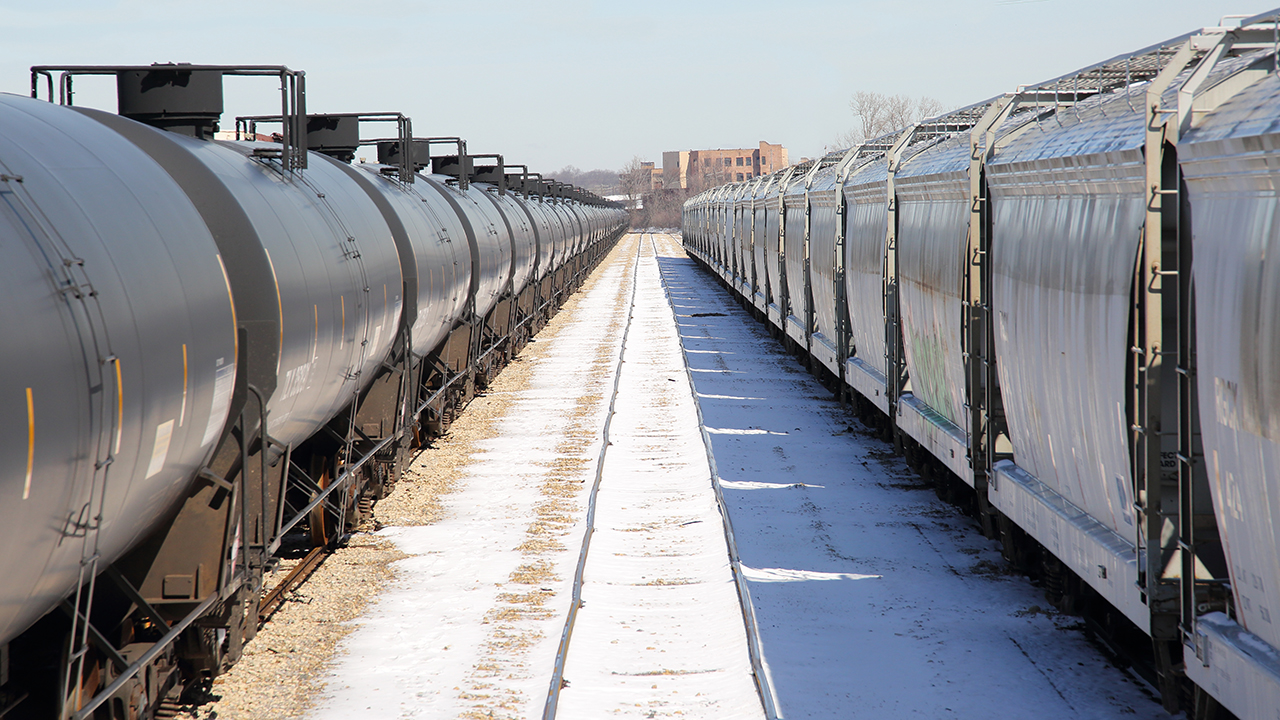
Photo by William Beecher.
RAILWAY AGE, APRIL 2024 ISSUE: Railinc’s analysis of the North American revenue-earning fleet reveals that the total fleet increased in 2023 with almost all car types accounting for the gain. One of the smallest car types—hoppers—continued declining in 2023. The average age of cars in the revenue-earning fleet was up, and new cars continued to trend on the larger side, with the majority having gross rail loads (GRLs) of 286,000 pounds.
This report from Railinc represents the period ending Dec. 31, 2023. It provides an industry overview of the North American railcar fleet, detailing essential rail equipment statistics and overall rail equipment trends. Railinc compiled all data in the report from its Umler® system.
The Umler equipment registry contains the physical characteristics, transportation management and pool assignments of more than two million pieces of rail equipment in North America. It is updated nearly one million times each month.
The revenue-earning fleet is largely composed of freight cars that can be used in interchange service and against which an interline waybill can be placed. The North American rail equipment fleet also includes locomotives, intermodal trailers and containers, end-of-train (EOT) devices, maintenance equipment, etc., which are not included in this report. In context, the revenue-earning fleet totaled 1.64 million units, while the total count for railroad equipment of all types was 2.10 million units.
The revenue-earning fleet is made up of six subfleets: hoppers, covered hoppers, gondolas, flats, tank cars and boxcars. Because not all intermodal trailers and containers are registered in the Umler system, Railinc does not report them as part of the revenue-earning fleet.
2023 RAIL EQUIPMENT TRENDS
Detailed analysis reveals the following trends:
The size of the revenue-earning fleet increased in 2023. The total fleet size was up 0.7% from year-end 2022 to year-end 2023, compared with a 0.4% increase the previous year.
Nearly all car types recorded gains in the revenue-earning fleet. Covered hoppers, gondolas, flats and boxcars all saw gains, with boxcars—the least populous car type—up 3.0%. It was the 14th consecutive year of decline for hoppers, down 0.8%.
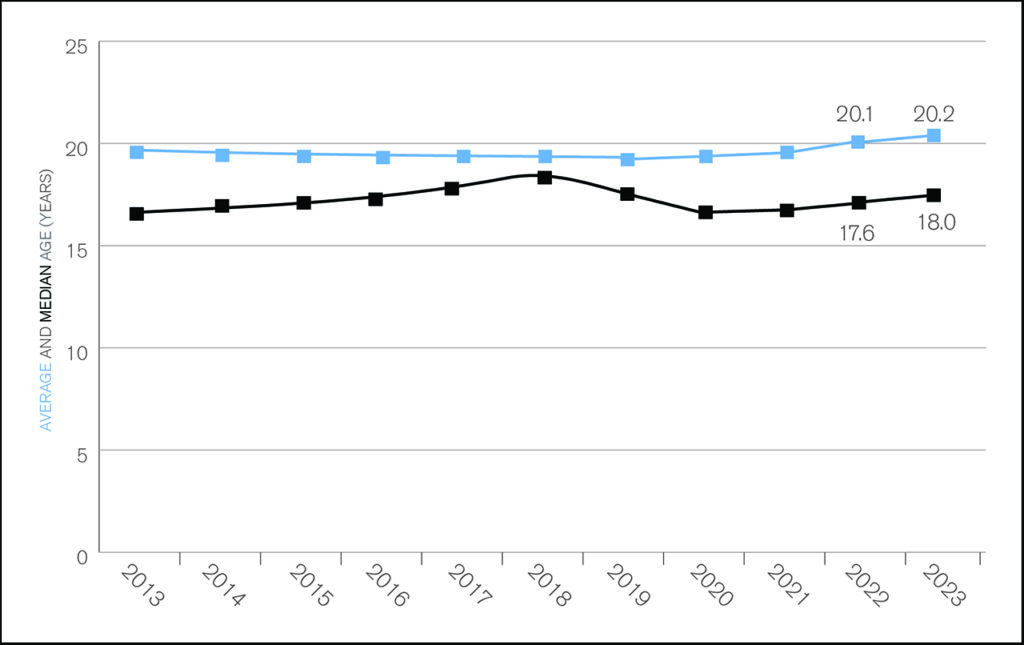
The average age of the revenue-earning fleet continued to climb in 2023. The average age rose to 20.2 years—its highest in more than a decade—continuing to suggest new cars were joining the fleet at a slightly lower rate than older cars were exiting last year.
The trend of GRL 286 cars predominating among additions to the revenue-earning fleet continued in 2023. The number of GRL 286 cars added to the fleet increased by about 3% in 2023. These cars accounted for 87% of all new additions in 2023 and about 88% in the past decade. Larger cars enable operational efficiencies that reduce costs and ease logistics challenges.
The revenue-earning fleet realized a net increase of 12,000 cars in 2023. At the end of 2023, the revenue-earning freight car fleet totaled 1.64 million units, up about 0.7% from the previous year (see Figure 1).
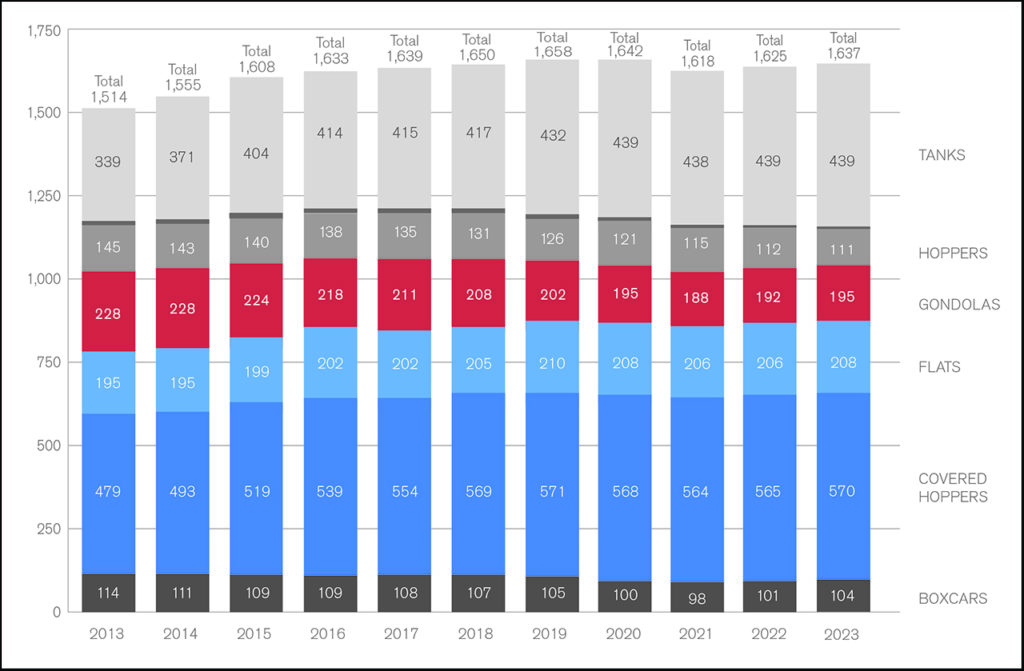
Hoppers and tanks were the two car types that decreased in the revenue-earning fleet, down 0.8% and 0.1%, respectively, over 2022. All other car types increased in 2023, with boxcars leading the gains by nearly 3.0%.
The average age of railcars in the revenue-earning fleet in 2023 was 20.2 years, a 0.1-year increase from 2022. The average age continues to hover around 20 years as it has for the past decade (see Figure 2). The slight increase in the age of the fleet in 2023 suggests that new cars are being added at a slower rate than old cars are exiting.
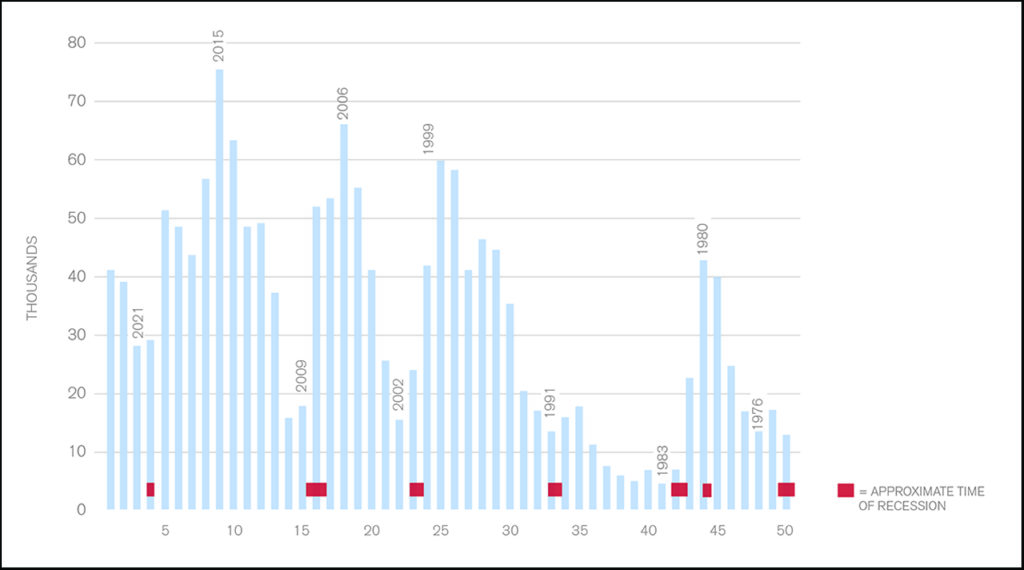
About 81,000 new cars have joined the revenue-earning fleet in the past two years (see Figure 3). The number of new cars added in 2023 increased 7.5% over 2022.
Railcars with a GRL of 286,000 pounds have made most of the new additions to the revenue-earning fleet in the past 25 years. Over that time, GRL 286 cars have accounted for 84% of all new additions to the fleet. This trend continued in 2023, as 87% of new equipment were GRL 286 cars (see Figure 4). The number of GRL 263 cars added in 2023 increased by about 420 cars from 2022.
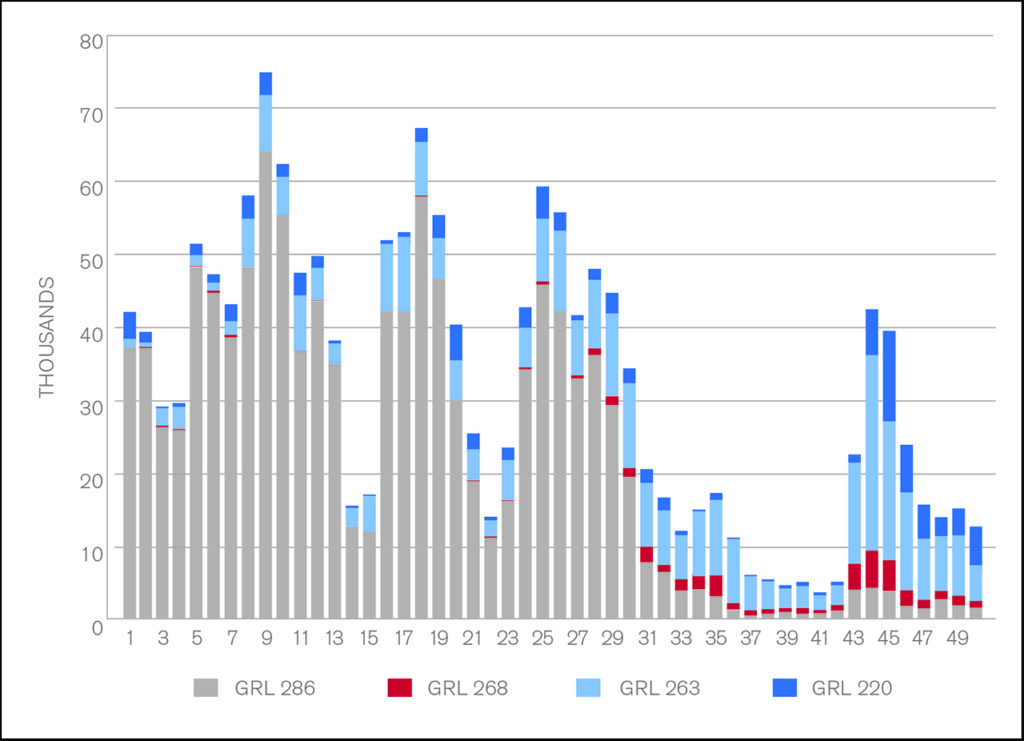
GRL 286 cars dominate among recent additions to the fleet because they enable operational efficiencies that reduce costs and ease logistics challenges. The fleet continues to add GRL 263 and GRL 268 cars, but at a much lower rate than GRL 286 cars. 2023 saw increases in GRL 220 cars added to the fleet for a second year of growth. The last year non-GRL 286 cars led among new additions to the fleet was 1992.
SUBFLEET TRENDS
More than 700 equipment type codes (ETCs) appear in the Umler equipment registry. Of those, 11 ETCs accounted for 55% of the revenue-earning fleet in 2023. For the eighth time since Railinc began producing this report in 2011, nine of the top 10 car types were either tank cars or covered hoppers—the two largest car types in the revenue-earning fleet.
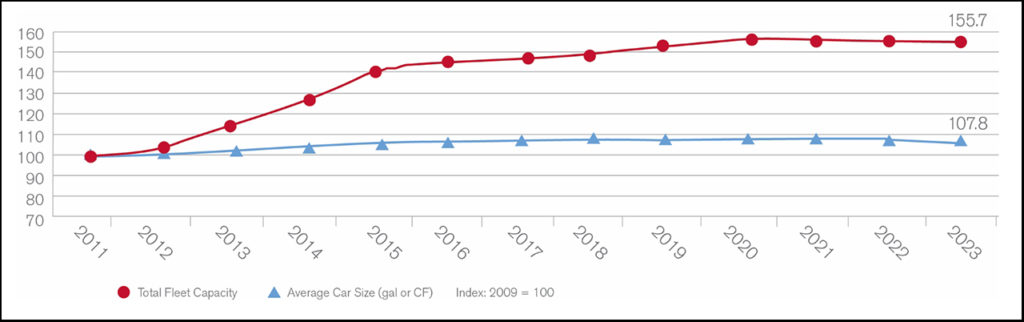
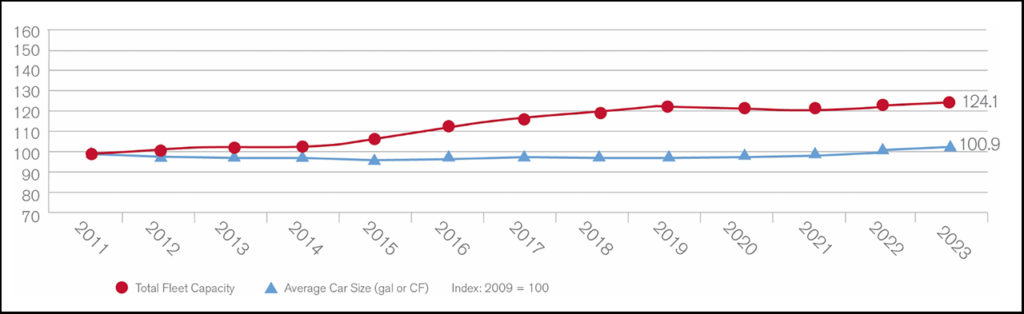
As the demographics of the car types change, so do the average car size and the total combined capacity of all the units in a car type. For example, with the growth in the tank car population, the total fleet capacity has increased by 55.7% since 2009 (see Figure 5). Most new tank cars are large, which has pushed the average car size up by 7.8%. The total fleet capacity for covered hoppers has increased, as well, by 24.1% (see Figure 6). However, the average car size has decreased slightly because most new covered hoppers are smaller.
In the past decade, the boxcar population has decreased, which has driven down the total fleet capacity. Large boxcars have joined the fleet, which led to an increase in average car size, but not at a fast enough rate to offset the population loss.
Several equipment types comprise the revenue-earning fleet. The following section of the report presents select car types by the kinds of commodities they carry. This provides a more nuanced view of these car types. For example, while covered hoppers carry grain, sand, plastic pellets, and other commodities, the types of covered hoppers that transport each commodity are very different in their characteristics.
The report takes a deeper look at a few of the car types, including covered hoppers, gondolas, open hoppers and boxcars. These car types were selected because they carry commonly shipped commodities and make up a sizable percentage of the revenue-earning fleet.
Plastics: Covered hoppers are commonly used to ship plastic pellets. This commodity subfleet added about 9,100 cars in the past two years—about 20% of what was added in the previous 10 years combined. Cars with equipment type code C214 comprise nearly the entire commodity subfleet as defined here and make up 9% of the revenue-earning fleet. They are the second-largest equipment type. New railcars have trended larger. Of the cars added to the commodity subfleet in the past 20 years, about 93% have had a capacity of 6,000 cubic feet or more.
Grain/Fertilizer: Railroads move grain and fertilizer in large covered hoppers. The grain and fertilizer subfleet added about 14,600 new cars in the past two years and make up about 17% of the revenue-earning fleet. Two types of covered hoppers—C114 and C113—account for about 96% of the commodity subfleet and are in the top five of the most populous equipment types in the revenue-earning fleet. Larger covered hoppers with capacities of at least 5,000 cubic feet have made up nearly 84% of the additions to the commodity subfleet in the past 20 years.
Sand & Cement: Railroads move sand and cement using small covered hoppers. No sand and cement cars were added in the past four years, but over the past 10 years, the revenue-earning fleet has added almost 44,000 covered hoppers with an equipment type code of C112. About 96% of the subfleet is comprised of C112s, which was the third-largest equipment type in 2023. Because of the density of sand and cement, the cars that carry these commodities tend to be smaller. Of the cars in the subfleet, almost all have a capacity of just over 3,000 cubic feet. Only about 3% of the sand and cement cars have capacities less than 3,000 cubic feet, and practically no cars of this size have been added to the subfleet in almost 25 years.
Coal: This commodity is shipped primarily in gondolas and open hoppers. These cars still made up a sizable portion of the revenue-earning fleet—10%, or 166,000 railcars—in 2022 and 2023. About 77% of those cars were added between 1990 and 2013 and none were added in the past eight years. Nearly all the coal-carrying railcars added in the past 30 years have been GRL 286 cars.
Aggregate: Aggregates such as limestone and crushed stone are shipped in gondolas and open hoppers. The number of these car types added to the revenue-earning fleet in 2023 and 2022 was several times greater than those added in the previous two-year period. Nearly half the cars in the aggregate commodity subfleet have been added in the past 16 years, though they make up only 2% of the total revenue-earning fleet. About 94% of all cars added to this commodity subfleet in the past 12 years have been GRL 286 cars.
Boxcar Commodities: Boxcars are the least populous car type in the revenue-earning fleet and are used to ship a wide variety of products—from consumer goods to automotive parts. The boxcar fleet is older than other car types. As older and smaller boxcars continue to age out of the fleet, new larger boxcars continue to be added. Boxcars with a GRL of less than 286,000 pounds make up about 32% of this car type, but most of those were built more than 40 years ago.
CONCLUSION
The North American railcar fleet grew in 2023. The total size of the revenue-earning fleet increased 0.7% from year-end 2022 to year-end 2023.
The revenue-earning fleet added cars in almost all subfleets—boxcars increased the most, up 3%, followed by gondolas at 1.7%. Hoppers and tanks contracted, decreasing by 0.8% and 0.1%, respectively. The average age of cars in the revenue-earning fleet increased to 20.2 years, suggesting new cars are joining the fleet at a slightly lower rate than older cars are exiting. GRL 286 cars continue to predominate among new additions to the revenue-earning fleet. This size of car accounted for about 86% of all new additions to the fleet in 2023.
Railinc is a wholly owned subsidiary of the Association of American Railroads. For more information and to download this report and related materials, visit www.railinc.com.