Commentary
Fourth of a Series: A New Kind of Border Dispute
Written by David Peter Alan, Contributing Editor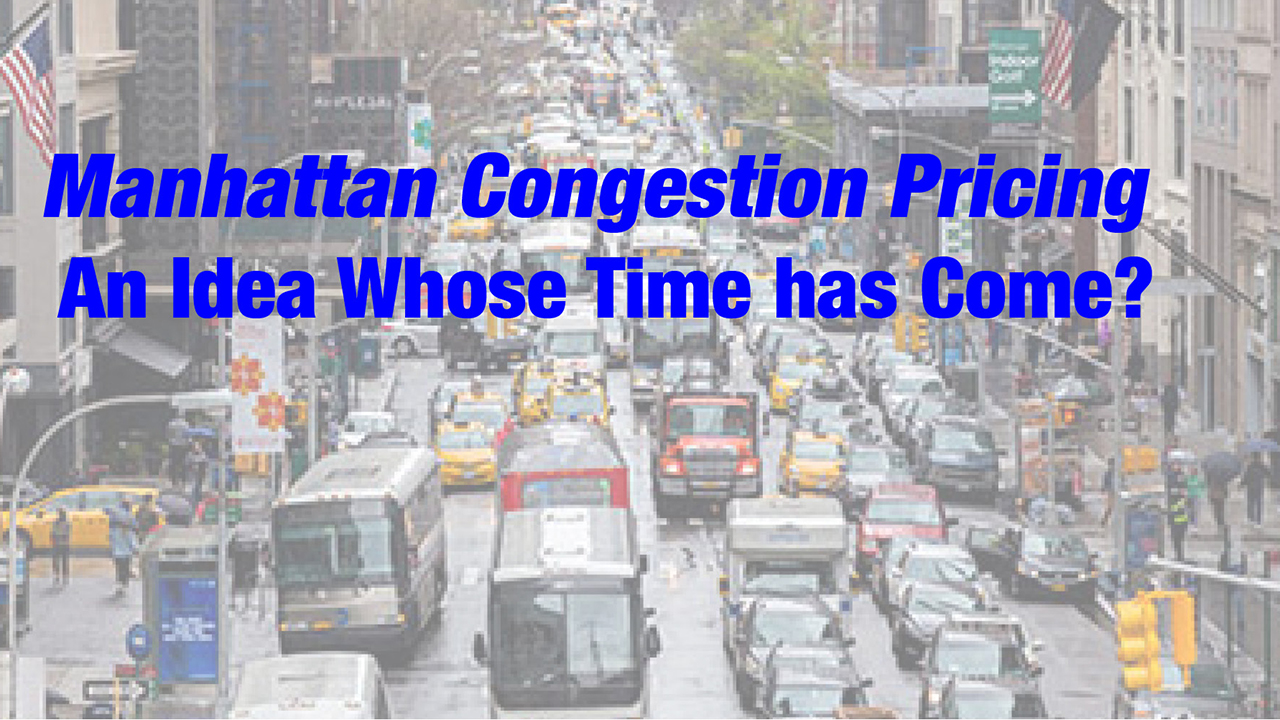
Border disputes between states of the United States are often fought over issues like one state complaining that another state, located upstream from it, is taking too much water from the river that runs through them, and not leaving enough for the states further downstream. We are now looking at a “border dispute” of a different sort. New Jersey is suing the Federal Highway Administration (FHWA), claiming that the agency exceeded its authority by approving the Finding of No Significant Impact (FONSI) and Environmental Assessment (EA) for the Central Business District Tolling Program (CBDTP), which would impose tolls on motor vehicles entering Manhattan south of 60th Street.
The case file can be found at https://www.courtlistener.com/docket/67625362/state-of-new-jersey-v-united-states-department-of-transportation/, which is our source for all documents cited in this article and the two that follow. It contains the entire file from the case, including pleadings, exhibits, motion practice, and judges’ orders. Two documents that are central to the case, the final FONSI (41 pages) and the Final EA (968 pages) can both be found there, as well as Exhibits filed with the original Complaint.
New Jersey Gov. Phil Murphy filed an action in the Federal Court for the District of New Jersey on July 21, 2023 (Case No. 2:23-cv-03885). The case is captioned “STATE OF NEW JERSEY v. UNITED STATES DEPARTMENT OF TRANSPORTATION, FEDERAL HIGHWAY ADMINISTRATION, SHAILEN BHATT, and RICHARD J. MARQUIS.” Bhatt is the Administrator for the FHWA, and Marquis is the Division Administrator for the New York Division of that agency. The Complaint takes up 68 pages and contains 171 paragraphs, in addition to the Request for Relief at the end. The State is not represented by its Attorney General or anyone in the State’s legal department. Instead, it is represented by King & Spalding LLP, a well-known firm that was founded in Atlanta in 1885 and still has its main office there. It also has more than 25 offices in the United States and elsewhere and employs about 1000 lawyers. Randy M. Mastro, who is New Jersey’s lead counsel on the case, is a famous litigator who has been involved with political cases before. Five other lawyers from King & Spalding were named, four of whom will participate pro hac vice, which means they are not admitted to practice in federal court in New Jersey but must apply for permission from the judge to participate.
New Jersey requested the judge to issue preliminary and permanent injunctions vacating and setting aside the FONSI and compelling the Defendants to file a full Environmental Impact Statement (EIS), declare that the failure to provide the EIS or to explain why one is not necessary violates the National Environmental Procedure Act (NEPA) and the Administrative Procedure Act (APA), require a transportation conformity analysis under the Clean Air Act (CAA), declare the FONSI and EA incomplete as a matter of law, order the defendants to produce a full EIS and a transportation conformity analysis under the CAA, and similar relief, along with costs, including attorneys’ fees.
Nature of the Case
Railway Age’s reporting scope consists of news about railroads and rail transit, with occasional exceptions. There is a nexus between the matter at issue and transit, because the congestion tolling program would provide revenue that would be used for capital programs at New York’s Metropolitan Transportation Authority (MTA). Therefore, it would help keep the New York City subways, the Staten Island Railway, the Long Island Rail Road and Metro-North in an improved state of repair.
In theory, at least, it also touches and concerns riders on New Jersey Transit’s trains who go to New York Penn Station directly, or who ride to Hoboken Terminal and change to Port Authority Trans Hudson (PATH) trains. Along with NJ Transit’s bus riders who go to the Port Authority Bus Terminal, they use the agency’s services to deliver them into the tolling zone and take them back to New Jersey. Yet the Complaint makes only tangential references to NJ Transit, as will be described.
There appear to be two primary prongs to the allegations presented in the Complaint. One is that the FWHA did not act properly in preparing the FONSI actions leading up to it. That is a matter of administrative law and the procedures required under the Administrative Procedure Act (APA). The other is based in environmental law: that the FHWA and New York agencies did not properly consider environmental issues as required under the National Environmental Policy Act (NEPA) or the Clean Air Act (CAA). The arguments that will stem from the Complaint’s allegations will probably concern administrative and environmental issues, not the quality of railroads and transit in New York City. Still, in the interests of appropriate reporting, we will look at what the State of New Jersey is alleging.
New Jersey’s Allegations
The first 11 pages (20 paragraphs) set forth the “Nature of the Case.” The State alleged that the tolling program would have significant environmental impacts on New Jersey, which require a full EIS (¶1). The next allegation was that the FHWA did not properly consider environmental problems in Bergen County that the program would cause (¶2). The State claimed that the program would have significant negative financial and environmental consequences for New Jersey residents (¶3) without New Jersey getting any of the money that the proposed toll would raise (¶4). New Jersey also claimed that, while NEPA requires consultation with the public and affected stakeholders during environmental review, the agency did not consult sufficiently with New Jersey (¶8) and ignored potential air pollution in Bergen County, which is across the Hudson River from Manhattan (¶9). Many of the allegations faulted the FHWA for not consulting sufficiently with New Jersey authorities.
The next sections of the Complaint dealt with Jurisdiction and Venue (¶¶21-24, at 11-12) and Parties (¶¶25-29, at 12-14). These sections are required for Complaints in Federal courts. The Factual Background, a statement of the facts as the Plaintiff views them, followed at (¶¶30-122, at 15-55).
Next came the Causes of Action, which introduces the legal theories that a plaintiff uses in an effort to prove that the defendants are liable and that the plaintiff deserves the relief requested. In the present case, that would include invalidating the FONSI. The State alleged violations of NEPA and the APA as a First Cause of Action, and of the Clean Air Act as a Second Cause of Action. In alleging causes of action, a plaintiff sets forth its version of the facts of the case, showing that, in its view, the defendant(s) violated the statutes as alleged. The Complaint concluded with the Request for Relief.
The State of New Jersey did not request a jury trial. Over the ensuing month, there were several filings concerning a status conference and pro hac vice appearances by lawyers not admitted to practice in Federal Court in New Jersey. The defendants filed their Answer on September 29, 2023. It was a general denial, in proper form and running 23 pages. They asserted in their defenses that the Plaintiff (the State of New Jersey) lacks standing, fails to state a cause of action, and failed to exhaust administrative remedies. They also asserted that venue in the federal court in New Jersey is improper.
While New Jersey Transit’s riders and their advocates might be concerned (for better or worse) about how the congestion tolling program might affect that agency’s ridership into Manhattan, the case was not concerned with transportation aspects, except tangentially. In Paragraph 75 (at 34) the Complaint alleged that, on Sept. 23, 2022, Gov. Murphy set a letter to FHWA asking for a full EIS that he said was required by NEPA, a letter that included comments from NJ Transit and other state agencies. In Paragraph 88 (at 39), the Complaint cites a June 12, 2023 letter from Murphy, joined by NJ Transit and other state agencies, opposing the final adoption of the Final EA and the Draft FONSI. None of the further allegations in that paragraph mentioned NJ Transit.
What NJ Transit Said
While the allegations of the Complaint barely mentioned NJ Transit, and the issues in the case concern administrative and environmental law more than actual transportation issues, NJ Transit commented, albeit indirectly. Exhibits filed by New Jersey include letters from Gov. Murphy dated June 12 and Sept. 23, 2022 that included comments from NJ Transit or regarding it. While they might or might not have a bearing on the case, it is instructive to learn what the agency said about congestion tolling.
Looking first at the Sept. 23, 2022 letter, it was filed as Exhibit 7 with the original Complaint. It was sent over Murphy’s signature to the New York Division of FHWA in Albany. Murphy’s one-page letter was followed by 6 more pages of comments by New Jersey’s transportation-oriented agencies, including NJ Transit. In calling for a full EIS at that time, Murphy said: “While New Jersey is conceptually open to traditional congestion pricing that makes traffic reduction its main goal, the Program as proposed has revenue production as a primary goal and the EA released outlines scenarios that cause concern among New Jersey commuters and agencies. There is a high degree of uncertainty and potential for significant impact associated with the CBDTP as outlined. As such, an Environmental Impact Statement should be conducted.” He went on to repeat the argument that the State made in the Complaint: “The Environmental Assessment (EA) is long and complex: 4005 pages in total. Six weeks at the end of the summer is insufficient for review and comment. Public hearings should have been held as part of the EA’s development, not after the fact. Due to the lack of public outreach, few New Jerseyans had opportunity to comment on the EA. New Jersey residents have the unfortunate distinction of being directly impacted by the Metropolitan Transportation Authority (MTA) plan without any representation in the New York State Legislature, the MTA Board, or the Traffic Mobility Review Board and will not receive any direct benefit from the revenue that the MTA will raise as is stated goal.”
NJ Transit’s comments appear on Pages 5 to 7, and the document does not attribute them to a specific person at the agency. NJ Transit began by criticizing the Program’s modeling approach and calling for additional analysis of the tolling scenarios presented: “Such analysis is needed to define the range of possible outcomes more accurately should the Program be implemented. The EA should acknowledge the potential for additional impacts given the sensitivity of New Jersey’s transportation network to tolling. The EA should include a more flexible framework to address unforeseen impacts, failing to do so would shift the mitigation burden for New York City’s transportation work to NJ Transit” (at 5).
The agency considered the commuter bus charge “problematic,” saying: “Certain scenarios contemplated by the Program involve charging NJ Transit buses a fee, amounting to a transfer subsidy to MTA by NJ Transit. Costs are estimated to be between $12M-25M per year, above the more than $2M that NJ Transit pays to the Port Authority of New York and New Jersey (PANYNJ) for PABT departure fees and more than $15M in PANYNJ tolls on the George Washington Bridge, Lincoln Tunnel, and Holland Tunnel (half of which accrues to the State of New York)” (at 5-6). In that instance, NJ Transit’s concern at the time may have become moot, because “commuter buses” are now exempt.
NJ Transit made an interesting comment about capacity, one of the few times the agency made an argument about a transportation issue, rather than the sufficiency of the Program to document its case: “The EA notes the potential for +2.3% increase in NJ Transit rail. Depending on the specific rail service, that ridership increase coupled with ambient growth could require additional service or enhanced capacity if possible, as some trains were already operating well above capacity. Adding service on either the New York-bound bus and rail systems is challenging given the existing capacity constraints at the Port Authority Bus Terminal and Penn Station New York” (at 6). It is unclear where the purported “capacity constraints” were during 2022, which was a time when ridership was beginning to recover from the COVID-era low points. Still, it shows a reluctance on the agency’s part to run additional service, even claiming that a 2.3% ridership increase could not be tolerated easily. The agency came to the point in the following sentence: “Even modest increases in bus service would result in millions of dollars of new expenditures per year” (Id.).
In his June 12, 2023 letter to FHWA representatives in New York, Murphy restated many of the arguments he had made before, and said little about NJ Transit, except as evidence that New Jersey was not consulted sufficiently, and to say that the Program could cost the agency money: “NJ TRANSIT will not only suffer direct impacts from the implementation of the CB DTP, but will also experience indirect expenses related to increased equipment needs and labor costs. NJ TRANSIT has concerns regarding the ability to absorb any increase in ridership that may result from the CBDTP and the scope of capital investments that may be required to scale its ability to serve additional customers” (at 8).
After the pleadings were filed, the case took some interesting turns. New York’s MTA joined the case, and both sides argued against having a trial. We will tell you about it in the next article in this series.
First of a Series: A New Congestion Remedy, with Help for Transit
Second of a Series: Congestion Pricing Around the World
Third of a Series: New York’s Plan and Why Officials Want It