RapidSOS Preps First Responders on Major Derailments
Written by Joanna Marsh, Contributing Editor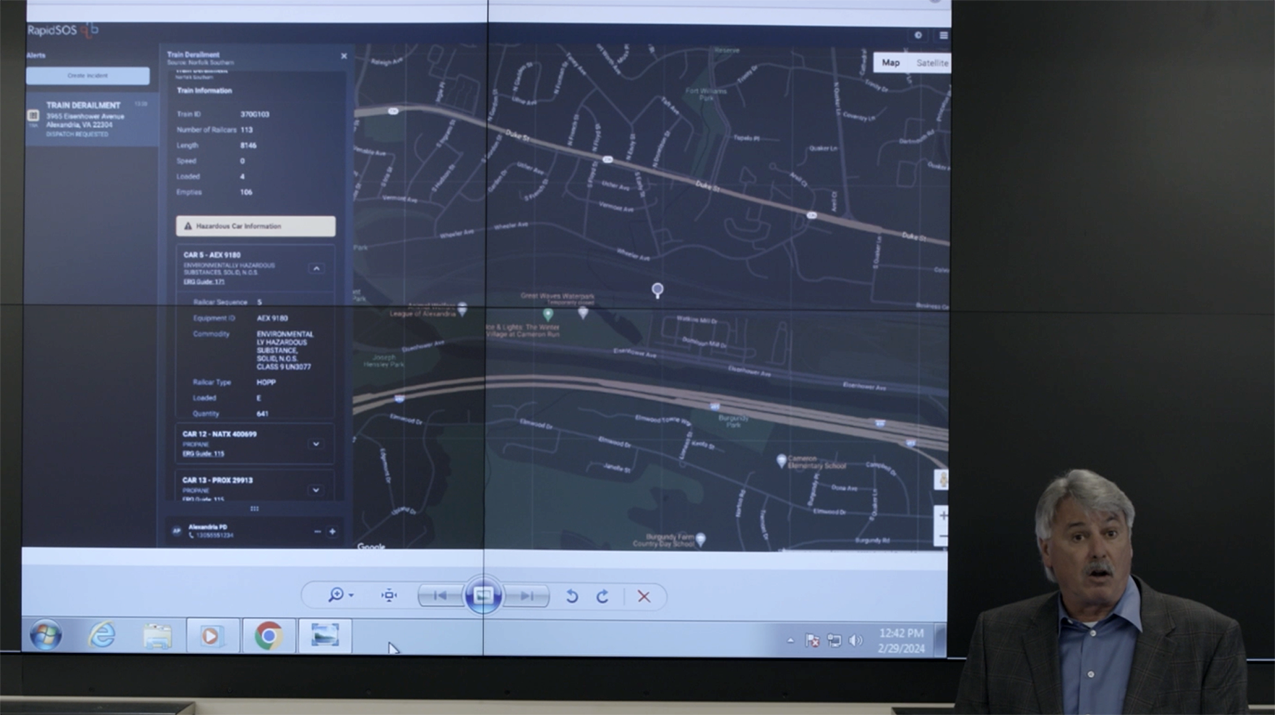
Robert Wood, NS Director of Hazmat. RapidSOS photo.
A partnership of first responders and Norfolk Southern via the RapidSOS platform provides train consist information to in the event of a major derailment.
In May 2018, a southbound CSX train was approaching a bridge overpass in Alexandria, Va., when it derailed. The incident involved 21 railcars, eight of which fell onto Norfolk Southern tracks under the bridge, according to the National Transportation Safety Board report on the incident. CSX’s bridge also sustained damage from the derailment.
That derailment was not considered a major incident, but Renee Gordon, director of Alexandria’s Department of Emergency and Customer Communications, says that first responders for the City of Alexandria would have benefitted from having real-time information about the contents the train was hauling, including whether any hazardous materials were involved in the derailment.
RapidSOS, a public safety tech platform that provides up-to-date information for first responders rushing to accidents, might have had such information on the train had RapidSOS existed at that time for train derailments.
“It was not a large derailment, but the information that RapidSOS provides now would have been critical when we had that derailment. That kind of information of where the train is exactly, what’s on the train, will help us in the future to send the right units and respond appropriately,” Gordon said.
More than 16,000 public agencies and emergency communications centers (ECC) have access to RapidSOS. First responders and 911 call centers use RapidSOS to get alerts about an incident, including critical information such as the location, injury status and other incident details so that first responders are prepared to handle the situation when they arrive.
Now, one railroad is providing access to information about major train derailments and accidents at highway rail grade crossings: Norfolk Southern, which is working with RapidSOS to provide incident information to first responders across all of NS’s 22-state network. NS’s partnership with RapidSOS follows a year in which the railroad announced several safety initiatives in response to the February 2023 derailment in East Palestine, Ohio. That derailment involved railcars carrying vinyl chloride, a hazardous material.
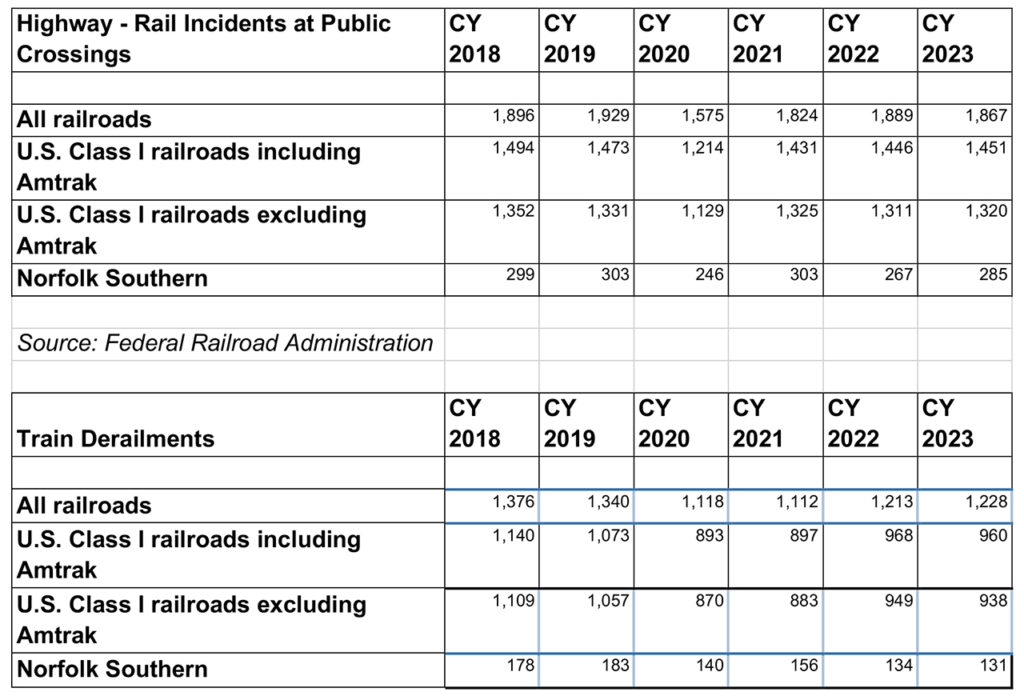
According to the Federal Railroad Administration (FRA), train derailments in 2023 for U.S. operations of the Class I railroads were roughly flat with 2022 but 6% above 2021 levels, while accidents at highway-rail crossings have hovered above 1,300 for every year since 2018, with 2020 being the exception. This excludes Amtrak data.
FRA’s data doesn’t parse out between what’s considered a major train derailment or a minor train derailment.
At a Feb. 29 event announcing the partnership, NS and RapidSOS officials said emergency responders wanted that freight train information on the RapidSOS platform. “The focus is to get that vital information on an emergency situation, using the quickest means possible, into the hands of that first responder who’s heading to that site. The quicker they have that information, the better they can make and the faster they can make the decisions that they have to,” said Robert Wood, NS Director of Hazmat, at the event.
Coordinating Responses
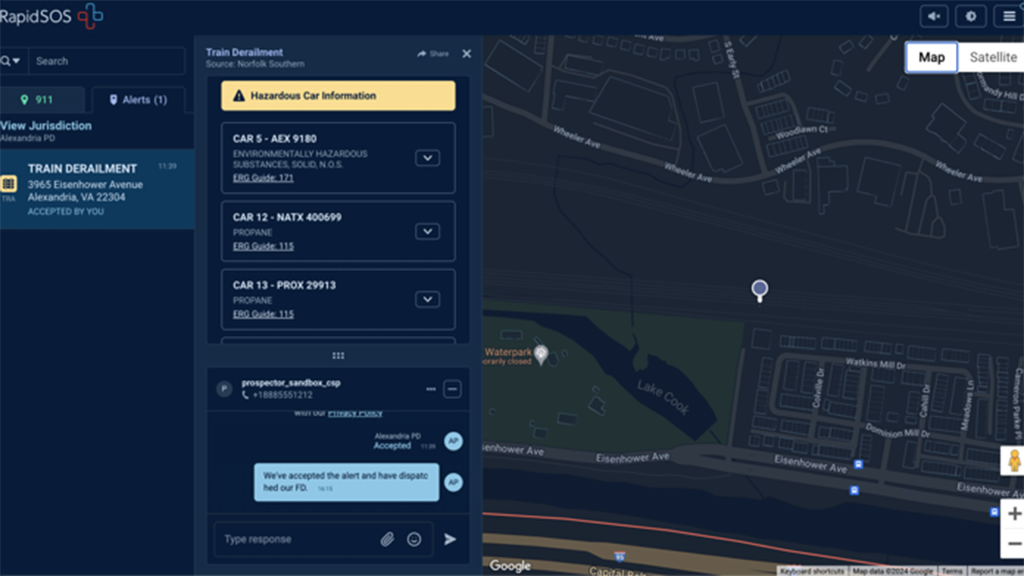
The partnership between NS and RapidSOS works like this: When a derailment or an accident at a rail crossing occurs, train crews notify NS dispatchers, who can then push an alert through the RapidSOS platform. Conversely, local first responders can notify NS police about an incident, and that information will be relayed to the NS dispatching center and the train crew involved.
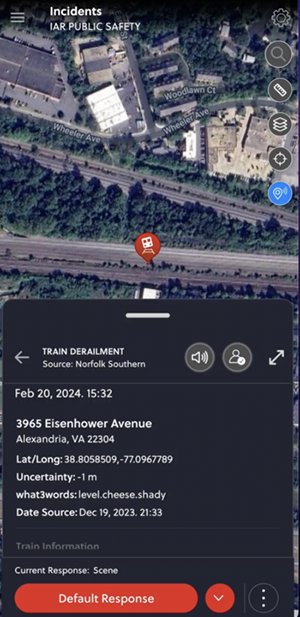
Should the incident or derailment warrant extra care from first responders, an alert will be sent out via the RapidSOS platform that first responders can access. That alert will include information on the contents of every railcar on that train, the position of each, and whether the train is carrying any hazardous materials.Information about the railcars carrying hazardous materials is at the top of any report that first responders receive, and the information will include hyperlinks to the U.S. Department of Transportation’s emergency response guide that guides responders on how to safely handle hazardous materials such as flammable liquids.
This information about hazardous materials is particularly helpful as first responders assess whether there are any threats to the residential and business communities that might be immediately nearby.
RapidSOS’ access to information from NS went live on Jan. 17.
The rail industry already provides information on major train derailments to first responders via the AskRail app that was developed in 2014, according to Wood. The app, according to the Association of American Railroads (AAR), provides real-time information on railcar contents and the safe handling of those materials. More than 2.3 million first responders across the U.S. and Canada have access to this information through ECCs and CHEMTREC, an emergency call center for hazmat handling.
But the benefit of having the information on the RapidSOS system is for ECCs and first responders who might not have downloaded the AskRail app, Wood said. “It’s just adding another tool. We still share the same information in other ways, and that won’t change.” He added that the train crew will still be required to share train consist information with first responders.
While NS is the only U.S. freight railroad to share information about major train derailment and rail crossing incidents with RapidSOS, the safety platform’s representatives said the company is in talks with the other Class I railroads about participating in the platform.
“It certainly is something that we believe should be deployed industry-wide,” said Daniel Seidberg, President and Co-founder of IamResponding, a RapidSOS Solution. “We are in active discussions with all of the other Class I’s about the solution and showing them what the advantages and benefits are of bringing this solution into the tools and processes that are used every day by ECCs and field responders to get it into their hands digitally” as soon as these derailments occur.”
One of the key benefits for first responders to having that information about train consists and the position of the railcars carrying hazardous materials relayed in a digital format is that it can minimize human error, Seidberg said. Previous procedures involved having to write down the names of chemical substances and delivering that information to 911 call centers and ECCs via analog means, such as a phone. “When you talk about a train that may be carrying 178 railcars, 28 with hazardous materials, transmitting that [information] by voice is time-consuming and error-prone.” he said. But now, “that information is digitally conveyed immediately to the ECC and out to the field … [to serve] ultimately the safety of the first responders in the field who are responding to that incident and the safety of community members in the area.”
Regulatory efforts requiring freight railroads to provide train consist information to first responders have been ongoing. In July 2023, the Pipeline and Hazardous Materials Safety Administration (PHMSA) issued a safety advisory encouraging 911 call centers to download the AskRail app, get training on how to use the app and then use it during rail incidents involving hazardous materials.
The PHMSA safety advisory follows a federal mandate under the 2015 FAST Act and 2021 Bipartisan Infrastructure Law requiring railroads to provide real-time train consist information to authorize emergency response and enforcement personnel involved in the response to or investigation of an accident, incident, or public health or safety emergency involving the rail transportation of hazardous materials.
According to an Association of American Railroads fact sheet, Class I railroads have also been assisting emergency responders by maintaining 24/7 hazmat safety teams and emergency response experts across the U.S. rail network and providing 24-hour emergency hotlines for first responders. The freight railroads also work with FRA, PHMSA, the Transportation Security Administration and the Federal Emergency Management Agency to train first responders and firefighters annually.
The Security & Emergency Response Center in Pueblo, Colo., works with first responders by having them undergo full-scale simulations. The center trained about 1,800 first responders, according to AAR, while the broader Class I railroad industry has trained about 35,500 first responders in 2023.