Commentary
Passenger Trains That Might Never Leave the Station
Written by David Peter Alan, Contributing Editor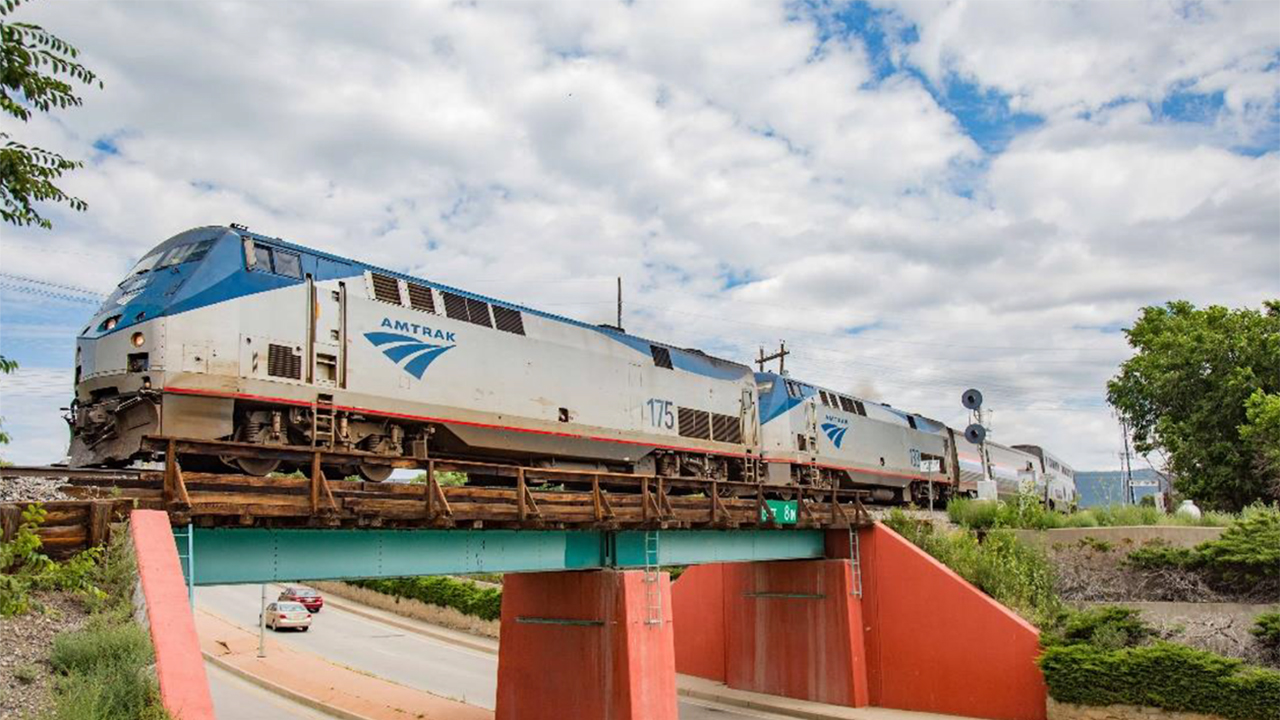
Amtrak photo
The FRA recently came out with an interim report in its Long-Distance Rail Study, which was commissioned by Congress in §22214 of the Infrastructure Innovation and Jobs Act (IIJA), also known as the Bipartisan Infrastructure Law (BIL) in 2021. My first report on the study started with some background and briefly described the 15 proposed routes, the sort of report often encountered here in Railway Age and elsewhere.
Then came a commentary, an opinion piece that pointed out potential difficulties concerning the outreach conducted by the study team. After reviewing the 163 pages of slides presented at the third meeting of the study, and also reviewing pertinent parts of the 73-page “Interim Report to Congress” issued last November), I have come to the conclusion that the overall study so far appears to rate an “A” for following statutory directions (if not always for rigor), and an “D” as in instrument that could advance the purported objective of restoring service to those 15 routes that had disappeared from the nation’s passenger-rail map long ago, at least in time for many of us now living to ride those trains.
What Did We Get?
A casual look at the presentation would, of necessity, bring a sense of excitement and anticipation to anyone who remembers even the tail end of the Great Age of the Streamliners. The trains that lived in the 1960s and until the end of April 1971 were back on a map. Advocates for a better passenger rail network, along with young people excited about a new way to travel, and also seniors who remember that Golden Era, could once again harbor the hope that they might again ride a great train that is now 53 years deceased.
The maps at slides 63 to 92, with the prospect that routes long-gone could rise from the dead could not have been better eye candy for the advocates who fought throughout their lives for the return of a train that never came, or for the dedicated railfans searching for the image of the UP’s Big Boy billowing smoke as it chugged and sped its way across the Great Plains. Even I, having just turned 76, was briefly caught up in the thrill. Did the government finally care? Could it really happen? Equally quickly, my scientific, business and legal training, along with my journalistic instincts, caught up with me. The answer is no. The beautiful map at slide 34 bore the words “Not an FRA proposal for service.” It was too good to be true. The projected timeline at slide 154, aided and abetted by political reality, says it all.
In my previous commentary on the subject, I described two deficiencies in the study’s outreach, which could prove fatal to its relevance, or at least a hindrance: the amount consultation with the last six remaining Class I railroads, which would host any restored passenger trains (although the FRA’s own comments in response to our inquiry noted a more thorough effort at consulting with the potential host railroads than the published Interim Report to Congress mentioned. Much more detrimental was the almost total lack of serious consultation with the advocates, who last saw a long-distance train added to Amtrak’s network and not subsequently discontinued back in 1985 (the Capitol Limited), and whose descendants have no reasonable expectation of riding one of the proposed routes for decades more.
The left side of Frame 154 shows a “Development and Implementation Timeline for a Preferred Route” that would take 15 years! The “preferred” routes listed were daily operation on the currently tri-weekly Sunset Limited and Cardinal. It only takes one additional train set to run the train the Cardinal and two to run the Sunset every day, and those entire routes already have a passenger train, so why should it take another 15 years to add four round trips a week? The other “preferred” route is where the Northern Pacific’s North Coast Limited ran (Amtrak called it the North Coast Hiawatha in the 1970s), south of the route of the Empire Builder in North Dakota and Montana.Even if that train manages to return to the rails 15 years from now, it will have been absent for an entire half-century.
Other trains would be interrupted for even longer periods of time. The right side of the graphic mentions “Conceptual Timeframes for Implementation”: Near-term is 2040 to 2050, mid-term is 2050 to 2060, and long-term is “2060+”! In other words, the study’s planning frontier would never end. Even at the conclusion of the projected mid-term in 2060, most of the routes mentioned in the study will have gone without a passenger train for 89 years or more. The few that Amtrak did not kill until 1979 will have have endured a slightly shorter absence: only 81 years. In a recent column, Railway Age Editor-in-Chief William C. Vantuouo called me a “ rail skeptic.” I don’t dispute that appellation, I wear it proudly, but sadly. With studies like this one, it’s difficult to be anything else. Is this any way to plan a railroad?
Who’s to Blame?
The short answer is: probably nobody. It appears that somebody issued some instructions, and everybody else followed them in the customary manner. The result appears to be a beautiful and useless map (at slide 34) that denotes a bunch of trains that will never run, at least not in anything resembling most of our lifetimes. My own academic training fails to provide an explanation for this. My experience of riding almost one million miles on somebody’s rails does not help, either. Only my experience as a journalist and my longer prior experience as an advocate allow me to hazard a guess.
Congressional staffers play a large role in drafting legislation, and the younger staffers cannot remember a time before Amtrak. Even the older ones, ready to retire, would not remember the pre-Amtrak long-distance network, except perhaps its terminal decline. They are younger than I am, and my assignment in commemoration of Amtrak’s 50th anniversary in 2021 was to remember trains I rode when I was 23 and they were doomed. So the policy wonks in the Nation’s Capital did what they do best, and what was probably the only thing they could have done: compiled lots of statistics about trains they never knew and the places they served. Nobody except some of us seniors can remember an Amtrak long-distance network with more than 14 trains that both non-motorists and motorists can ride, and even many in our age cohort remember only a slightly-larger network that was cut 45 years ago.
Then the task went to the FRA, whose primary area of concern has been safety. From my experience, I can say that people at the FRA “know the railroad” and care about it. That does not mean that they have such a level of familiarity with long-distance passenger trains that they could generate a truly rigorous study about them without dissecting the memory of them and reducing it to an abstraction. They should not be blamed for the study’s shortcomings generally, because it is difficult to fathom how anybody can meet the standard I just described, without having ridden the trains in question on a regular basis, and even advocated for any improvement, or at least their return. Where the FRA missed out was in failing to include the advocacy community in its study. Besides the Rail Passengers’ Association (formerly the National Association of Railroad Passengers) with its paid staff and robust political efforts, only one local advocacy organization was contacted: the Big Sky Passenger Rail Authority in Montana. Could it be just a coincidence that the train for which that group has been advocating is listed as the sole “preferred route” for restoration? It does not appear so.
The report cited here has the correct appearance for a governmental epistle of its type, and so does the slide presentation, in its own way. They should. The project managers who supervised the study and compiled the data are longstanding professionals in the field. I first knew Ruby Siegel, the Project Manager, when she was involved with the Access to the Region’s Core (ARC) Project, which New Jersey Gov. Chris Christie terminated in 2010, and was the predecessor of today’s Gateway Program. In the 1990s, Siegel’s outreach included Regional Citizens’ Liaison Committees (RCLCs) for the ARC Project and the Portal Bridge Capacity Enhancement Project. I was on both. I encountered her again when she did similar work on the Gateway Program and the more-recent NEC Future study, neither of which had similar RCLCs. I know Joe Black less well, but he improved scheduling on the South Shore Line when he was with the Northern Indiana Commuter Transportation District, and I last saw him in Austin, when he promoted the proposed Lone Star Corridor between Georgetown and San Antonio, yet another good rail idea that was never implemented. The project managers appear to be experienced professionals at this sort of work, and it would be unfair to fault them for being competent consultants.
A Matter of Age?
So, after Congressional staffers, FRA folks, consultants from the big firms that control the industry, and who knows who else complete a project and submit a report, it should be packed with useful information. Yes, it is packed with information. There are long, involved discussions on such topics as methodology, demographics, and the history of the lines in question (with a few errors). In addition to the numbers, there are plenty of flowcharts and graphs. Whether or not members of Congress would actually take the time to read and digest that work product is questionable, but it appears to do its job.
Still, the report and the slide presentation are missing something vitally important that even the most-experienced members of the team probably could not grasp. They are simply too young. I am barely old enough to remember the lore of the railroad as it existed when I was young, and the magical feel of trains, each one providing its unique and special experience, before Amtrak started to standardize its trains in 1973. It’s not their fault that they can’t remember those experiences, trains like that only existed before their time, much like only the oldest people alive today remember World War II. The rest of us can only read books or watch movies about it. The same is true with great trains, whose utility is tinged with nostalgia. Even famed anti-rail activist Randal O’Toole has a website devoted to Streamliner Memories, which lasted barely into the Amtrak era. One difference between us is that I still ride trains.
There is not much left of the institutional memory, as most of the remaining advocates who remember long-distance trains are seniors. We still appreciate the experiences of looking out the window at the scenery and striking up conversations in the lounge car, even possibly making new friends. The skeletal Amtrak long-distance network, with its 14 routes (the same number as in 1971, but the composition has changed somewhat), is all that most people know today, or have ever known, or at least for decades.
Do Decision-Makers Know How Useful Trains Really Are?
Trains are not just nostalgic. They take people to and from every community they serve. They provide access to the “outside world” for everybody. I have visited communities on Amtrak where the only way to get in or out of town was on the train, even if it only came through once a day, or even three times a week. The train gives non-motorists their only opportunity to go anywhere at all, and it gives motorists a more-pleasant mode of travel, enabling them to enjoy the trip, rather than merely focusing on the road ahead of them. These factors might be derisively described as “market externalities” or “intangibles.” Yet, to the folks who ride the trains, they mean something that cannot adequately be summed up through the means of statistical compilation into a theoretical abstraction.
Long-distance trains help keep local economies alive, they are good for the environment, they foster inclusivity and understanding across demographic lines, and they do a lot of other good things, which also do not lend themselves to statistical compilation. It’s true that there are plenty of Americans who care about rail, even though it’s not as convenient as motoring for those fortunate enough to be allowed to operate an automobile and have the means to afford one. There are plenty of Americans who ride rail transit in cities, local trains that serve those cities for commuting and other trips, the NEC, and other corridors that have emerged elsewhere in the country. But there are not many Americans who truly understand long-distance trains, and how they can improve mobility. Reading, or even preparing, reports does not teach that. Only experience riding them does, and there are so few such trains, which Amtrak runs with ever-smaller capacity, that only a limited number of people can have that experience.
What Might Have Improved the Study?
Everybody who participated in the study should have been required to ride a minimum distance on the existing long-distance trains, so they could get the flavor of the experience. As I mentioned before, the outreach to the potential host railroads probably should have been much deeper and more comprehensive, although the FRA made a better start than its published report indicated. After all, without the host railroad’s approval and a series of negotiated shred caital and track improvement contracts, no future train can again return to serve people who want to go somewhere.
The study’s proposed timeline is completely unrealistic. By the time some of the proposed trains could be restored to the rails, it would have been almost a century since their former incarnations had ended. Nobody would remember them, all they would have seen of them would be a picture in a history book or a film produced with cinematic technology so old that almost nobody would be able to relate to it. This study’s extremely long (multi-generation) planning timeline is highly unlikely to produce certain and usable service results.
There is no valid reason why it should take decades to bring some trains back, just as there was no valid reason why it took 73 years to complete the Montclair Connection in New Jersey and almost a century after it was initially planned to complete a single four-stop segment of the Second Avenue Subway in New York City. If today’s planners are serious about improving mobility and everything else that comes with it by getting some trains back onto the rails, it’s time to make some new PERT charts and proceed as if there were a “clear” indication stretching out to the vanishing point. In other words, that means a commitment to complete the task and a means for doing it within a reasonable time.
The almost total lack of outreach to the citizen-advocates who fight for improvements in the train service they have, or just to get a train at all, was completely disrespectful of the people who fought for more and better trains before the current administration and a recent Congress added the study at issue to the huge infrastructure bill that touches almost every aspect of American life. Only a few of these advocates are elected officials or “well-known personalities” in some other way, and that is probably why most rider-advocates are so ignominiously ignored at every turn. I was in that position for decades, too, so I make sure that I cover the advocacy movement, and I appreciate that our editors at Railway Age allow me to include the advocates in my reporting. The efforts of the advocates are are grossly under-reported. There is very little coverage about the efforts of people who fight to get a train, or more trains than they have today, or better transit on rails. These unsung heroes remain out of sight, and therefore out of mind, to the current group of reporters on the transportation beat.
In recent years, the FRA has featured strong railroaders like Ron Batory and Joe Szabo. Next month, current Administrator Amit Bose and I will both be speaking at a rail conference in Texas. I look forward to meeting him in person. I hope to convince him to focus his efforts more toward the riders, along with the railroaders who run our trains. The FRA’s continuing efforts toward coordinating the advent of more and better trains with a timeline that could produce outcomes within the foreseeable future could make our long-distance passenger trains, as well as other trains, great again.

David Peter Alan is one of North America’s most experienced transit users and advocates, having ridden every rail transit line in the U.S., and most Canadian systems. He has also ridden the entire Amtrak and VIA Rail network. His advocacy on the national scene focuses on the Rail Users’ Network (RUN), where he has been a Board member since 2005. Locally in New Jersey, he served as Chair of the Lackawanna Coalition for 21 years and remains a member. He is also Chair of NJ Transit’s Senior Citizens and Disabled Residents Transportation Advisory Committee (SCDRTAC). When not writing or traveling, he practices law in the fields of Intellectual Property (Patents, Trademarks and Copyright) and business law. Opinions expressed here are his own.